

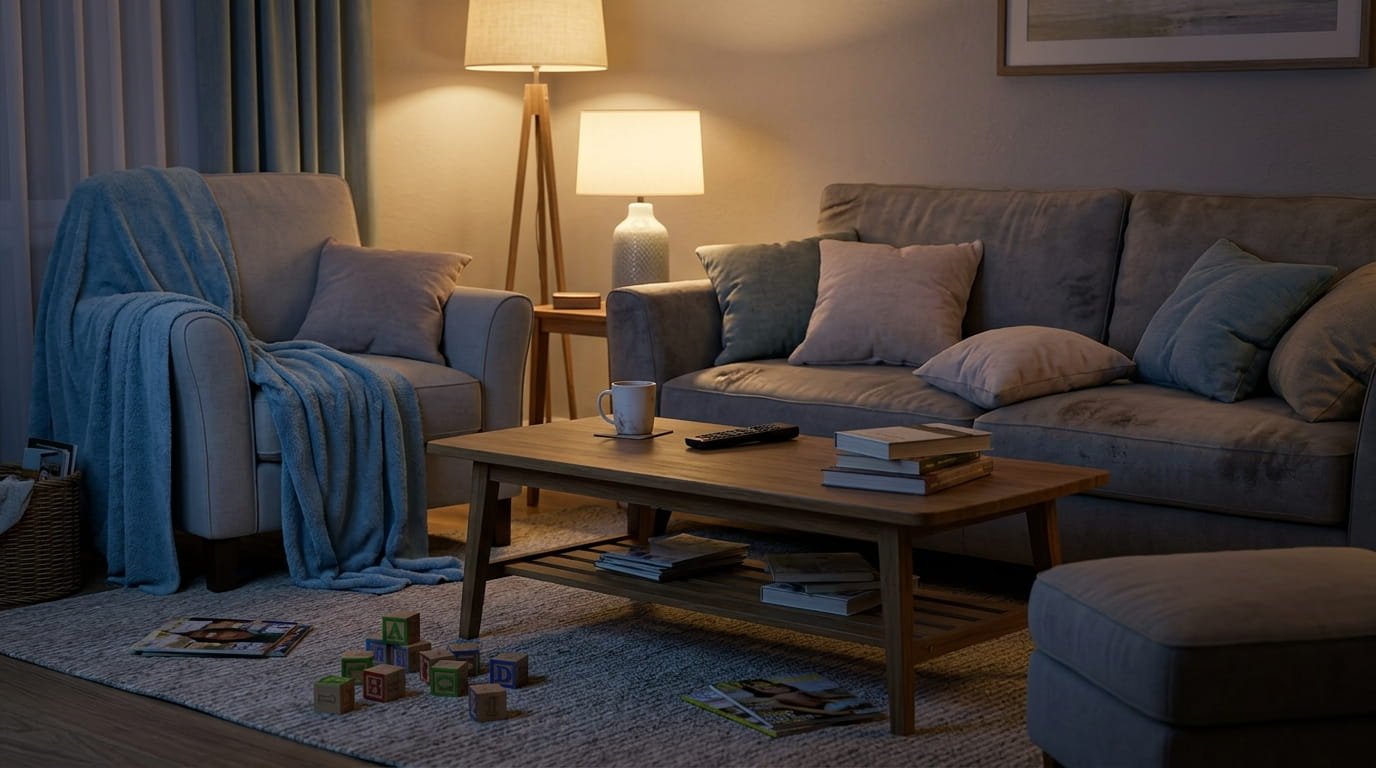
Knowing how to organize your living room starts with one honest fact: it’s the busiest room in your home. It’s where the kids play, the mail lands, the remotes disappear, and the blankets pile up. By Friday night, it can feel like the room is working against you.
The good news is that you don’t need a bigger space or new furniture. You need a simple system. This guide walks you through six steps: declutter, zone, arrange, store, handle your hot spots, and reset. It works for busy families, renters with limited storage, and anyone who wants a calm room that still works hard. If family living room organization feels like a never-ending job, this system makes it a smaller one.
Along the way, you’ll get hidden toy storage ideas, easy fixes for common clutter spots, and a 5-minute nightly reset that keeps everything in place.
Quick Takeaways
- A living room stays organized when every item has a zone and a home.
- Declutter first. Buy storage last.
- Use closed storage for the bulk and open storage for favorites.
- A 5-minute nightly reset beats a big monthly clean-up.
Why Living Rooms Get Messy So Fast
Most rooms have one job. A living room has many. People watch TV here, play here, work here, nap here, and drop their things here on the way in. Each activity brings its own gear, and that gear rarely has a clear home.
So the mess isn’t a sign that you’re lazy or that your family is hard to live with. It usually means your items don’t have an address. When something has nowhere to go, it lands on the nearest flat surface. Give things an address, and most of the clutter stops coming back.
Step 1: Declutter First (The 20-Minute Sweep)
Before you buy a single basket, clear out what shouldn’t be here. Storage only works when it holds things you actually need. Set a timer for 20 minutes and work your way around the room. It’s quick, and you’ll see progress right away.
The Four-Bucket Sweep
Grab four laundry baskets or boxes and label them:
- Keep Here
- Wrong Room
- Donate
- Trash and Recycle
Walk a loop around the room and pick up anything that’s out of place. The Wrong Room bucket is the secret. Most living room clutter isn’t trash. It simply belongs somewhere else, like cups in the kitchen, shoes by the door, and laundry in the bedroom.
When the timer ends, deliver the Wrong Room bucket right away. If you leave it by the door, it becomes a new pile.
What to Edit Out First
If you’re not sure where to start, look for these common culprits:
- Old magazines, catalogs, and mail you’ve already handled
- Duplicate or dead remotes
- Outgrown toys and toys with missing pieces
- Chargers and cords that don’t match any device you own
- Extra throw pillows and decor that crowd your surfaces
A Simple Rule for Keepers
Ask one question: does this get used or loved in this room? If the answer is no, it needs a new home or a spot in the donation box.
Letting go can be hard, especially with sentimental items. If you get stuck, our guide to Minimalist Home Organization Tips can help you build the habit.
Step 2: Map Your Zones (Family Living Room Organization That Works)
What Zoning Is and Why It Works
A zone is a spot in the room set aside for one activity, with the gear for that activity stored right there. The reading chair gets a lamp and a basket of books. The TV area gets the remotes and game controllers.
When gear lives where the activity happens, putting it away is easy. And when it’s easy, people actually do it. Zoning works in every room, so you can see it in action in our Small Kitchen Organization Ideas too.
The 5 Core Zones
1. Seating and conversation zone. This is your sofa, chairs, and the space between them. Keep it simple, with throws, pillows, and coasters. A storage ottoman or blanket basket within arm’s reach keeps soft items from piling up.
2. Media and tech zone. This holds the TV, console, and anything electronic. Remotes, controllers, and cords belong here. A closed console, a few cord clips, and a small tray for remotes keep this area calm.
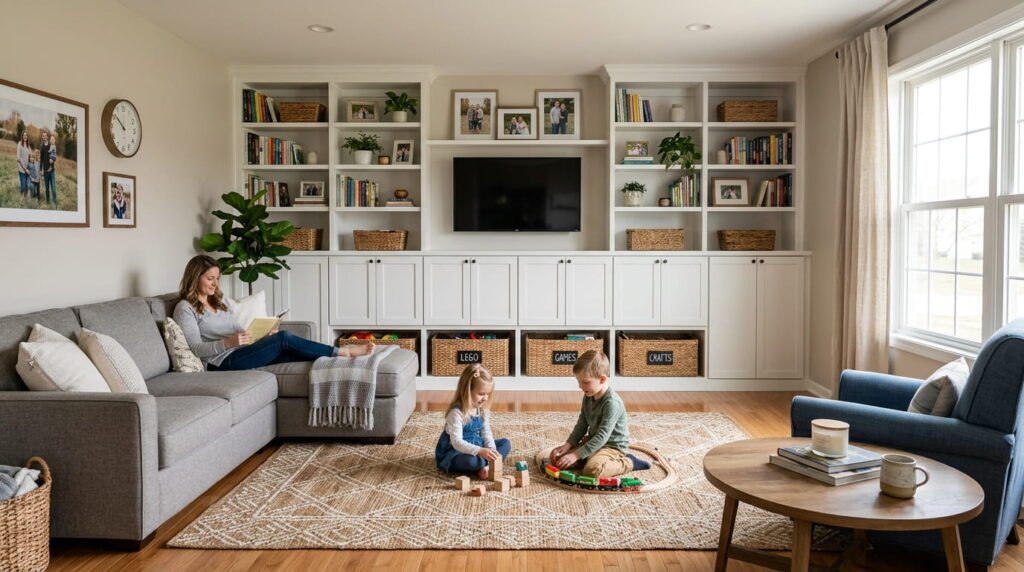
3. Kid play zone. Give play its own low, open area, ideally with a rug that marks the space. Toys, books, and art supplies live here in low bins, lidded baskets, or a storage bench.
4. Quiet corner. This is a spot for reading, homework, or a laptop. Even a single chair and a small side table count. A wall shelf or a side table with a drawer keeps books and chargers close.
5. Drop zone. Every home has a place where mail, keys, and remotes land. Choose that spot on purpose, and give it a tray, a few wall hooks, or a slim console. When items have one landing spot, they stop spreading across the room.
| Zone | What lives here | Best storage |
| Seating | Throws, pillows, coasters | Storage ottoman, blanket basket |
| Media | Remotes, game controllers, cords | Closed media console, cord clips, tray |
| Kid play | Toys, books, art supplies | Low bins, lidded baskets, bench |
| Quiet corner | Books, laptop, chargers | Wall shelf, side table with a drawer |
| Drop zone | Mail, keys, remotes | Tray, wall hooks, slim console |
Zoning a Small or Open-Plan Room
You don’t need walls to make zones. Try these tricks:
- Use rugs to mark zones. One rug under the seating and a different one under the play area tells everyone where each activity belongs.
- Use the back of the sofa as a divider. A slim console table behind it makes a built-in drop zone.
- Try a low shelf unit as a room divider. Keep it low so light and sightlines stay open.
- Let zones overlap. In a tiny room, one ottoman can be seating, toy storage, and a coffee table. Just keep each piece’s job clear.
If you rent, stick with freestanding pieces and use adhesive hooks only where your lease allows.
Step 3: Choose a Functional Living Room Layout
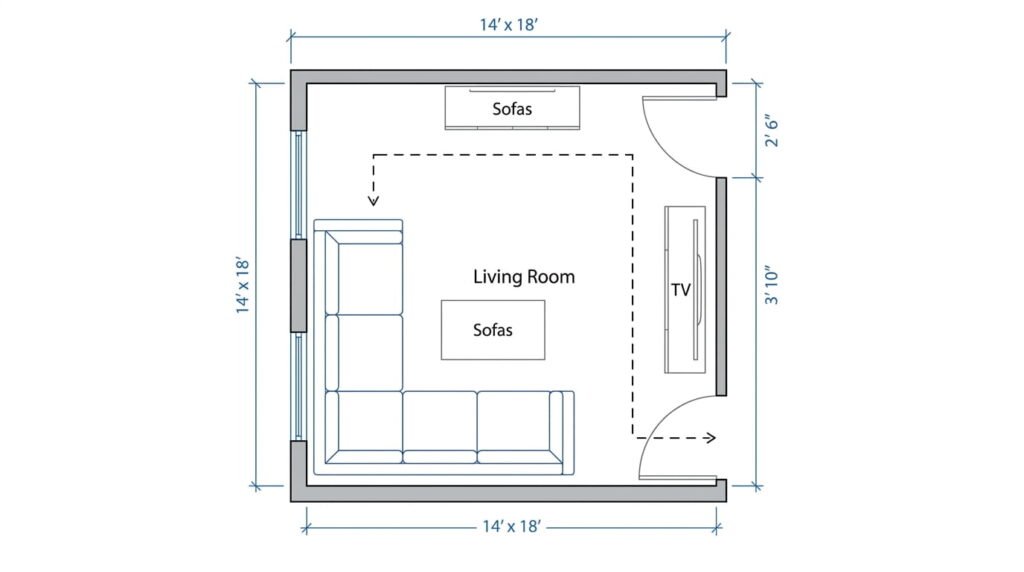
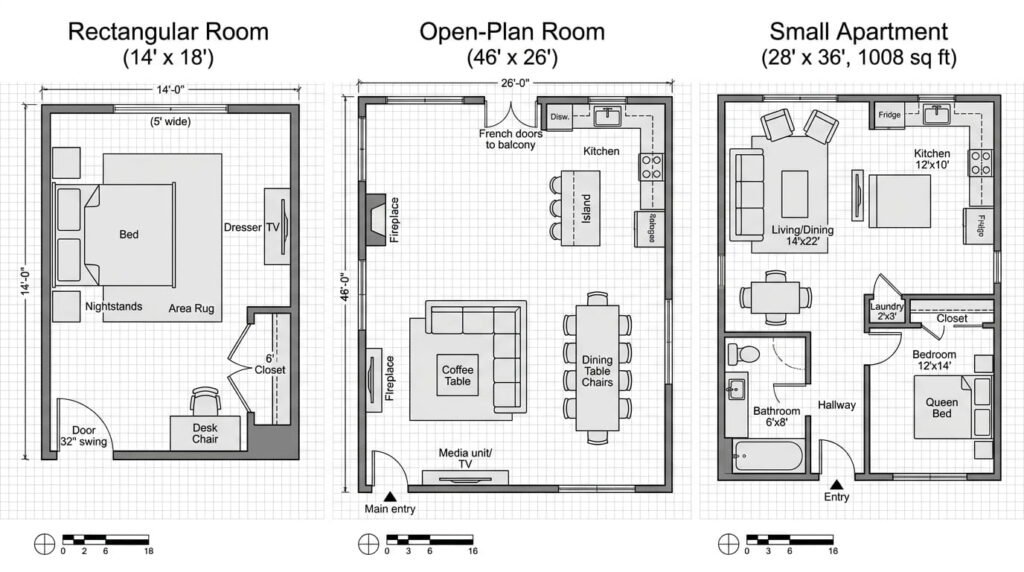
Organizing isn’t only about bins. A functional living room layout makes tidiness easier because the room flows and nothing is in the way. Clutter tends to build up fastest wherever furniture blocks natural paths.
Start With Traffic Flow
Walk the paths people use every day. Go from the doorway to the sofa, from the sofa to the TV, and from the room to the kitchen or hallway. You should be able to walk through without turning sideways or stepping around a toy bin.
If a piece of furniture blocks the main path, move it first. Also check that your coffee table leaves enough space to sit down and stand up comfortably.
Arrange for Conversation and the TV
Group your seating so people can face each other, not just the screen. Two chairs angled toward the sofa create an easy conversation circle. Place the TV so it sits near eye level when you’re seated, and avoid spots that get glare from windows.
If every seat faces one wall, the room feels like a theater. A slight angle changes the whole mood.
Family-Friendly Layout Rules
- Keep the play area visible from the sofa. You can relax and still keep an eye on little ones.
- Leave open floor space for play. Don’t fill every inch with furniture.
- Pick furniture that stores things. Ottomans, benches, and consoles with doors do two jobs.
- Choose softer edges where small kids play. A round or rounded-corner coffee table is kinder to toddlers.
Layout Fixes for Small Rooms and Rentals
- Float the sofa and place a slim console behind it. This creates a divider and a drop zone.
- Swap a regular coffee table for a lift-top or storage version.
- Use nesting tables that tuck away when you need space.
- Choose a slim, freestanding shelf instead of drilling into the wall.
Step 4: Toy Storage Ideas for the Living Room (That Don’t Look Like a Toy Store)
Toys are one of the biggest sources of clutter in a family living room. The goal isn’t to hide childhood. It’s to give toys a home that looks good and that kids can use on their own.
Hide It in Plain Sight
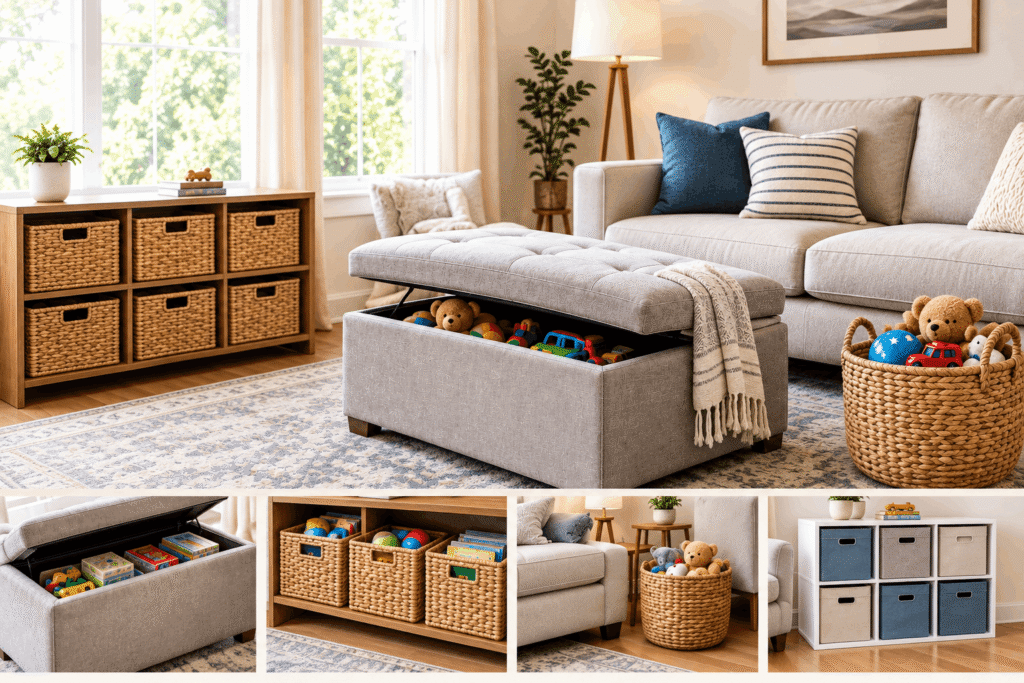
These toy storage ideas for the living room blend in with your decor:
- Storage ottoman. It works as seating, a footrest, and a toy chest in one.
- Storage bench. Place it under a window or against a wall.
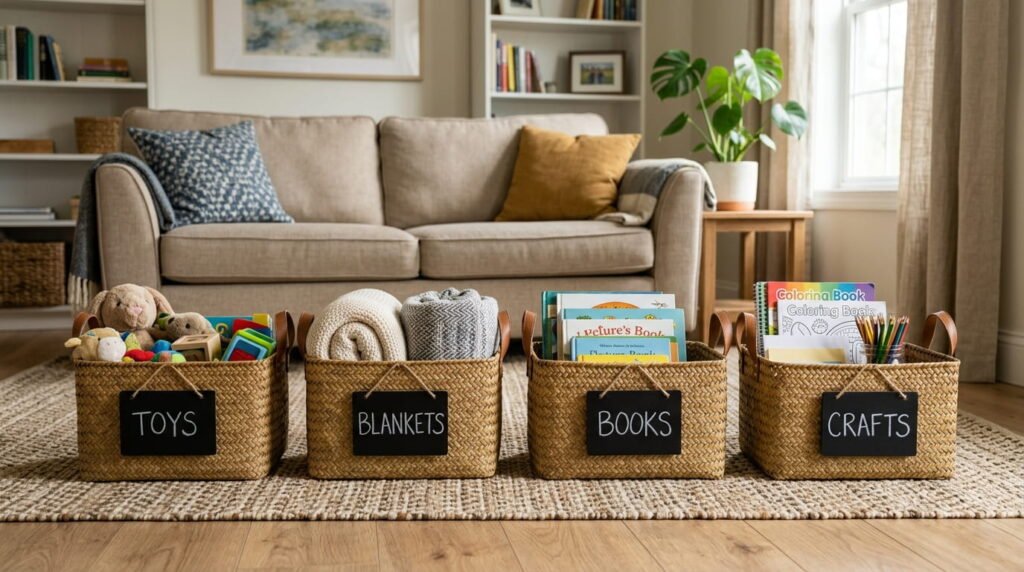
- Lidded baskets. Woven baskets look like decor but hide a lot of toys.
- Cabinet or credenza with doors. Shut the doors and the room looks calm in seconds.
- Console with bins underneath. Slide matching bins into the open space below.
Closed vs. Open Storage
Use closed storage for the bulk, like building blocks, small cars, and loose pieces. Use open, low storage for favorites, like picture books and stuffed animals. Kids can see and reach what they love, and the rest stays out of sight.
Too much open storage creates visual noise, so mix the two.
Kid-Height Access
Here’s a simple test: if a child can reach it, a child can put it away. Put everyday toys on the bottom shelf or in low bins. For kids who can’t read yet, stick a photo or drawing of the contents on the front of each bin.
Pay attention to lids. Choose lightweight lids or ones with slow-close hinges so little fingers don’t get pinched.
Sort by Category and Set a Limit
Give each type of toy its own bin: one for blocks, one for cars, one for dolls, and one for art supplies. Avoid a single giant toy bin. Everything sinks to the bottom, and kids dump the whole thing out to find one piece.
Add a simple limit: one bin, one category. When a bin is full, something rotates out or gets donated. The bin itself becomes your guide to how much is enough.
Toy Rotation
Keep a small set of toys out and store the rest in a closet or under a bed. Swap them in when interest fades. Old toys feel new again, and there’s less to pick up each night.
Match the Room
Choose bins in natural materials and colors that fit your space, like woven baskets, canvas, or wood. You don’t have to spend a lot. A set of matching baskets can make a mixed pile of toys look planned.
A quick safety note: Anchor tall bookcases and cabinets to the wall so they can’t tip over. If you rent, ask your landlord about wall anchors, or choose low, sturdy pieces instead.
Step 5: Living Room Clutter Solutions for Everyday Hot Spots
Every living room has a few trouble spots where clutter collects again and again. Here are quick living room clutter solutions for the most common ones.
| Hot spot | Common problem | Fix | Budget or renter tip |
| Remotes, cords, chargers | Tangles and lost remotes | Charging station, cord clips, a small tray | Use a lidded box with a cable hole as a charging station |
| Blankets and pillows | Piled on the sofa | Basket, blanket ladder, or ottoman | A large basket you already own works fine |
| Books, mail, magazines | Paper stacks | Mail tray, keep only a few favorite books out | Use a desktop file holder as a mail sorter |
| Coffee and side tables | Surface overload | Group items on one tray | Any flat tray from your kitchen will do |
| Media shelves | Visual clutter | Closed bins for messy items, empty space on open shelves | Fabric bins hide mixed items for a low cost |
The Tray Rule
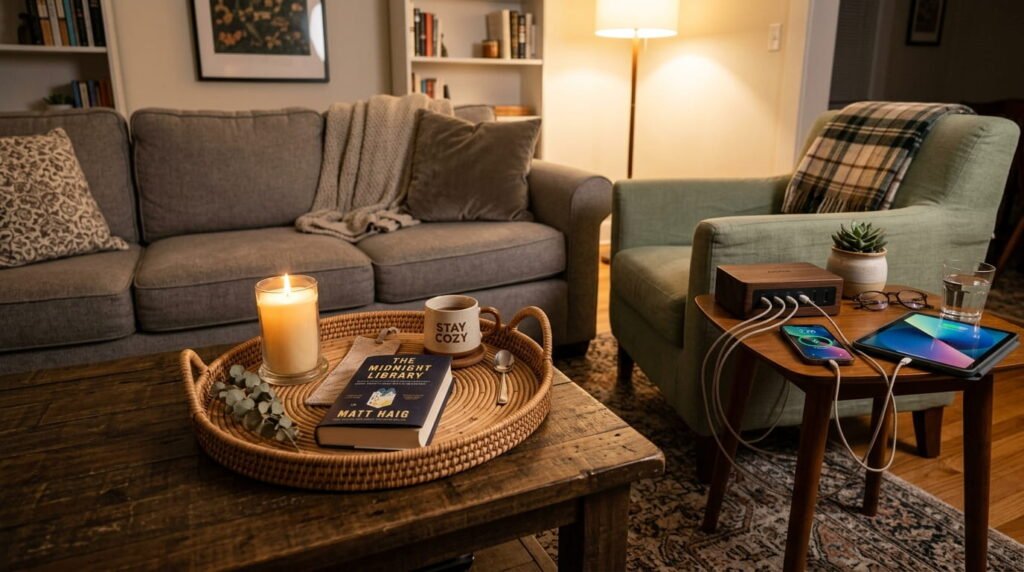
Place one tray on your coffee table and keep loose items on it. A candle, a coaster, and a book look intentional on a tray. Better still, clearing the table becomes a one-grab job.
Tame the Cords
Use cord clips to guide cables along the back of furniture. Keep power strips in a ventilated spot, and don’t bury them under blankets or fabric.
Sort the Mail Once
Open mail near the recycling bin. Put anything that needs action, like a bill or a form, in one tray at your drop zone. Check that tray once a week and clear it out.
Step 6: The 5-Minute Nightly Reset
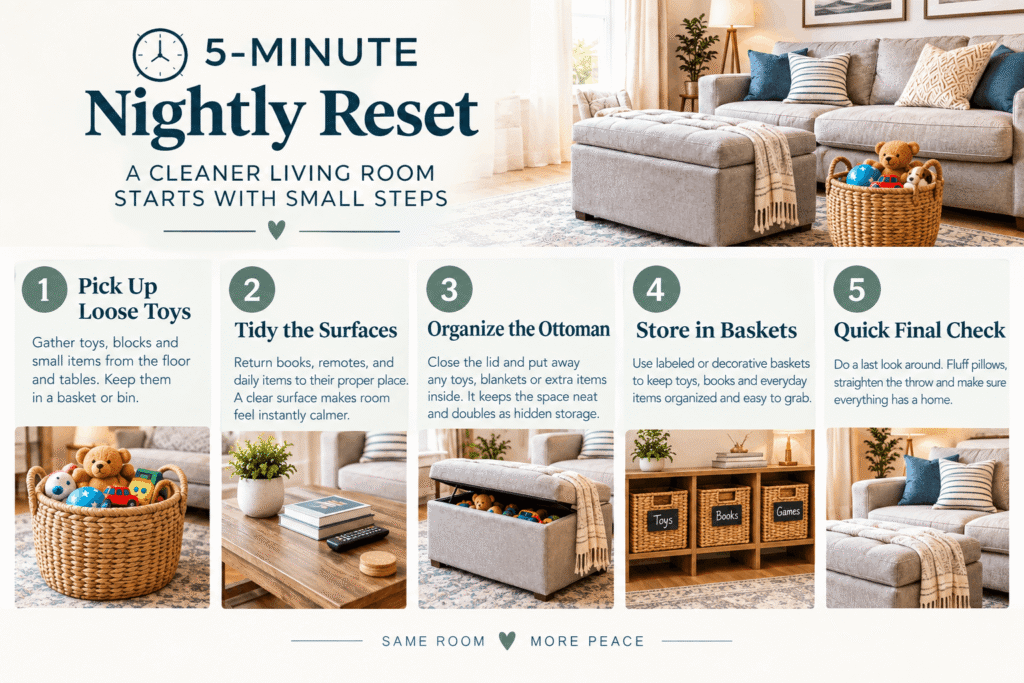
Even the best system fails without a habit. A nightly reset is that habit. It takes five minutes, so it’s easy to keep.
The Routine
Set a timer and follow these steps:
- Minute 1: Collect cups, plates, and trash, and take them to the kitchen.
- Minute 2: Put toys back into their bins.
- Minute 3: Fold blankets and straighten the pillows.
- Minute 4: Return remotes, chargers, and mail to the drop zone.
- Minute 5: Clear the coffee table and take a quick look around the room.
Done. The room is ready for tomorrow.
Getting Kids Involved
Kids can do more than you think. Make it a game by racing the timer, or play one song and clean until it ends. Kid-height bins and picture labels make the job doable for little ones.
Keep the routine at the same time each night, like right after dinner or before story time. Praise effort over perfection, and the habit will stick.
Weekly Mini-Reset and Seasonal Edit
Once a week, do a slightly longer pass. Wipe the surfaces, vacuum the floor, and check your drop zone and toy bins for things that don’t belong.
Each season, repeat the 20-minute sweep from Step 1 and refresh your toy rotation. This catches what the nightly reset misses.
Want a routine that covers the whole house? Our guide on How to Stay Organized Daily pairs well with this one.
Common Living Room Organizing Mistakes (and Quick Fixes)
- Buying storage before decluttering. Clear things out first, then measure what you really need.
- Using one big bin for all the toys. Switch to smaller bins sorted by category.
- Keeping kid items out of reach. Move everyday toys to the bottom shelf.
- Blocking walkways with furniture. Rearrange until you can walk through easily.
- Overloading open shelves. Mix in closed storage and leave some breathing room.
- Skipping the nightly reset. Tie it to something you already do, like after dinner.
Living Room Organization Checklist
Use this as your weekend plan:
- Set a 20-minute timer and do the four-bucket sweep.
- Return everything from the Wrong Room bucket to where it belongs.
- Remove broken, unused, and outgrown items.
- Choose your zones and give each one a home for its gear.
- Check traffic flow and move any furniture that blocks it.
- Set up toy storage at kid height, sorted by category.
- Create a drop zone with a tray, hooks, or console for remotes and mail.
- Add cord clips or a charging station.
- Do your first 5-minute nightly reset tonight.
FAQs
How do I organize a living room with kids?
Start by decluttering, then set up a kid play zone with low bins they can reach. Use closed storage for most toys and open storage for favorites. Finish each day with a quick 5-minute reset so the room stays manageable.
How do I organize a small living room with no storage?
Choose furniture that does double duty, like a storage ottoman, a lift-top coffee table, or a console behind the sofa. Edit what you own, since fewer items matter more in a small room. If you can use the wall, add a slim shelf.
Where do toys go if I don’t have a playroom?
Use living room furniture that doubles as storage, such as a bench, an ottoman, or a cabinet with doors. Keep a small set of toys out, and store the rest in a closet or under a bed for rotation.
How often should I declutter my living room?
Do a quick reset every night, a short mini-reset each week, and a full sweep each season or whenever the room feels crowded.
How do I hide TV cords and electronics clutter?
Use cord clips or a cord cover to guide cables out of sight. Keep power strips in a ventilated spot, and don’t cover them with fabric. A closed media console also hides the rest.
What is the best storage for a rental living room?
Stick with freestanding pieces like baskets, ottomans, consoles, and standalone shelves. Use adhesive hooks only where your lease allows, and ask your landlord before anchoring tall furniture to the wall.
Final Thoughts
Organizing your living room isn’t about perfection. It’s about giving every item a home and making the room easy to reset. Start with the 20-minute sweep, set up your zones, and add storage that fits how your family really lives. Then keep it going with the 5-minute nightly reset.
Ready for the next room? Try our Closet Organization Ideas on a Budget guide for a closet that works as hard as your living room does. And once your space is organized, you can start styling it with organize your home step by step.




Leave a Reply