

Introduction
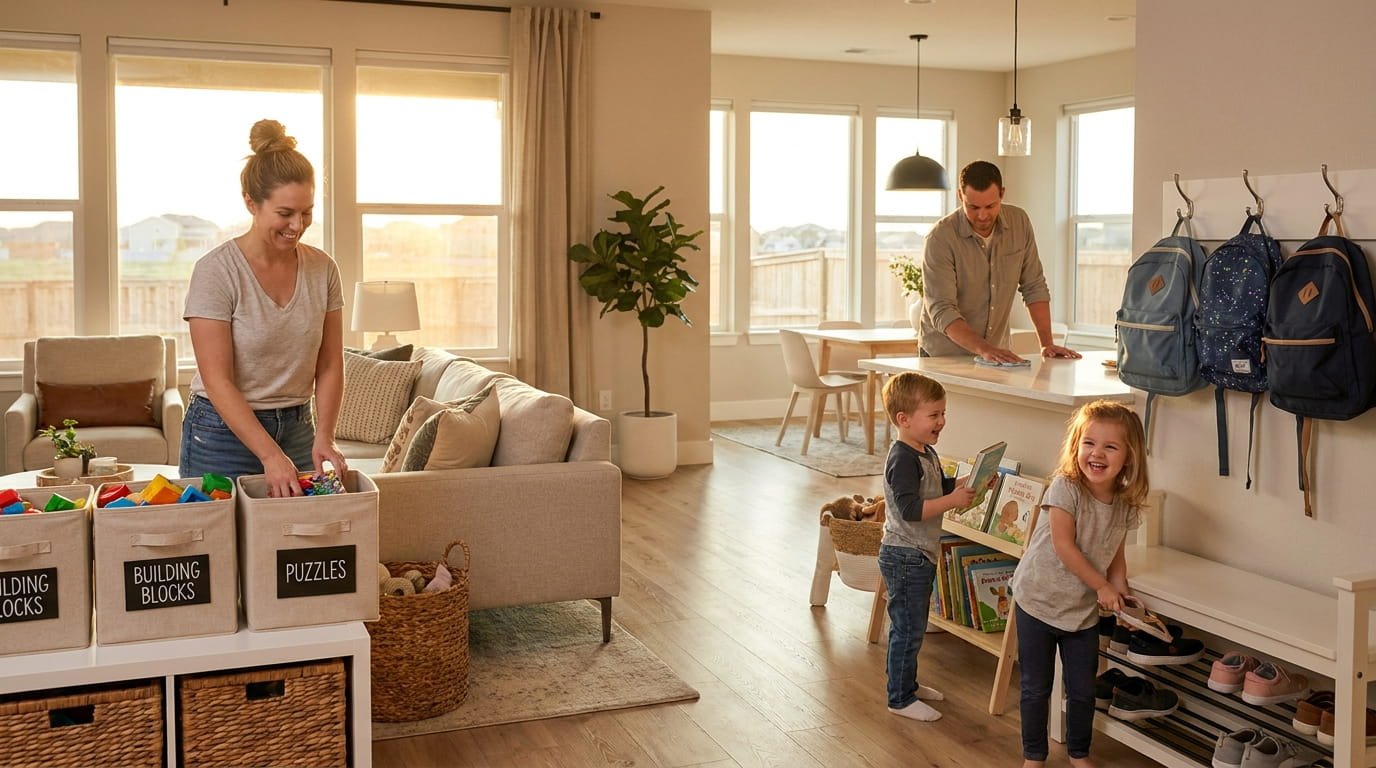
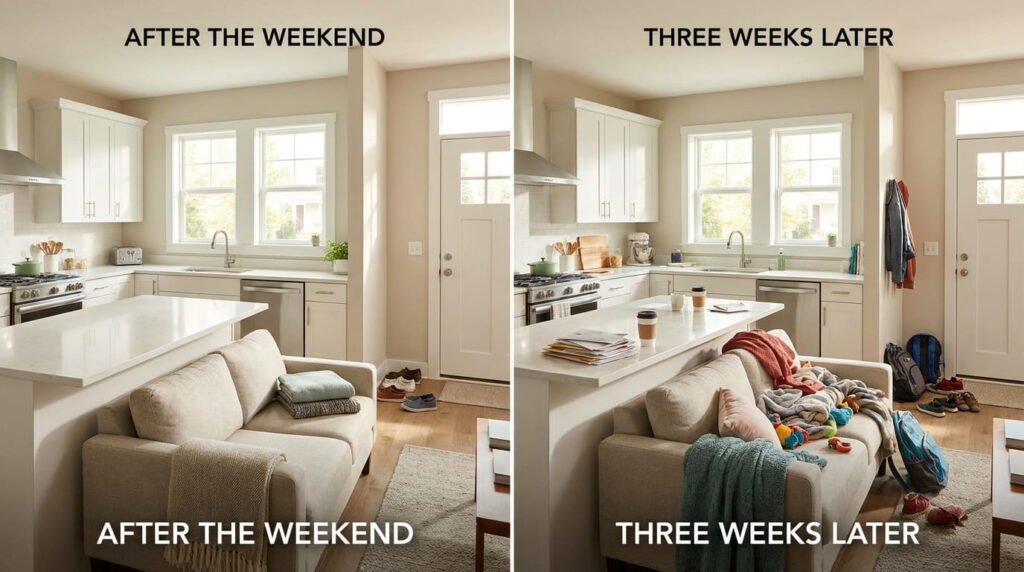
Here’s the cycle most families know intimately. You spend a Saturday getting the house in order. Every room looks good. The counters are clear, the closets are functional, the floor is visible. You feel genuinely proud of what you accomplished.
Three weeks later, it looks exactly like it did before.
This is not a failure of effort. It’s a failure of strategy. One big organizing session without a daily maintenance habit is like washing your car and then leaving it in a muddy field. The initial work doesn’t hold without the ongoing upkeep to back it up.
The families who live in consistently organized homes are not doing giant weekend purges every month. They’re doing small, specific things every single day that take five to fifteen minutes total. Not because they’re more disciplined than you or because they have less stuff or fewer kids. Because they’ve built simple daily habits that prevent clutter from compounding into chaos.
Daily organization habits are not about perfection. They’re about keeping the baseline close enough to manageable that your home never gets so far from functional that it requires a full-day intervention to fix. Building automatic routines grounded in behavioral science allows your brain to shift these repetitive chores into autopilot, saving your mental energy for the rest of your day.
This guide will show you exactly which daily habits make the biggest difference, how to build them into a schedule that already feels packed, and how to get the rest of your family doing them without turning every evening into a negotiation.
The 10-Minute Daily Reset Routine
Ten minutes. Every evening. That’s the core of a daily organization habit that actually holds up for real families.
The goal of the daily reset is not to deep-clean or reorganize anything. It’s to return the home to a functional baseline before you go to sleep, so you wake up to a home that feels manageable rather than one that already feels like it’s winning.
Here’s what a complete 10-minute evening reset looks like broken into specific tasks:
Minutes 1 to 2: Kitchen sweep Load any remaining dishes into the dishwasher or wash them. Wipe down the counters. Return any items that have landed on the counter during the day to their permanent homes. The kitchen doesn’t need to be spotless. It needs to be clear and functional for morning.
Minutes 3 to 4: Main living area Return all toys to their designated bins or shelves. Fold and return any throw blankets to their basket. Put remote controls back in their tray. Return any cups or snack items to the kitchen. Pick up anything from the floor.
Minutes 5 to 6: Entryway and drop zones Return shoes to their spots. Hang any bags or jackets that landed on chairs or the floor. Sort any mail or papers into their home, whether that’s a mail organizer, the recycling bin, or a “to deal with” tray.
Minutes 7 to 8: Hot spots Every home has one or two surfaces that attract clutter faster than others. The kitchen table. The bottom of the stairs. The bathroom counter. Do a 60-second pass on your home’s specific hot spots and clear them to baseline.
Minutes 9 to 10: Quick floor check Walk through the main areas and pick up anything from the floor. Shoes, toys, clothes, bags. Thirty seconds per room is enough to make a visible difference in how the home feels.
That’s it. Ten minutes, and your home is back to a functional baseline.
Morning vs Evening Habits: What to Do When
Not all daily organization tasks belong in the evening. Some things are genuinely better handled in the morning, either because they set up the day more smoothly or because they’re naturally part of the morning sequence.
Morning Organization Habits (5 to 7 minutes total)
Make the bed immediately. This is the single highest-impact individual organization habit most people can build. It takes two to three minutes and makes the entire bedroom look dramatically more organized. It also sets a psychological tone: you’ve already accomplished something before you’ve done anything else.
Do a quick kitchen start. Before everyone scatters for school and work, wipe any breakfast dishes into the dishwasher, wipe the counter once, and clear any items left out from last night that didn’t get handled in the evening reset. Three minutes maximum.
Pack and stage outgoing items. Backpacks, permission slips, work bags, and anything leaving the house today get staged at the door or in the entryway. This prevents the frantic morning search and keeps the entryway from becoming a dumping ground because nobody knew where else to put things.
Evening Organization Habits (10 to 15 minutes total)
The full evening reset described above, plus two additions:
Start a load of laundry or move one along. Laundry is the household task most likely to compound into an overwhelming pile if ignored daily. Running one load per evening, even if you don’t fold it immediately, keeps laundry from becoming a weekend-consuming event.
Do a 60-second tomorrow prep. Before you sit down for the evening, spend 60 seconds thinking about tomorrow. Is there anything that needs to be remembered, packed, or prepared? Put it where it needs to be tonight so you’re not doing it tomorrow morning at 7:15 when everyone is already late.
Habit Stacking: How to Make These Habits Automatic
The reason most people fail to build new habits is not lack of motivation. It’s that the new habit has no anchor in the existing daily routine. It floats free, relying on willpower to remember it, and willpower is the first thing to disappear on a hard day.
Habit stacking solves this by attaching a new habit to something you already do every day without thinking. The existing habit becomes the trigger for the new one.
Practical habit stacks for daily home organization:
“After I turn off the coffee maker in the morning, I wipe the kitchen counter.”
“After I put my keys down when I get home, I spend two minutes clearing the entryway.”
“After the kids start their bedtime routine, I do the 10-minute evening reset.”
“After I brush my teeth, I make the bed.” (For a morning routine starter)
“After I load the dishwasher from dinner, I do a quick living room pickup.”
The specific trigger event matters less than the consistency of the connection. Once the stack is established, which takes roughly two to four weeks of daily practice, the new habit starts to feel as automatic as the one you attached it to. You stop having to remember to do the reset. It just happens.
Write down your specific stacks before you go to bed tonight. Personalizing them to your actual daily sequence is what makes them stick.
Involving Your Kids and Spouse in Daily Organization
The daily reset only works long-term if it’s genuinely shared. One person maintaining a family home solo is not a sustainable system. It’s a recipe for resentment and burnout, and it guarantees the system collapses the moment that one person has a hard week.
Getting Kids Involved
The key with kids is matching the task to the age and making the expectation completely clear.
Ages 5 to 7: Return toys to designated bins. Put dirty clothes in the hamper. Carry their own plate to the sink after dinner.
Ages 8 to 11: Full toy and personal item cleanup in shared spaces. Help load the dishwasher. Wipe their own bathroom sink. Make their own bed.
Ages 12 and up: Full ownership of one room or zone during the evening reset. Empty the dishwasher. Fold and put away their own laundry. Manage their own space independently.
The critical ingredient is consistency, not perfection. A 9-year-old who loads the dishwasher imperfectly every night is contributing infinitely more to the household than one who does it perfectly twice a month. Praise the habit, not just the execution.
Getting Your Spouse or Partner Involved
This conversation works best when it’s about systems and fairness rather than criticism. Instead of “you never help clean up,” try “I want us to build a quick evening routine together so neither of us is carrying this alone. Can we figure out what that looks like?”
Divide the reset tasks based on natural strengths and preferences where possible. If one person cooks, the other handles the kitchen reset. If one person is better at getting the kids through the bedtime routine, the other handles the main living areas.
Write it down. A shared understanding of who does what removes the daily negotiation and the simmering resentment that comes from undefined expectations.
Common Daily Organization Struggles and Solutions
“I’m too tired at the end of the day to do anything.” Lower the bar. The reset doesn’t have to be perfect. On genuinely exhausted nights, do only three things: dishes in the dishwasher, clothes off the floor, and bags at the door. That’s it. A partial reset beats no reset every single time.
“I do it but nobody else does.” This is a system problem, not a people problem. The expectations aren’t clear enough, the tasks aren’t assigned, or the kids don’t know specifically what their role is. Revisit the family division of tasks and make it more explicit. A visual checklist on the fridge for kids works better than verbal reminders for most households.
“We start strong but fall off after two weeks.” Two weeks is exactly when new habits feel hardest. The initial motivation has worn off and the automatic behavior hasn’t formed yet. This is the critical window. Use a simple habit tracker, even just check marks on a piece of paper, during this period. Seeing a streak builds its own momentum.
“The house is too disorganized to maintain daily.” Daily habits work best when the underlying organization system is already in place. If there are no homes for items, a daily reset has nowhere to put anything. Go back to the Organize Your Home Step by Step guide and build the foundational system first. Daily habits are maintenance, not construction.
Tools and Reminders That Actually Help
You don’t need an app or a complicated system to build daily organization habits. Here’s what works for real families.
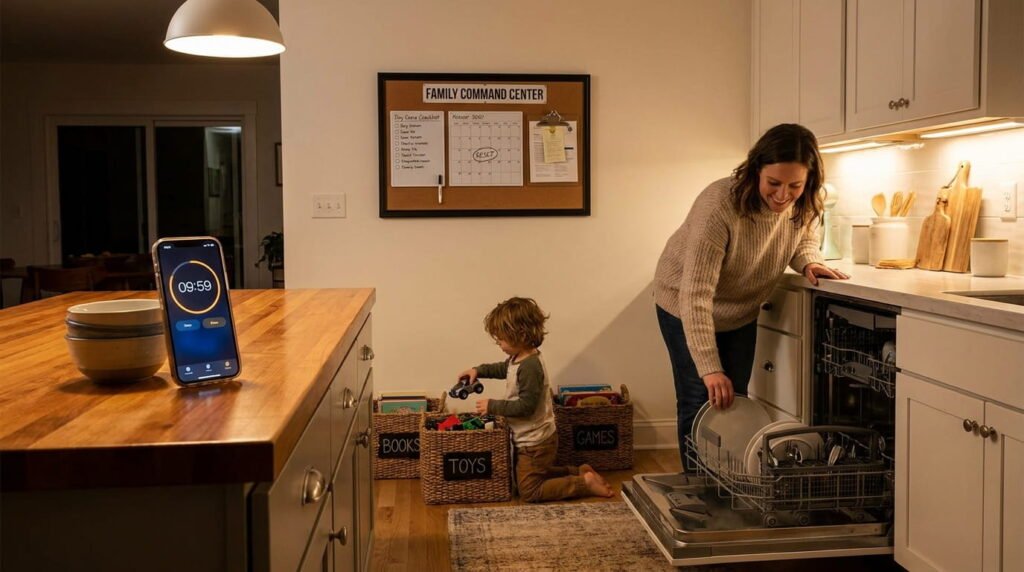
A visible checklist. A simple paper checklist posted in the kitchen or on the fridge, listing the evening reset tasks with checkboxes, works better for most families than any app. Kids can check things off. It’s visual. It removes the “I forgot” excuse.
A shared family calendar reminder. Set a repeating phone reminder at the same time every evening that says simply “10-minute reset.” Seeing it at the same time every day, even on days when it feels unnecessary, reinforces the habit loop.
A family reset basket. A basket at the bottom of the stairs or in a central location that collects items needing to go to other rooms during the evening reset makes the relocation step faster. Family members grab from the basket as they go up or down during the reset.
A timer. This is mentioned throughout all previous guides for good reason: timing yourself genuinely changes how efficiently you work. Set a 10-minute timer for the evening reset and see how much more focused and effective the process becomes compared to open-ended cleaning.
How to Build Consistency Without Burnout
Burnout in home organization almost always comes from one of two sources: the bar is too high, or the system is carried by one person.
Keep the daily bar low enough that you can hit it on your worst day. A five-minute reset on a terrible Tuesday is more valuable than a 30-minute deep clean on a good Saturday, because the five-minute reset happens every Tuesday.
Celebrate small wins genuinely. Not sarcastically, not performatively, but actually noticing and acknowledging when the system works. A week of consistent evening resets is worth acknowledging. A month is worth a small family celebration.
Build in a no-guilt skip day. Life happens. Kids get sick, work explodes, emergencies arise. One missed evening is not a system failure. The only failure is using one missed evening as permission to stop entirely. The rule is simple: miss a day, do the reset the next day. No drama, no starting over, just continue.
Conclusion: Small Habits, Big Difference
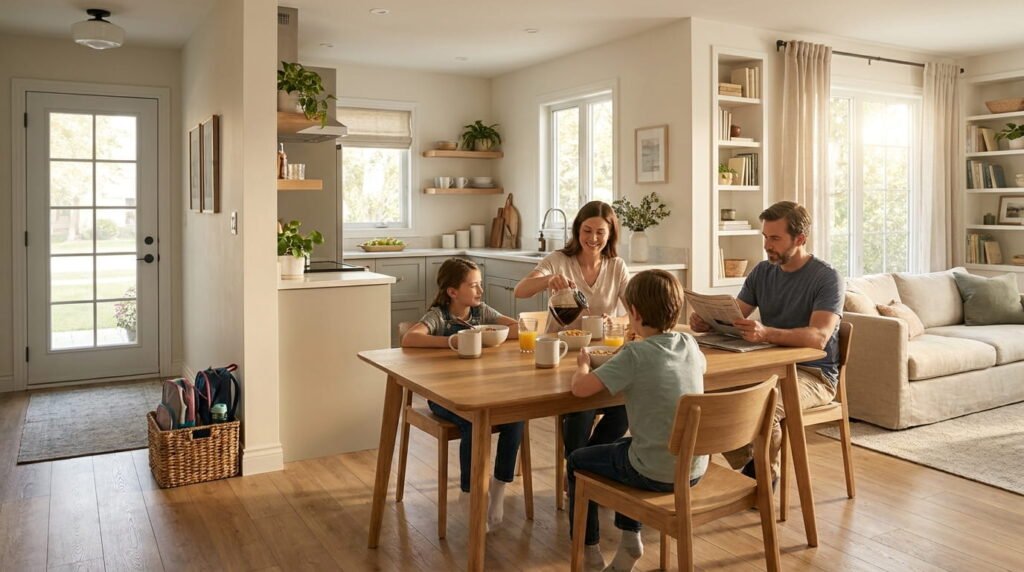
The gap between a home that feels chaotic and a home that feels manageable is usually not a weekend renovation project. It’s a 10-minute daily habit done consistently enough to become automatic.
Start with just the evening reset. Make the bed every morning. Stack one new habit onto something you already do. Get your family doing their part, however imperfectly at first.
Those small daily actions compound. After 30 days, your home will be meaningfully different. After 90 days, it will feel automatic. After a year, you won’t be able to remember what it was like when the house felt out of control.
For the bigger weekly reset that keeps the whole house truly on track, the Weekly Home Reset Routine: 60-Minute System to Keep Your Home Organized is your next read. And if you’re still working on getting the foundational system in place before you can maintain it, the Organize Your Home Step by Step is where to start.
Daily habits are the bridge between the home you have right now and the home you want to live in every day.
Also helpful: 10 Home Organization Mistakes | How to Declutter Your Home Fast | How to Organize Your Living Room




Leave a Reply