

Introduction
If you ask families who have successfully maintained an organized home for more than six months what their secret is, almost all of them will mention some version of the same thing. Not a specific product. Not a particular organizational system. Not a professional organizer who visits twice a year. A consistent weekly reset.
Not a deep clean. Not a top-to-bottom overhaul. Just a focused, intentional 60 to 90 minutes once a week that brings the entire home back to a functional, calm baseline before the next week starts.
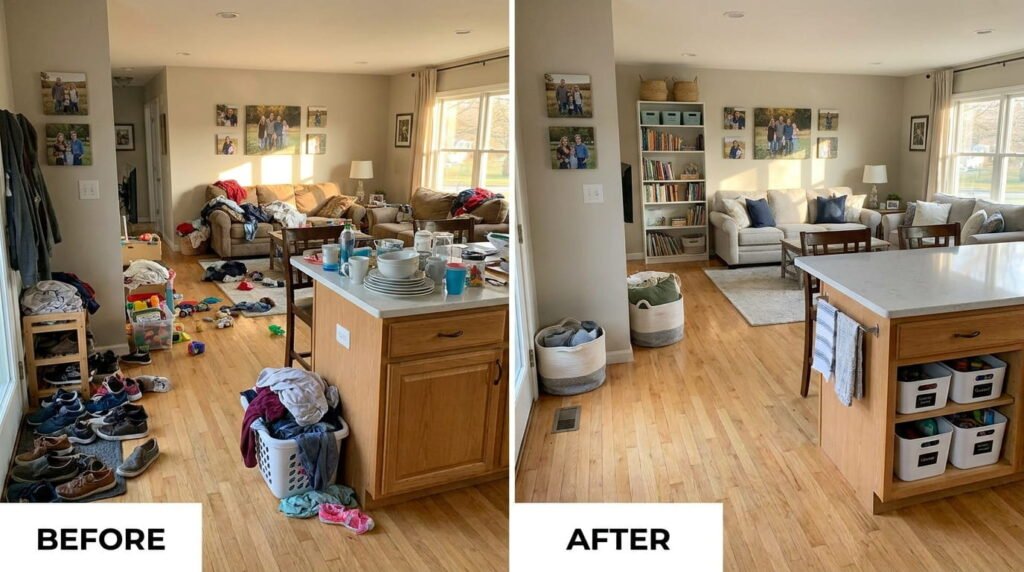
This is the habit that turns a one-time organizing effort into a permanently organized home. Without it, even the most beautifully organized spaces drift back toward chaos within three to four weeks, because life happens every single day and entropy is relentless. With it, the daily maintenance becomes lighter because the weekly reset catches everything the daily habits miss.
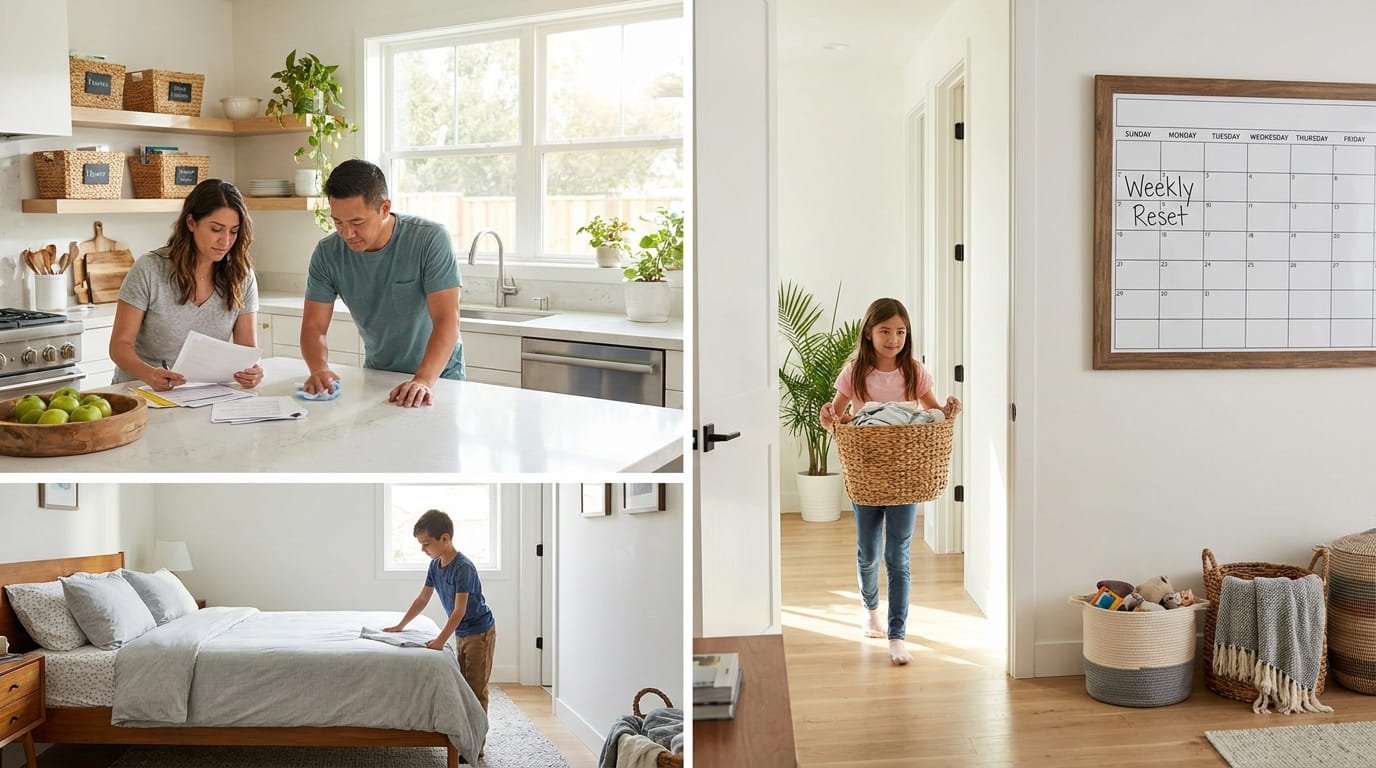
Here’s the realistic picture: the weekly reset is not glamorous. It doesn’t look like the Pinterest version of a spotless home with candles burning and matching linens. It looks like a family in weekend clothes spending an hour moving purposefully through their home, returning things to where they belong, processing the week’s accumulation, and setting up for the coming week. It’s functional, not aesthetic.
It also works. Consistently, sustainably, and with results that compound over time in ways that genuinely change how your family experiences your home.
In this guide, you’ll get a complete step-by-step weekly reset routine laid out zone by zone, a printable checklist you can post on your fridge, a family task division system that gets everyone contributing, guidance for what to do when you inevitably miss a week, and honest insight into the long-term results families experience when this habit becomes part of their regular rhythm.
Let’s build your reset.
The Real Benefits of a Weekly Home Reset
Before getting into the how, it’s worth being clear on the why. Understanding what you’re actually getting from this habit makes it easier to protect the time for it when life gets busy.
It prevents the snowball. Clutter compounds. A few items out of place on Monday become a pile by Wednesday, become a crisis by Sunday. The weekly reset interrupts that compounding cycle before it gets out of hand. You’re dealing with one week of drift, not three weeks or three months.
It dramatically reduces daily maintenance. When you know a weekly reset is coming on Sunday, you don’t have to maintain perfect order every single day. The daily reset can stay light (10 minutes) because the weekly reset handles the deeper catch-up. The two systems work together.
It reduces decision fatigue. Knowing that Sunday is reset day means you’re not constantly thinking about “should I deal with this now or later?” The answer is always the same: handle daily items in the daily reset and everything else in the weekly reset. The decision is already made.
It creates a fresh-start feeling every week. Walking into Monday with a home that was deliberately reset on Sunday feels different from walking into Monday in the middle of last week’s mess. That fresh-start feeling is not a small thing. It affects how the whole week begins.
It models good habits for your kids. Children who grow up in homes where a weekly reset is a normal, expected part of family life learn the systems and expectations that will serve them independently as adults. It’s a practical life skill delivered through osmosis.
The Best Day and Time for Your Weekly Reset
The most common recommendation is Sunday, and for most families it makes sense. It’s typically a lower-pressure day than Saturday, and doing the reset on Sunday means you start the work week from a place of calm rather than chaos. But the best day is the one that actually works for your specific family’s schedule.
Questions to help you choose your day:
Which day of the week do you most consistently have a 60 to 90-minute window available? Not free time necessarily, but time you could protect for this purpose.
Which day do you want to use as your “starting fresh” point? The day before your week feels the busiest is often the best choice.
Does your family have a consistent schedule that makes one day naturally better than others? School schedules, sports commitments, and work patterns all affect which day will hold up over time.
For the time within that day: Earlier is almost always better. A morning reset, done before afternoon activities take over, tends to be more consistent than an evening reset that can get pushed by dinner, fatigue, and the gravitational pull of the couch. Many families find that a 9 or 10 AM start on Sunday, with kids involved, works well. The house is reset by noon and the rest of the day is genuinely free.
Whatever day and time you choose, put it in your shared family calendar as a recurring event. Treat it with the same commitment you’d give a scheduled appointment. Because it is one. An appointment with the home that keeps everything else from falling apart.
Complete Step-by-Step Weekly Reset Routine
This routine is designed to be completed in 60 minutes for most families, with 90 minutes on heavier weeks. The time estimates are realistic for a 3 to 4 bedroom home that has had a daily reset happening throughout the week. If you haven’t been doing daily resets, give yourself 90 to 120 minutes for the first few weekly resets until you build the baseline.
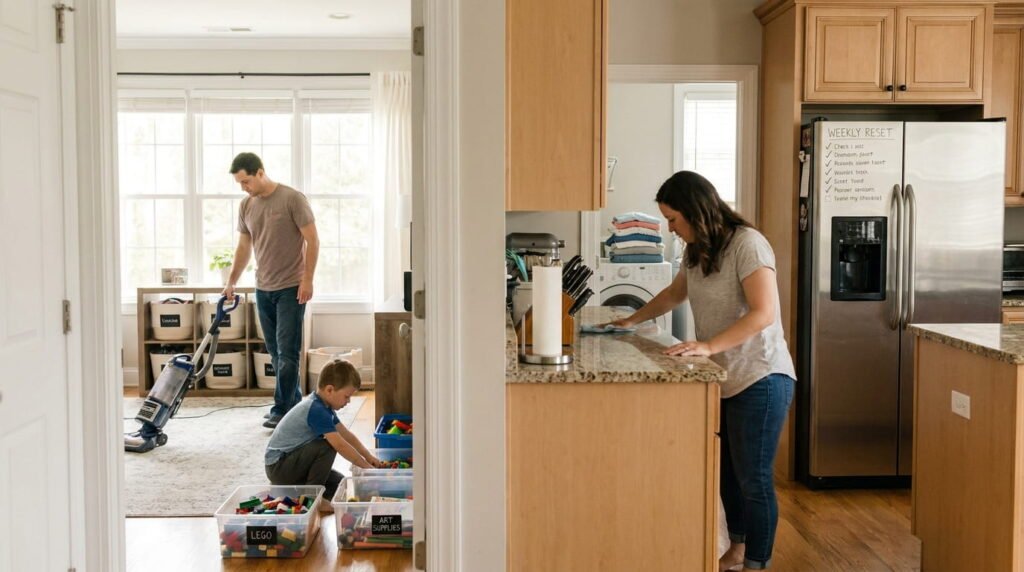
Work through the home zone by zone, completing each zone fully before moving to the next. Moving from room to room inefficiently is what makes resets feel endless.
Zone 1: Entryway and Transition Areas (5 to 8 minutes)
The entryway sets the tone for how the whole home feels. Start here.
Tasks:
- Clear all surfaces of anything that doesn’t permanently live here
- Return shoes to their designated spots and remove any extras beyond the one-pair-per-person rule
- Hang all bags, coats, and jackets on their hooks or in the closet
- Clear outgoing mail and papers: file, recycle, or act on anything sitting in the entry
- Wipe down the entry table or shelf
- Sweep or vacuum the entry floor
- Check the hook and bin system: are things returning to their homes, or is the system drifting?
Red flag check: If the entryway fills back up within a day of being cleared, the system needs more homes or clearer expectations. Read the Organize Your Home Step by Step guide’s section on zoning for a fix.
Zone 2: Kitchen and Pantry (12 to 15 minutes)
The kitchen is the most heavily used room in most homes and the one that accumulates the most between resets.
Tasks:
- Clear and wipe all counters completely
- Unload and reload the dishwasher; hand-wash anything remaining
- Wipe down the stove, microwave exterior, and sink
- Check the pantry: pull anything to the front that needs to be used soon, return misplaced items to their correct section, do a quick expired-food check
- Wipe down the inside of the microwave if needed
- Empty and reline the kitchen trash
- Sweep or vacuum the kitchen floor
- Check the junk drawer: has anything accumulated that needs a real home or the trash?
One extra task for every other week: Wipe down cabinet fronts and appliance exteriors. This takes five extra minutes and keeps the kitchen looking maintained rather than just surface-clean.
Zone 3: Main Living Areas (10 to 12 minutes)
This includes the living room, family room, dining area, and any other main-floor shared spaces.
Tasks:
- Clear all surfaces: coffee table, dining table, side tables, TV unit
- Return all items to their permanent homes (toys to bins, remotes to tray, blankets to basket)
- Straighten and fluff sofa cushions and throw pillows
- Return any dishes, cups, or snack items to the kitchen
- Dust surfaces and shelves quickly
- Vacuum the main living area rugs and floors
- Check cable situation at the TV unit and re-bundle anything that has crept back into chaos
- Wipe down the dining table and chairs
Toy check: If the living room toy situation has expanded beyond its designated zone, this is the moment to return excess toys to kids’ rooms and assess whether the rotation needs refreshing.
Zone 4: Bathrooms (8 to 10 minutes for all bathrooms combined)
Bathrooms are often the quickest zone in a weekly reset because daily habits tend to keep them closer to baseline.
Tasks (for each bathroom):
- Clear and wipe the vanity counter completely
- Clean the mirror
- Wipe down the sink and faucet
- Wipe down the toilet exterior and seat
- Do a quick scrub of the toilet bowl with the brush
- Wipe down the shower or tub surround (a full scrub every other week)
- Refill any running-low supplies: soap, shampoo, toilet paper
- Replace or straighten the hand towel
- Empty the bathroom trash
- Sweep or mop the floor
Organization check: Is everything returning to its place after use? If products keep ending up on the edge of the tub or the bathroom counter instead of in their designated spots, the homes may need to be reconsidered or made more accessible.
Zone 5: Bedrooms (8 to 10 minutes per bedroom)
For most families this means the primary bedroom plus however many kids’ rooms are in the rotation.
Primary Bedroom Tasks:
- Make the bed fully (not just daily-style, but with all pillows and throws arranged)
- Clear nightstands completely and return them to their designated items only
- Return any clothes from the chair, floor, or doorknob to the closet or hamper
- Do a quick closet check: are things returning to their correct sections?
- Dust surfaces
- Vacuum or sweep the floor
Kids’ Bedroom Tasks (do these with your kids):
- Full toy and item return to labeled bins and shelves
- Clear the floor completely
- Quick closet check for anything that needs attention
- Change or straighten bed linens
- Return any dishes or cups to the kitchen
- Empty the kids’ bedroom trash
Zone 6: Laundry (ongoing throughout the reset)
Laundry doesn’t have its own isolated time slot in the weekly reset. It runs in the background while you move through the other zones.
How to integrate it:
- Start a load at the beginning of the reset
- Move it to the dryer when you finish the kitchen zone
- Fold and put away when the rest of the reset is done
The goal for the weekly reset is to have all laundry either washed, drying, or put away by the time the reset is complete. Not caught up for the whole week, but at a clean baseline to start the week from.
Zone 7: The Paper and Admin Pass (5 to 8 minutes)
Paper clutter is one of the most common sources of chronic low-level stress in family homes, and it almost never gets addressed in daily resets.
Tasks:
- Gather all paper from around the house into one pile
- Sort quickly: recycle junk mail and expired papers immediately
- File or action anything important: bills, school forms, invitations
- Create or check your weekly to-do list for household tasks that came up during the reset
- Check the family calendar for the upcoming week: are there events, appointments, or preparations that need to happen?
Even a quick five-minute pass through accumulated paper prevents the “I can’t find that form” situations that cost far more time later.
The Weekly Reset Checklist
Below is a complete printable-style checklist you can copy, customize, and post on your fridge or inside a cabinet door. Check off tasks as you go.
WEEKLY HOME RESET CHECKLIST
ENTRYWAY
- [ ] Surfaces cleared and wiped
- [ ] Shoes returned to spots
- [ ] Bags and coats hung up
- [ ] Mail and papers processed
- [ ] Floor swept or vacuumed
KITCHEN
- [ ] All counters cleared and wiped
- [ ] Dishes done and dishwasher run
- [ ] Stove and microwave wiped
- [ ] Pantry quick-check done
- [ ] Kitchen trash emptied
- [ ] Floor swept or vacuumed
LIVING AREAS
- [ ] All surfaces cleared
- [ ] Toys returned to designated zones
- [ ] Cushions straightened
- [ ] Dusting done
- [ ] Floors vacuumed
BATHROOMS (each)
- [ ] Counter cleared and wiped
- [ ] Mirror cleaned
- [ ] Toilet wiped and scrubbed
- [ ] Shower/tub wiped
- [ ] Supplies restocked
- [ ] Trash emptied
- [ ] Floor cleaned
BEDROOMS (each)
- [ ] Bed made fully
- [ ] Surfaces cleared
- [ ] Clothes off floor and returned
- [ ] Closet quick-check done
- [ ] Floor vacuumed
LAUNDRY
- [ ] Load started at reset start
- [ ] Load moved to dryer mid-reset
- [ ] Laundry folded and put away
PAPER AND ADMIN
- [ ] Paper gathered and sorted
- [ ] Important items filed or actioned
- [ ] Weekly calendar checked
Family Task Division for the Weekly Reset
A 60-minute weekly reset is dramatically more achievable and sustainable when the tasks are shared across the family rather than carried by one person.
Here’s a realistic task division by age group for a family of four or five:
Parent 1: Kitchen, entryway, and paper pass
Parent 2: Bathrooms, main living areas, and laundry management
Child aged 12 to 15: Full responsibility for their own bedroom plus vacuuming the main floor
Child aged 8 to 11: Their own bedroom with guidance, plus one bathroom task (wiping sink and counter)
Child aged 5 to 7: Return their toys to their rooms, make their own bed, carry their dishes to the kitchen
The key is that each person’s tasks are written down or visible, not communicated verbally in the moment. When everyone knows their role in advance, the reset runs without constant direction and delegation.
Family reset tip that consistently works: Start the weekly reset together as a household at the same time. When everyone begins simultaneously rather than sequentially, the energy is collective and the accountability is mutual. Kids are far more likely to do their portion when they can see everyone else working.
Seasonal Adjustments to the Weekly Reset
The weekly reset stays largely consistent year-round but benefits from some seasonal tuning. Adjusting your workflow to match American time use data helps keep expectations realistic as your household’s daily chores and seasonal demands shift throughout the year.
Fall: Add a quick check of seasonal clothing as kids’ wardrobes transition. Add 10 minutes for reviewing school paper flow, which typically accelerates in fall.
Winter: Add a check of the entryway for wet boots, heavy coats, and winter gear overflow. Add a quick check of holiday decor and seasonal storage.
Spring: Add a 10-minute seasonal declutter mini-session to the reset for one month. This is when to process what didn’t make it to the donation box over winter.
Summer: Kids are home more, which means significantly more daily drift. Consider adding five extra minutes to the kids’ zone portion of the reset. A summer schedule chart posted in the kitchen helps kids maintain their own spaces during unstructured days.
What to Do When You Miss a Week
You will miss a week. A sick kid, a work deadline, a family emergency, a weekend trip. Life does not pause for weekly resets.
Here’s the rule: one missed week is not a crisis. Do not treat it as one.
When you come back after a missed week, give yourself 90 minutes instead of 60. Work through the same zones in the same order. Expect that each zone will take a bit longer because two weeks of drift has accumulated instead of one. That’s it. No guilt spiral, no “I can’t believe the house got this bad again,” no starting over from scratch. Just 90 minutes instead of 60.
If you miss two weeks in a row, block out a two-hour session and treat it like a mini-version of the bigger Organize Your Home Step by Step process rather than a standard reset. Work zone by zone, prioritizing the areas that have drifted farthest.
The consistency of the habit across the year matters far more than the perfection of any individual week.
Advanced Tips: Going Beyond the Basics
Once the weekly reset is established and running consistently, there are two additions that significantly improve the long-term results for most families.
Integrate monthly deep-clean tasks. Assign one deep-clean task per month that rotates through the home: cleaning the oven, washing windows, deep-cleaning the refrigerator, cleaning behind large appliances. Add it to the weekly reset for that week. It adds 20 minutes and ensures the home gets a genuine deep clean over the course of each quarter without requiring a separate dedicated session.
Add a 10-minute micro-declutter to your monthly reset. Once a month, add a quick declutter pass to one specific area: one drawer, one shelf, one basket. This prevents the gradual accumulation that turns an organized space into a stuffed one over months. The How to Declutter Your Home Fast guide has the 12-12-12 rule which works perfectly for these monthly micro-sessions.
Create a running maintenance list. Keep a small notepad or use your phone’s notes app to capture small repairs, organizational improvements, and items to replace as you notice them during the weekly reset. Review it monthly and batch the small tasks that can be handled in 30 minutes together. This prevents the “I’ve been meaning to fix that for six months” problem that quietly accumulates stress.
Long-Term Results Real Families Experience
The weekly reset is one of those habits whose value isn’t fully visible until you’ve been doing it consistently for two to three months. In the first few weeks, it mostly feels like cleaning. By month three, something shifts.
Real outcomes families describe after six months of consistent weekly resets:
“Our kids stopped having meltdowns about not finding their things. It sounds small but it made mornings completely different.” A mom of three in Texas.
“I used to spend every Sunday stressed about the state of the house. Now I spend an hour fixing it and then actually relax for the rest of the day. The mental shift alone was worth it.” A working dad from Ohio.
“We’ve stopped buying organizing products. The systems we set up actually hold because we’re maintaining them every week instead of letting them collapse and starting over.” A family from North Carolina.
“My husband and I stopped arguing about the house. We both know what our jobs are on Sunday morning and we both do them. There’s nothing to argue about.” A mom from Florida.
The weekly reset won’t solve every household challenge. It won’t do the deeper work of decluttering, zoning, and building the foundational systems that the Organize Your Home Step by Step guide covers. But once those foundations are in place, the weekly reset is what keeps them functioning month after month, year after year, through busy seasons and slow ones, through growth spurts and pet chaos and unexpected life events.
It’s the habit that makes everything else hold.
Conclusion: 60 Minutes That Changes Everything
You don’t need more space. You don’t need a bigger house, a professional organizer, or a partner who is naturally tidier than the one you have. You need a consistent weekly reset that your whole family does together, on a schedule you’ve committed to, with tasks that are clearly divided and expectations that are visible to everyone.

Start this weekend. Block 60 minutes. Work through the zones in the order above. Get your kids doing their part. Do the paper pass at the end.
Come back next weekend and do it again.
After four weeks, check in with how your home feels on Monday mornings compared to before you started. The difference will tell you everything you need to know about whether this habit is worth protecting.
For the daily habits that support the weekly reset and keep things close to baseline throughout the week, read How to Stay Organized Daily. For the foundational room-by-room system that makes maintenance possible in the first place, the Organize Your Home Step by Step: A Realistic 2026 Guide for Busy Families is your complete roadmap.
One hour a week. Consistent, shared, systematic. That’s all it takes to keep the home you’ve worked to organize actually organized.
Also helpful: Small Home Storage Ideas | 10 Home Organization Mistakes That Are Secretly Destroying Your Progress| How to Organize Your Living Room| Minimalist Home Organization Tips for Busy Families





Leave a Reply