

Introduction
Picture Tuesday morning. 7:18 AM.
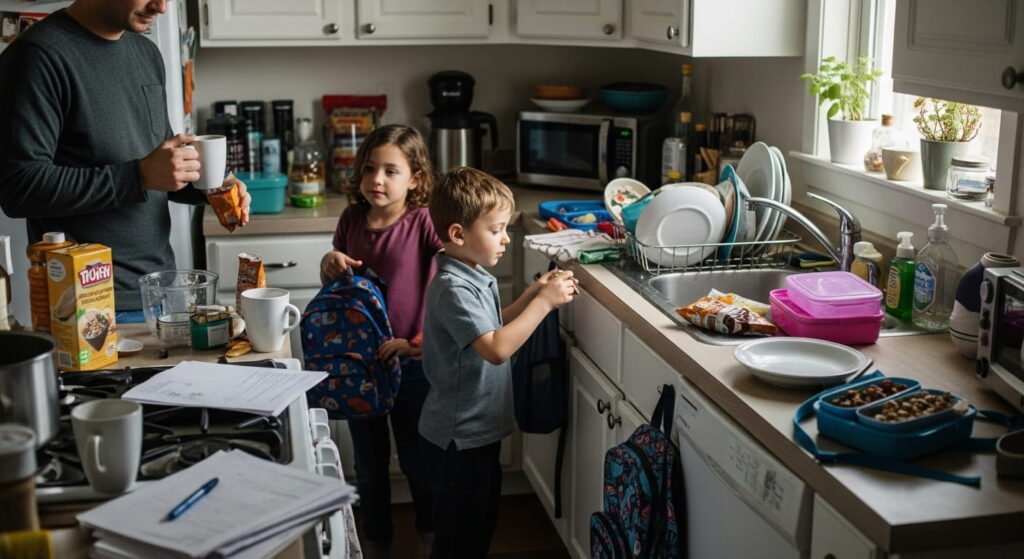
Your oldest needs her lunch packed. Your youngest is asking for the specific cereal that is somehow buried behind four other boxes even though you just bought it. The dog needs feeding. You’re trying to make coffee with one hand and locate the permission slip that was “definitely on the counter last night” with the other. A pot from last night’s dinner is still soaking in the sink. Someone left a juice box on the one square inch of counter space that wasn’t already occupied, and now there’s nowhere to set anything down while you do any of this. This is exactly why many families create kitchen organization centers to keep paperwork, meal essentials, snacks, and daily necessities organized and within easy reach.
By the time you leave the house, you feel like you’ve already run a marathon. And the kitchen looks like a natural disaster was declared somewhere between the toaster and the knife block.
Sound familiar?
The small or medium family kitchen is one of the most genuinely challenging spaces to keep functional in any home. It’s not just that it’s small. It’s that it is the most used room in your house by a significant margin. Breakfast. School lunches. After-school snacks. Dinner. Late-night snack runs. Coffee at 6 AM and tea at 10 PM. The kitchen never gets a rest day. It runs seven days a week, sixteen hours a day, with multiple family members using it simultaneously, each with different needs and zero consistent system for putting things back.
Last spring I worked with a family in Charlotte, two parents, three kids aged 8 to 14, a Labrador, and a kitchen roughly the size of a generous parking space. The mom, Renee, had organized the kitchen twice in three years. Both times it looked great for about two weeks. Then the post-school snack chaos reclaimed the counters, the cabinet with the mixing bowls became a liability, and the spice drawer was so chaotic she had stopped using it entirely and just kept the four spices she used daily in a mug next to the stove.
What Renee needed wasn’t a bigger kitchen. She needed a system built for real family cooking life, not for a kitchen that only gets used occasionally. That’s exactly what this guide is going to give you.
By the end of this article, you’ll have a complete kitchen organization framework, a room-specific decluttering system, a functional zoning plan, and a daily maintenance routine that takes eight minutes and actually holds up through the chaos of real family life. No major purchases required to get started. No renovation. Just a smart plan applied to the kitchen you already have.
Let’s transform this kitchen.
Why Small Kitchens Need a Completely Different Approach in 2026
Here’s what most kitchen organization advice gets wrong: it’s written for people who cook occasionally, eat simply, and use their kitchen as a single-function space. That is not a family kitchen in 2026.
A family kitchen in 2026 is:
- A cooking space for meals that serve three to five people with different preferences
- A snack station that gets raided three to six times a day by kids who are growing at an alarming rate
- A homework surface at 4 PM
- A coffee and breakfast bar at 6 AM
- A dog food station
- A charging station for at least two devices
- A paper management zone for school forms, grocery lists, and permission slips
- Sometimes a craft surface, sometimes a dinner party prep zone, sometimes both simultaneously
A system that doesn’t account for all of these functions will fail, because the kitchen will keep being used for all of them whether the system accounts for it or not.
The 2026 reality for most suburban families is also this: homes built between 1995 and 2015, which is when most of the families I work with live, were not designed with modern family food culture in mind. Kitchens from that era tend to have adequate cabinet space for a single person’s cooking habits and roughly zero counter space for a family that batch-cooks on Sundays, snacks constantly, and has a coffee station, an air fryer, and a stand mixer all competing for the same 18 inches of counter real estate.
The solution is not a bigger kitchen. The solution is a system that ruthlessly aligns what your kitchen holds with how your kitchen actually gets used, and then optimizes every inch of available space accordingly.
The Step-by-Step Kitchen Organization Framework
Before diving into individual areas, here’s the overarching process. Follow these steps in order and the whole system falls into place. Skip steps and you’ll be organizing the same chaos into different-looking chaos.
Step 1: Remove everything first. Every item out of every cabinet, every drawer, every corner of the counter. Yes, everything. You cannot accurately assess what you have or how to organize it when it’s all in its existing location. This step is non-negotiable.
Step 2: Ruthless declutter before you put anything back. Once it’s all out, you’ll see immediately how much you actually own. This is usually the moment families realize they have four potato peelers and a bread maker that hasn’t been used since 2019.
Step 3: Define your kitchen zones based on actual use. Every item goes back in the zone that reflects where you use it, not where it happened to land last time someone put away groceries.
Step 4: Optimize storage within each zone. Once the right things are in the right zones, use the storage solutions that make those zones most functional.
Step 5: Build and maintain a daily kitchen reset habit. The system holds long-term only with a consistent maintenance routine.
Declutter Your Kitchen Ruthlessly
The kitchen is one of the rooms where “just in case” thinking runs completely unchecked. Most family kitchens contain equipment and supplies for three or four different versions of the family’s life, only one of which they’re actually living right now.
The Kitchen-Specific Declutter Rules
The 90-Day Rule for gadgets: If you haven’t used a kitchen tool in the last 90 days, it doesn’t earn counter or cabinet space. The exception is genuine seasonal equipment like a turkey roaster or a holiday cookie set. Everything else is a candidate.
The duplicate audit: Pull out every utensil and count. How many spatulas? How many wooden spoons? How many whisks? Keep your two favorites in each category. Donate everything else. You will never miss the third spatula. You will immediately gain a functional drawer.
The appliance honesty check: Every countertop and cabinet appliance gets evaluated against one question: how often does this actually get used in our home? Weekly use earns a counter spot. Monthly use earns a cabinet spot. Less than monthly goes to a higher shelf or leaves the kitchen entirely.
The Specific Things to Let Go (Kitchen Edition)
| Category | What to Remove |
| Appliances | Anything unused for 90+ days, duplicate appliances, broken items |
| Cookware | Pots or pans with damaged nonstick coating, sizes you never cook with, duplicates |
| Food storage | Containers without matching lids (just go), cracked or stained containers, excess sizes |
| Utensils | Third and fourth of any type, melted spatulas, gadgets that only do one obscure thing |
| Dishes | Chipped or cracked items, excess quantity beyond family size plus four guests |
| Pantry | Expired items, ingredients for recipes you’ve made once and never will again, excess duplicates |
| Mugs | Be honest. How many mugs does your family need. Donate to 150% of your household size and stop |
The “Would I Buy This Again Today?” Test
This is the fastest kitchen declutter question I know. Pick up any item you’re unsure about and ask: if I didn’t already own this, would I buy it today knowing what I know about how our family cooks? If the honest answer is no, it goes. That question cuts through the sunk-cost reasoning that keeps kitchen drawers stuffed with things nobody uses.
Smart Zoning: Give Your Kitchen a Logical Floor Plan
Zoning is the single most functional upgrade you can make to a kitchen without spending a dollar. It means organizing your kitchen around how you actually move and work in it, rather than wherever things historically landed.
Most family kitchens can be organized into five zones:
| Zone | What Lives Here | Where It Should Be |
| Cooking Zone | Pots, pans, cooking utensils, oils, spices, oven mitts | Directly beside or above the stove |
| Prep Zone | Cutting boards, knives, mixing bowls, measuring cups | Near the main counter and sink |
| Coffee & Breakfast Zone | Coffee maker, mugs, coffee supplies, cereal, daily breakfast items | Away from the main cooking zone, near the outlet |
| Kid Zone | Snack items, kids’ cups and plates, lunch supplies | Lower cabinets or shelves kids can access independently |
| Storage Zone | Pantry staples, baking supplies, bulk items, infrequently used appliances | Higher shelves and deeper cabinets |
Once you define these zones, every item has a neighborhood. Finding things while cooking becomes automatic because the spices are always where spices live, the mixing bowls are always where the mixing bowls live, and you stop spending four minutes searching for the garlic press every single time you make pasta.
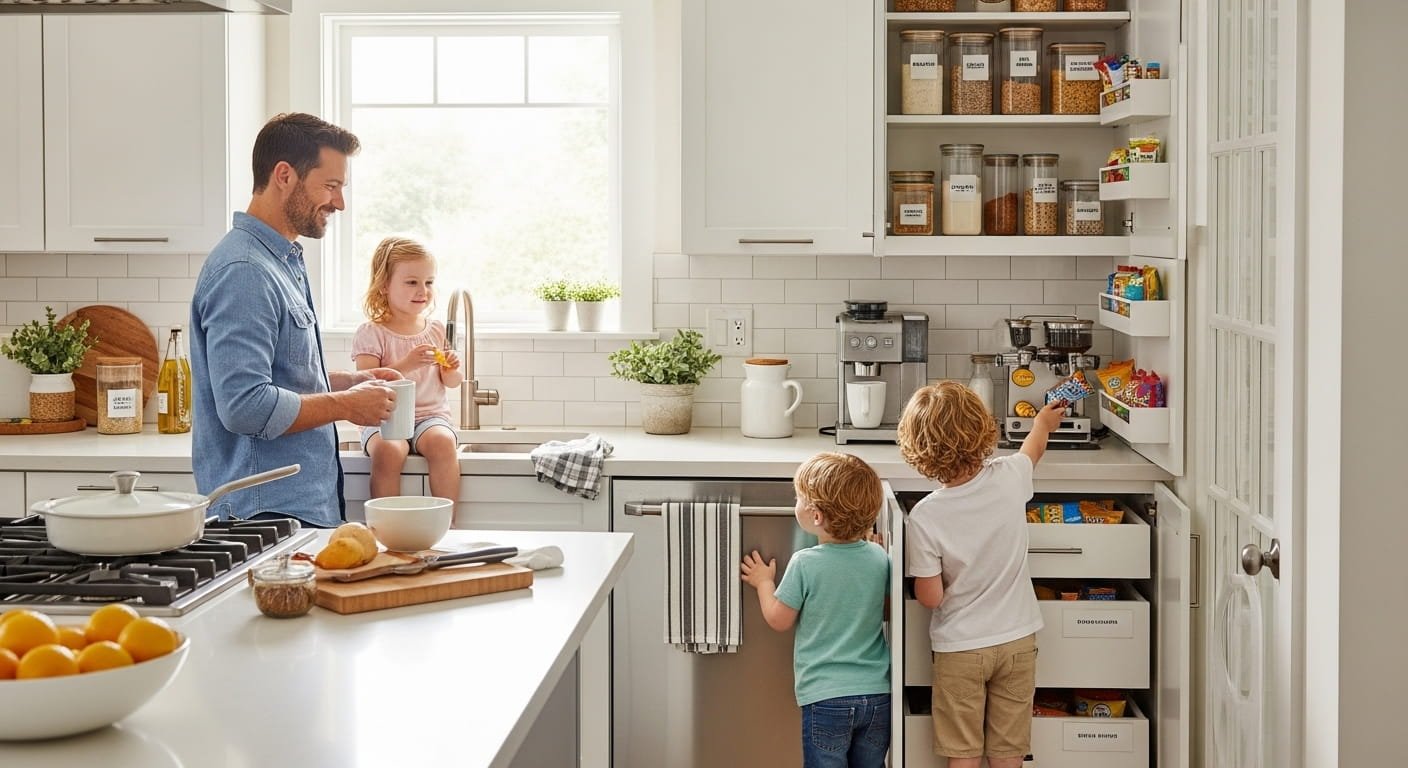
The Kid Zone deserves special attention in a family kitchen. When kids can access their own snacks and dishes independently, they stop asking you for things while you’re mid-cooking, and they stop creating counter chaos by pulling things from wherever they happen to find them. A low cabinet or a single bottom shelf designated as the kid zone, stocked with approved snacks and their own cups and plates, reduces kitchen chaos at a level most parents don’t anticipate until they experience it.
Countertop Organization Mastery: Reclaim Your Workspace
The counter is the most fought-over real estate in a small kitchen. And the number one rule of small kitchen counter management is blunter than most organization advice: almost nothing should live on your counter permanently.
I know. That feels impossible. But stay with me.
Every item currently living on your counter is paying rent with your workspace. Your counter’s job is to be a prep surface, a cooking surface, and a plating surface. Items that live on it permanently are reducing the amount of functional workspace you have for those jobs.
The Counter Audit: What Actually Earns a Spot
Earns a permanent counter spot: Items used every single day without exception. For most families that means the coffee maker, the toaster, and sometimes a knife block. That’s often it.
Earns a counter spot near an outlet: The air fryer, if used four or more times a week. The stand mixer, only if you bake multiple times weekly. Everything else gets stored and pulled out when needed.
Does not earn a counter spot: The blender used twice a month. The bread maker from 2019. The fruit bowl holding three dried-up limes and a stress ball. The pile of mail. The charging cables. The kids’ school papers. The dog leash. All of these are freeloaders. They are taking workspace and giving you chaos in return.
The Counter Organization Principles That Actually Work
Use trays to define zones. A tray on the counter creates a visual boundary. Everything inside the tray belongs there. Everything outside the tray is a visitor. This simple principle makes counter maintenance dramatically easier because putting things away means putting them inside the tray, and anything outside the tray is obviously out of place.
Group the coffee station and protect it. Your morning coffee routine should be a frictionless 90-second operation even at 6 AM when your eyes aren’t fully open. Everything for that routine, coffee maker, mugs (two or three, not fourteen), sugar, the specific spoon, lives together in one area. Nothing else lives in that area.
Vertical options for the counter. A small wall-mounted shelf just above the counter, a magnetic knife strip on the wall, or a tiered spice shelf on the counter itself can hold items that were previously flat on the counter surface while freeing up that surface for actual food prep. Going vertical on the counter’s backsplash area is one of the most effective small-counter moves available.
One-in-one-out on the counter, forever. Any new item that wants to live on the counter displaces an existing one. No exceptions. The counter is the most limited real estate in your kitchen and the most consequential to how the space functions and feels.
Cabinet and Drawer Optimization: Every Inch Working Harder
With the right items in the right zones and the counters cleared, let’s make the cabinets and drawers do significantly more work than they’re currently doing.
Lower Cabinets: Make Everything Visible and Accessible
The biggest problem in lower cabinets is that items get stacked and the ones in the back become permanent residents you forget you own. The fix is making everything visible.
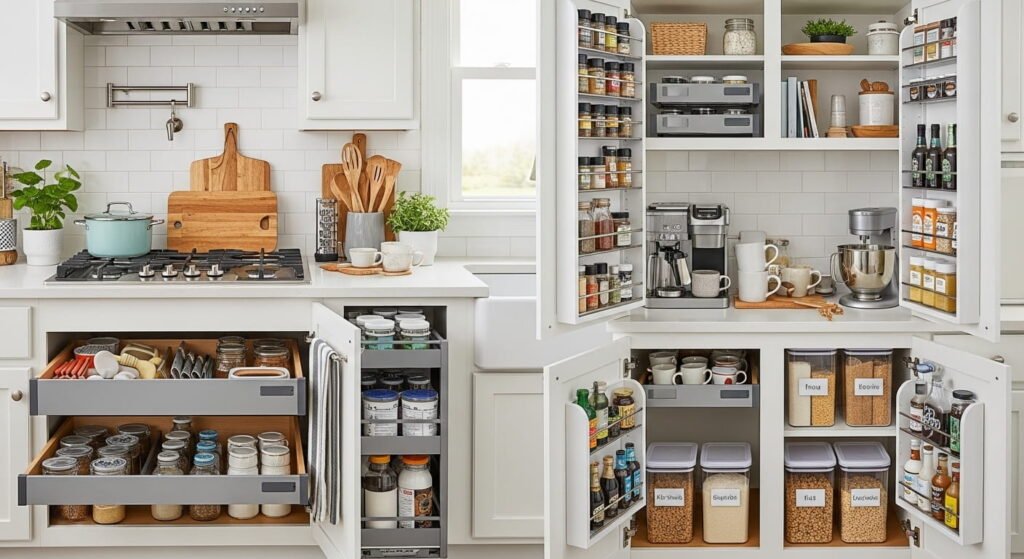
Pull-out shelf risers (available at any home store for around $15) elevate the back row in a cabinet so you can see everything. No more mystery items hiding behind the front row.
Pot lids organized vertically. A tension rod installed vertically inside a lower cabinet creates slots for pot lids to stand upright instead of getting stacked in a pile that avalanches every time you open the door. Game-changer, $4 fix.
Pan and sheet organization. Baking sheets, cutting boards, and sheet pans stored vertically in a slot organizer take dramatically less space than the same items stacked flat and are infinitely easier to access. Mount a file-folder style organizer inside a lower cabinet and you’ll never dig through a pile of sheet pans again.
Drawers: Stop the Silverware Avalanche
A kitchen drawer without dividers is just a mixed pile that grows. Drawer dividers cost between $8 and $20 depending on the style, or you can use small boxes and containers you already own.
The drawer zones that make a real difference:
- Utensil drawer: divide by category (stirring, flipping, cutting, measuring). No more mystery drawer
- Junk drawer (yes, keep one, just contain it): one section per category (batteries, rubber bands, takeout menus, mystery keys)
- Knife drawer alternative: a magnetic knife strip on the wall clears an entire drawer and puts your knives in better condition by keeping blades from banging against other items
Upper Cabinets: Use the Full Height
Most people use the first 12 to 14 inches of upper cabinet height and ignore everything above it. Small wire shelves or stackable shelf risers inside upper cabinets create a second level for mugs, plates, or small items. Suddenly your cabinet fits 60% more without buying a new cabinet.
Creative Storage Solutions for Tiny Kitchens
When the standard cabinet and drawer space simply isn’t enough, these creative storage moves find square footage you didn’t know you had.
The inside of cabinet doors. Adhesive hooks or over-the-door organizers on the inside of cabinet doors hold measuring cups, pot lids, spice packets, aluminum foil boxes, and cleaning supplies without using any shelf space whatsoever. A family in Raleigh I worked with added four over-the-door organizers to their pantry cabinet door and freed up an entire shelf for bulk items.
The magnetic wall. A section of wall beside the stove equipped with a magnetic knife strip, a magnetic spice rack, and a couple of magnetic hooks can hold knives, a dozen spices, and small tools like whisks and tongs, all within arm’s reach of the stove and all taking zero counter or cabinet space.
The rolling cart in the gap. That narrow gap beside the refrigerator or between the stove and counter? A slim rolling pantry cart, typically four to six inches wide, fits there and adds a full column of storage. Pull it out to access, push it back in when done. Many families report this one addition adding the equivalent of an entire cabinet’s worth of storage space.
Above the cabinets. If there’s a gap between your upper cabinet tops and the ceiling, matching baskets up there hold seasonal bakeware, serving platters, and items used less than monthly. It looks intentional, keeps those items accessible without taking prime cabinet space, and uses space that’s currently just collecting dust.
Under the sink, maximized. The under-sink cabinet is usually underorganized because the plumbing creates awkward space. A tension rod for spray bottles, small stackable bins around the pipes, and a tiered shelf riser that fits beside the drain pipe can transform this cabinet from “chaotic pile” to “organized cleaning station.”
Pantry and Refrigerator Organization: Where Food Actually Gets Found
A disorganized pantry costs money. When you can’t see what you have, you buy duplicates, you miss expiration dates, and you end up making dinner decisions based on what’s visible in the front rather than what you actually have.
Pantry Organization That Sticks
Group by meal category, not by food type. Instead of “canned goods” as a category, try “pasta night supplies,” “taco night supplies,” and “soup supplies” as your organizational groups. When you’re planning dinner on a Wednesday night, you look at what complete meal categories you have rather than searching through individual items. Families who switch to this method report spending significantly less time on meal planning and significantly less money on duplicate grocery purchases.
Decant basics into clear containers. Flour, sugar, rice, pasta, oats, and similar staples in clear containers with labels make quantity visible at a glance. You know when you’re running low before you run out. Clear containers also take less shelf space than the original bags and boxes they replace because they stack and arrange neatly.
The FIFO rule (First In, First Out). New groceries go to the back. Older items come to the front. This basic rotation prevents the situation where you find a can of beans expired in 2022 buried behind items purchased last month.
A snack bin that belongs to the kids. A dedicated, clearly labeled bin at an accessible height stocked with approved snacks that kids can reach independently eliminates roughly 60% of the mid-cooking “can I have a snack” interruptions. Kids know what’s available and can get it themselves. You know exactly what’s available because you stock it intentionally.
Refrigerator Organization
- Designate specific shelves for specific categories: leftovers on one shelf, dairy on one shelf, drinks on one shelf
- Use a clear lazy Susan on one shelf for condiments so nothing gets lost at the back
- A dedicated “use this week” bin brings items close to expiring to the front where they actually get used
- Keep the eye-level shelf for the items most frequently accessed during meal prep
The 8-Minute Daily Kitchen Reset Routine
This is the maintenance habit that makes everything above hold up. Eight minutes, every evening, and your kitchen wakes up functional every morning.
Minutes 1 to 2: Load the dishwasher or wash remaining dishes. Wipe the sink.
Minutes 3 to 4: Clear and wipe all counters. Every item returns to its zone. Nothing stays on the counter that doesn’t permanently live there.
Minutes 5 to 6: Wipe the stove surface. Return any items near the stove to their cooking zone homes.
Minute 7: Do a quick pantry and fridge check, anything left out that belongs inside, any open items that need to be sealed.
Minute 8: Sweep or do a quick vacuum of the kitchen floor. Empty the kitchen trash if full.
That’s it. Eight focused minutes. The kitchen that felt chaotic at 7 PM is functionally clean by 8 PM and ready for 6 AM.
This reset works exponentially better when it’s shared. If one person cooks, the other resets. Or everyone does their piece: kids return their dishes, one adult does the counter and stove, the other handles the dishwasher and floor. Built into the after-dinner routine, this habit feels less like extra work and more like the natural close of the cooking day.
Common Small Kitchen Organization Mistakes to Avoid
Organizing before decluttering. Still the most common mistake. A beautifully organized kitchen full of things you don’t use is still a chaotic kitchen in practice. Declutter first, every single time.
Buying matching containers before knowing what you need. Before purchasing any storage products, complete your declutter and your zoning. Then you know exactly what containers you need, what sizes, and how many. Buying first leads to beautiful containers that are the wrong size or the wrong quantity.
Not involving kids in the system design. Kids who don’t know where the snacks live will raid every cabinet until they find them. Kids who have their own clearly labeled zone with their own accessible items become self-sufficient snackers. The difference in daily kitchen chaos is not small.
Creating systems too complicated to maintain. If putting the garlic press away requires three steps, it will end up on the counter. Every system should pass the “tired adult at 9 PM” test: can it be maintained at minimum energy? If no, simplify it.
Ignoring the floor. Kitchen floors in family homes attract crumbs, pet hair, and random items at a startling rate. A quick daily sweep, literally 60 seconds with a broom or handheld vacuum, prevents the buildup that makes kitchens feel grimy regardless of how organized everything else is.
Conclusion
You don’t have to do all of this in one Saturday. In fact, please don’t try. Here’s a realistic session-by-session plan that breaks the whole transformation into focused, manageable chunks.
Session 1 (45 minutes): Full kitchen declutter. Everything out, honest decisions, boxes to the car for donation.
Session 2 (30 minutes): Define your five kitchen zones. No moving yet, just decide what goes where and why.
Session 3 (45 minutes): Organize the cabinets using your new zone system. Add any shelf risers, tension rods, and dividers you already own or inexpensive ones from the store.
Session 4 (30 minutes): Counter reset. Everything off. Only permanent items back. Trays in place.
Session 5 (30 minutes): Pantry and refrigerator organization. Categorize by meal type, decant basics, FIFO everything.
Session 6 (20 minutes): Drawer organization. Dividers in, categories assigned, junk drawer contained.
Final step: Do your first 8-minute evening reset. Start the habit tonight.
Once you’ve worked through all six sessions, you’ll have a kitchen that looks different, feels different, and works differently for your family. The morning rush will still exist, because kids and 7 AM will always exist, but you’ll be able to find the cereal, clear a counter space, and make the coffee without feeling like the kitchen is actively working against you.
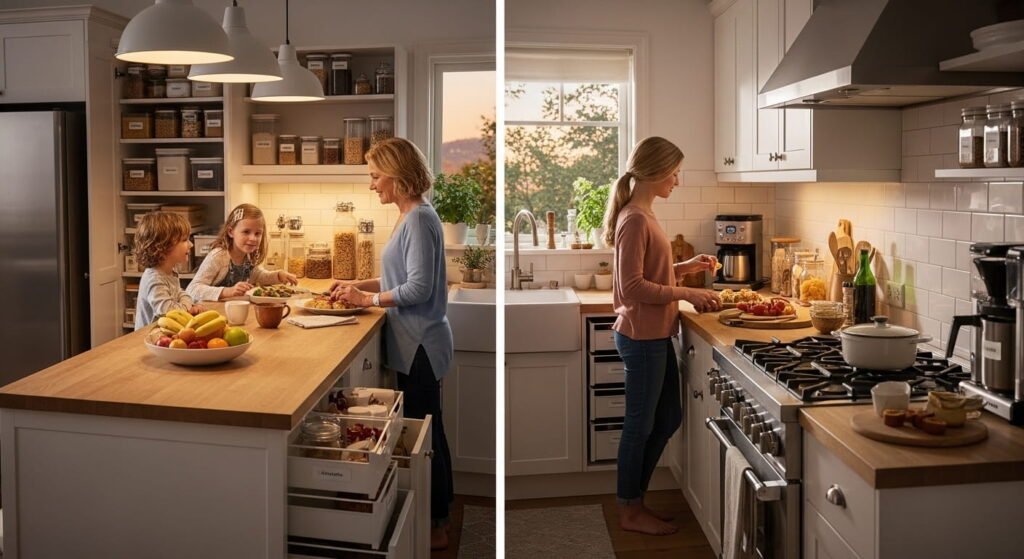
That’s not a small thing. In a home where the kitchen is the center of everything, a kitchen that works is a home that breathes.
For the foundational whole-home organization system that supports everything in this guide, start with the Organize Your Home Step by Step. And if your biggest challenge is having too much stuff in too little space across the whole house, Small Home Storage Ideas: Maximize Space Without Renovating gives you the complete toolkit.
Your kitchen is ready for its transformation. Pick your first free hour and start with the declutter. Everything else follows from there.
Also helpful: Kitchen storage without cabinets | Pantry Organization Ideas for Busy Families | How to Declutter Your Home Fast | 10 Home Organization Mistakes



Leave a Reply