

The Common Confusion
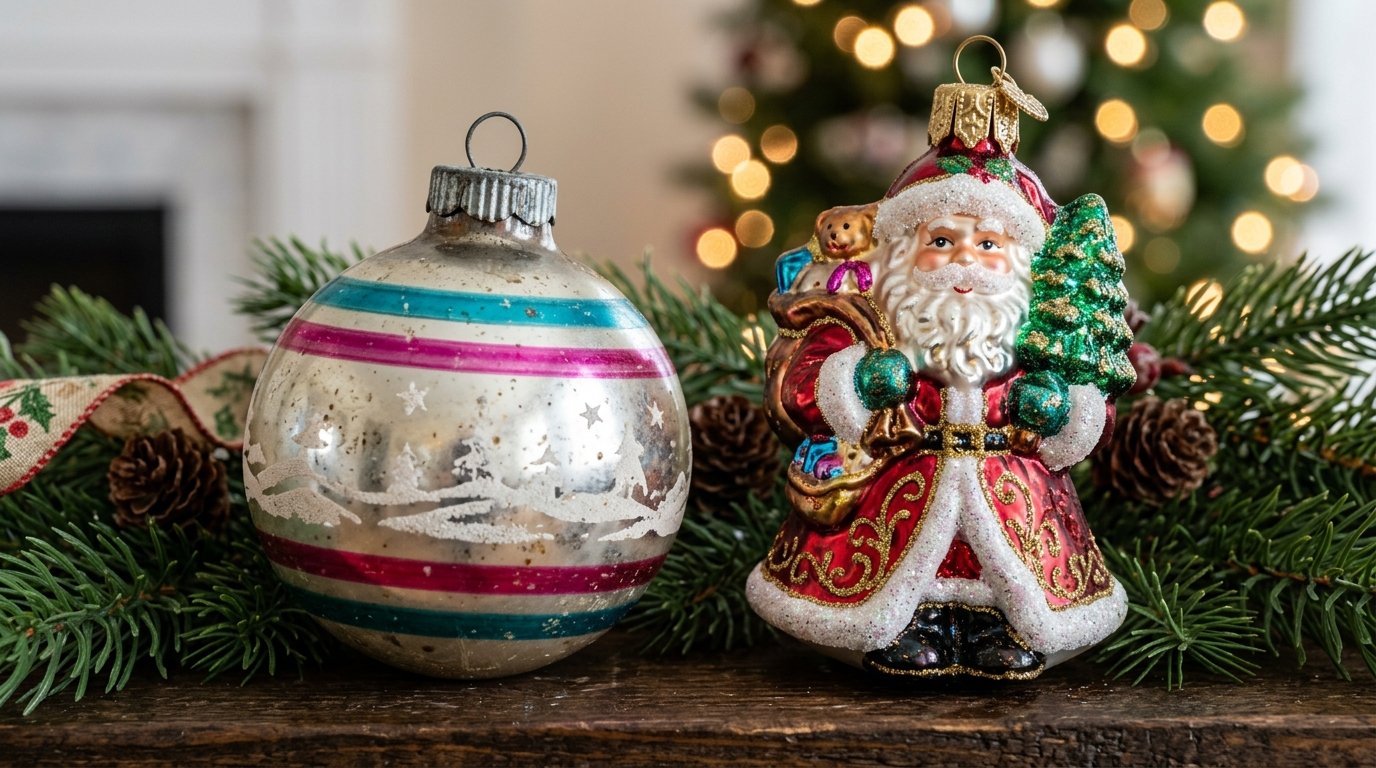
Browse an estate sale table of mid-century glass balls or scroll a holiday retail site, and you will see both “Shiny Brite” and “Christopher Radko” on boxes that look nothing alike. That is not a labeling error. The two names cover three genuinely different products, spanning nearly a century of Christmas history, and mixing them up can mean paying collector prices for a mass-market reproduction, or walking past a real piece of 1940s Americana because it looked too plain.
Quick answer:
- Original Shiny Brite: Mass-produced, mid-century American glass ornaments made between the late 1930s and early 1960s.
- Christopher Radko Signature: High-end, hand-blown and hand-painted European ornaments made since 1985.
- Radko’s Shiny Brite line: Modern, vintage-style reproductions of the classic mid-century designs, produced under the Radko brand since 2001.
This guide walks through where each line came from, how to tell them apart in hand, what they are actually worth, and how to display and store them so a 1940s original and a modern reproduction can share the same tree without either one getting damaged.
The Origin Stories: Two Very Different Eras
The History of Shiny Brite
Max Eckardt founded Shiny Brite in 1937. He had spent decades importing hand-blown glass ornaments from Germany, and with war on the horizon he saw his supply chain was about to break. Eckardt partnered with Corning Glass Works, which adapted the ribbon machine it used to make lightbulbs into a line that mass-produced clear glass ornaments. Those blanks were shipped to Eckardt’s New Jersey factories for hand silvering and decoration.
Source: Wikipedia, “Shiny Brite”
By 1940, Corning was producing roughly 300,000 unadorned ornaments a day, and Shiny Brite’s all-American manufacturing became a selling point during World War II, when German imports had stopped entirely.
Source: Antique Trader
The brand peaked through the 1940s and 1950s. Eckardt died in 1961, and Shiny Brite’s popularity faded soon after as plastic ornaments took over the market.
Source: Kovels
The Rise of Christopher Radko
Christopher Radko’s company traces back to a household accident in the early 1980s, when his family’s towering Christmas tree toppled over and smashed more than a thousand antique European ornaments. Unable to find replacements that matched the quality of what was lost, Radko traveled to Poland, his family’s homeland, and found a glassblower willing to recreate them under his direction.
Source: Columbia College Today
By 1985, sixty original designs had debuted and a real business was underway, built on hand-blown, hand-painted glass made by artisans using techniques dating back centuries.
Source: Collectors Weekly
The Late-1990s Acquisition and 2001 Relaunch
The Shiny Brite trademark did not pass directly from Eckardt’s company to Radko. Poloron bought the name in the 1970s, and production carried on in a diminished form into the 1980s. Radko acquired the rights to the Shiny Brite name in the late 1990s, then spent a few years developing the line before launching reproductions of the classic mid-century designs in 2001. That is the line now sold as “Shiny Brite by Christopher Radko”: modern manufacturing, vintage-inspired designs, and no direct link to Eckardt’s original factories.
Source: The Spokesman-Review
Key Differences: Side-by-Side Comparison
| Feature | Vintage Shiny Brite | Christopher Radko Signature | Modern Radko “Shiny Brite” |
| Era | 1937 – early 1960s | 1985 – present | 2001 – present |
| Style | Mid-century pastels, stripes, reflector interiors | Intricate 3D figural designs, ornate detail | Retro mid-century reproductions |
| Craftsmanship | Machine-blown American glass, hand-decorated | Hand-blown and hand-painted European glass | Modern, mass-produced reproduction |
| Cap markings | Metal or cardboard cap stamped “Shiny Brite USA” | Star crown cap with gold Radko charm | Stamped modern “Shiny Brite” cap |
| Price point (approximate, varies by condition and rarity) | 5-30 per piece | 50-150+ each | 30-60 for boxed sets |
Prices above are rough, current-market ranges, not fixed values. Condition, rarity, and which platform you are buying from all move the number, so check recent completed listings before you buy or sell.
How to Spot True Vintage Shiny Brite vs. Modern Radko Reproductions
Inspect the Caps and Hardware
- WWII era (early-to-mid 1940s): Metal was rationed, so caps are cardboard or paper, often tied on with string rather than a metal hook.
- Mid-century original (1940s-early 1960s): A metal cap stamped “Shiny Brite Made in U.S.A.”
- Modern Radko Shiny Brite (2001-present): A newer, shinier metal cap, usually sold in a reproduction vintage-style box with other modern pieces.
Glass Condition and Aging
Original Shiny Brite glass often shows unsilvered patches, a soft natural patina, and minor paint flaking from eighty-plus years of handling and storage. A piece that looks flawless and uniformly glossy, with crisp, unworn paint, is almost certainly a modern reproduction rather than a true vintage survivor.
Packaging Cues
Original Shiny Brite boxes carry distinctive green-and-red period box art with no Radko branding anywhere on them. Modern Shiny Brite reproductions ship in Christopher Radko-branded boxes designed to evoke that retro look, but the Radko name and logo are printed on the packaging itself.
Collecting and Value Guide
Which Is More Valuable?
It depends on what you are chasing. Rare, retired Christopher Radko Signature pieces, especially early designs or limited editions, hold strong collector value because production runs are small and Radko retires roughly a third of its designs every year. Pristine vintage Shiny Brite boxes, particularly WWII-era unsilvered pieces with their original cardboard caps, are just as sought after by mid-century and retro-design collectors, precisely because so few survived in good condition. Neither category is categorically “worth more” than the other; rarity and condition drive price far more than brand name does.
Where to Buy Each Type
- Vintage Shiny Brite: Antique shops, eBay, Etsy, and estate sales are the most reliable sources. Always ask for close-up photos of the cap markings before buying online.
- Modern Radko and Shiny Brite reproductions: Department stores such as Macy’s and Bloomingdale’s, and official Christopher Radko stockists, carry current and recent-season lines.
Care, Storage, and Styling Tips for Your Tree
Styling Ideas
Mid-century Shiny Brites and high-end Radko pieces pair well because their scale and finish contrast rather than clash. Use the simpler vintage balls and stripes as a textured base layer throughout the tree, then reserve the ornate Radko figurals for eye-level focal points, where their detail actually reads. The mix reads as curated rather than mismatched, and it gives a tree both nostalgic depth and a showpiece quality.
Storage Warnings
- Keep ornaments in a climate-controlled space. Attics and garages swing too far in temperature and humidity for thin, decades-old glass.
- Avoid moisture entirely; trapped humidity accelerates silvering loss and paint flaking on vintage pieces.
- Wrap each ornament individually in acid-free archival tissue rather than newspaper, which can transfer ink and acid onto the glass over time.
- Store upright in compartmentalized boxes so ornaments never rest directly against each other.
Frequently Asked Questions
Does Christopher Radko own Shiny Brite?
The companies behind both names are now the same. Christopher Radko’s company was sold to Rauch Industries in 2005, and Rauch now holds both the Christopher Radko and Shiny Brite trademarks.
Source: Justia Trademarks
Christopher Radko the designer left the business in 2007 under a ten-year noncompete agreement, which expired in 2021; he has since started a separate ornament line called HeARTfully Yours.
Source: QVoice News
So “Christopher Radko” ornaments sold today come from the company, not personally from the man whose name is on the box.
Are all Shiny Brite ornaments made in the USA?
Only the originals. Vintage Shiny Brite ornaments made from 1937 through the early 1960s were manufactured at Corning’s plant in Pennsylvania and decorated at Eckardt’s New Jersey factories. The modern “Shiny Brite by Christopher Radko” reproductions are not made in the USA.
How do I know if my Radko ornament is authentic?
Check for the star crown cap and the gold Radko charm, both standard on genuine Christopher Radko Signature pieces. Authentic ornaments also carry a printed or embossed Radko mark, usually near the cap, and come in branded packaging rather than a generic box.
Why are original Shiny Brite ornaments so popular again?
Mid-century modern design has been back in fashion for over a decade, and Shiny Brite’s pastel stripes and simple glass forms fit that aesthetic directly. For many collectors, the appeal is also personal nostalgia: these were the ornaments on American trees for two full generations, and finding a box of them at an estate sale connects directly to that family history.
Conclusion
Whether you are drawn to the mid-century history of an original Shiny Brite or the luxury European craftsmanship of a Christopher Radko Signature piece, both bring a different kind of timeless charm to a holiday tree, one rooted in American wartime ingenuity, the other in hand-blown artistry. Knowing which era and which company you are actually buying from means you pay the right price for either one.
Ready to start or grow a collection? Head back to the Where to Buy Each Type section above for trusted sources, vintage and modern alike.




Leave a Reply