

Introduction
You’ve done this before. You spent a whole Saturday pulling everything out of the closet, bought a set of those nice matching bins from Target, felt genuinely excited for about four days, and then slowly watched the chaos creep back in like it never left.
Maybe it was the laundry pile that broke you first. Or the kitchen counter that somehow grows dishes, school permission slips, dog leashes, and half-eaten granola bars by 7 AM. Or the kids’ rooms that look like a Walmart toy aisle exploded.
You’re not failing at life. You’re just a busy family living in a real house.
I’ve worked with hundreds of families who were exactly where you are right now. Overwhelmed. Guilty. Convinced that organized people have some secret gene they weren’t born with. And I want to tell you straight: that’s not true.
The real reason most home organization attempts fall apart is not laziness, lack of time, or the wrong storage bins. It’s that most advice out there was written for people without kids, without full-time jobs, and without a dog who treats every clean basket as a personal challenge.
This guide is different. It was written for the Mark and Sarah Thompsons of the world. Parents in their mid-to-late thirties, grinding through full-time jobs, raising two or three kids between elementary and high school, and staring at a 3-bedroom suburban home that somehow accumulates more stuff every single week.
Here’s the honest promise I can make you: you will not transform your home in a weekend. Anyone who says otherwise is selling you something. But you absolutely can build a system that works, room by room, week by week, without burning out or spending a fortune. Families who have been drowning in clutter for years have done exactly that. You can too.
Let’s get into it.
Step 1: The Mindset Shift That Changes Everything
Before you touch a single item, you need to do a small but powerful reset in how you think about organizing.

Stop Trying to Organize Your Clutter
Here’s the thing that most people get backwards: organizing does not mean finding a better place for all your stuff. It means deciding which stuff actually deserves a place in your home at all.
Buying more bins and baskets before you declutter is like rearranging furniture in a burning house. It feels productive, but you’re just moving the problem around.
The real goal is this: Less stuff. A home for everything that stays. A simple system the whole family can follow.
Accept That It Will Look Worse Before It Gets Better
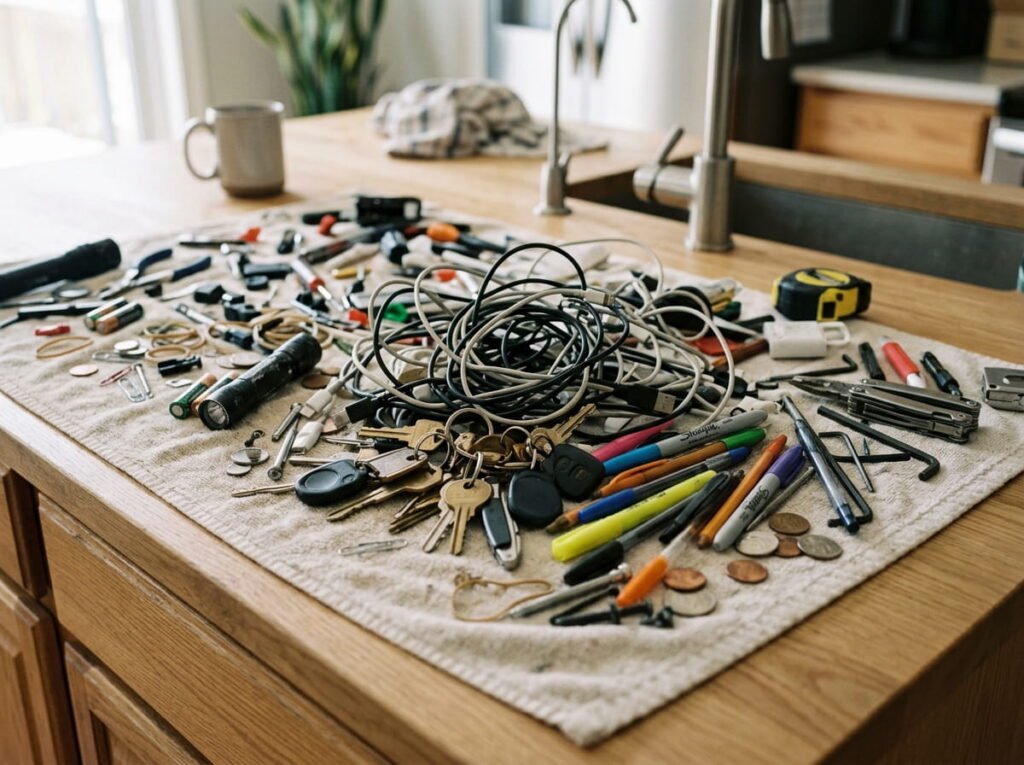
Every organized home went through a “war zone” phase. When you pull everything out of a junk drawer or a hall closet, your kitchen table turns into a disaster scene. That’s normal. That’s the process. The mess you make during a declutter session is not evidence that you’re making things worse. It’s the necessary step before things get better.
Give Yourself Permission to Go Slow
You don’t have to tackle the whole house in one session. In fact, I’d strongly recommend you don’t. Trying to do everything at once is one of the top reasons people quit. We’ll talk about a room-by-room priority plan in Step 6 that makes this feel manageable.
The Mental Load Is Real
If you’re the person in your household carrying most of the mental weight of managing the home, the clutter is not just physical. It’s exhausting in a way that’s hard to explain to someone who hasn’t felt it. Every surface covered in items you still haven’t dealt with is a small tax on your mental energy every time you look at it. Getting organized isn’t about aesthetics. It’s about giving yourself some of that mental space back.
Step 2: Ruthless Decluttering (The Rules That Actually Work)
Decluttering sounds simple until you’re standing in front of your grandmother’s bread maker that you haven’t used in six years but absolutely cannot get rid of. Let’s talk about the rules that help you make real decisions.
The 20/20 Rule
If you can replace an item in less than 20 minutes for less than $20, you don’t need to keep it “just in case.” This rule is a lifesaver for the “but what if I need it someday” mindset that fills closets with things you’ve forgotten you own.
The 12-12-12 Rule
On a tough decluttering day, just find:
- 12 items to throw away
- 12 items to donate
- 12 items to be returned to their proper place in the house
That’s it. 36 decisions. Most people can do this in 20 minutes, and it creates visible progress without the overwhelm of a full room overhaul.
The 4 C’s of Decluttering
Ask yourself these four questions about any item you’re unsure about:
| Question | What It Means |
| Current | Do I use this now, in my current life? |
| Condition | Is it in good enough condition to actually use? |
| Claim | Would someone else actually want this? |
| Count | Do I have too many of this same item? |
If the answer is “no” to more than two of those, it goes.
The Hardest Categories (And How to Handle Them)
Sentimental Items
This is where most people get stuck for hours. A helpful approach is to designate a single “memory box” per family member, no larger than a shoebox or small bin. Anything sentimental goes in there. Once it’s full, you have to choose what comes out before something new goes in. You don’t have to throw away memories. You just have to put limits on how much space they take up.
Kids’ Stuff
Kids grow fast. Clothes and toys that don’t fit their current age or interest level are just taking up space that could go to things they actually love. Get your kids involved in the process for older ones (ages 8 and up). Let them make choices about their toys. Most kids are surprisingly willing to let go of things they’ve outgrown if you give them ownership of the decision.
“Just in Case” Items
Apply the 20/20 rule here every single time. If it’s cheap and easy to replace, let it go. Holding onto low-value items “just in case” is one of the biggest clutter culprits in most homes.
Step 3: Sort and Categorize Everything
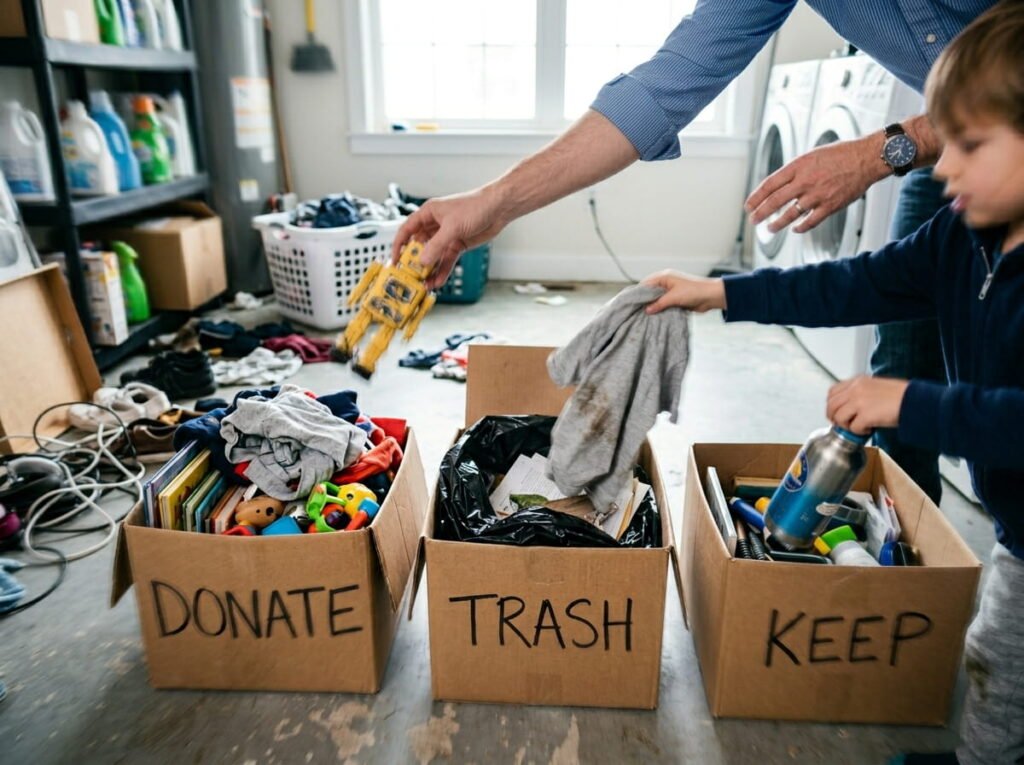
Once you decide what stays, it’s time to sort it. Use four clear categories for every single item in a space.
Keep: It belongs in this home and gets used regularly.
Donate: It’s in good condition, and someone else could genuinely use it.
Trash: It’s broken, expired, stained, or truly worn out.
Relocate: It belongs in your home, but not in this room. Put it in a “relocate” bin during your session and move everything to the correct room after.
Use physical bins or bags for each category so the sorting is tactile and clear. Trying to keep it all mental leads to decision fatigue fast.
Step 4: Assign Every Item a Permanent Home
This is the step that separates one-time “clean-outs” from actual organization systems. Every single item that stays in your home needs to have one specific, permanent place.
Not “somewhere in the kitchen.” Not “on a shelf in the office.” An exact home.
The Zoning Method
Think of your home in zones based on how items are actually used. Things should live closest to where you use them. Here’s a simple family home zoning map:
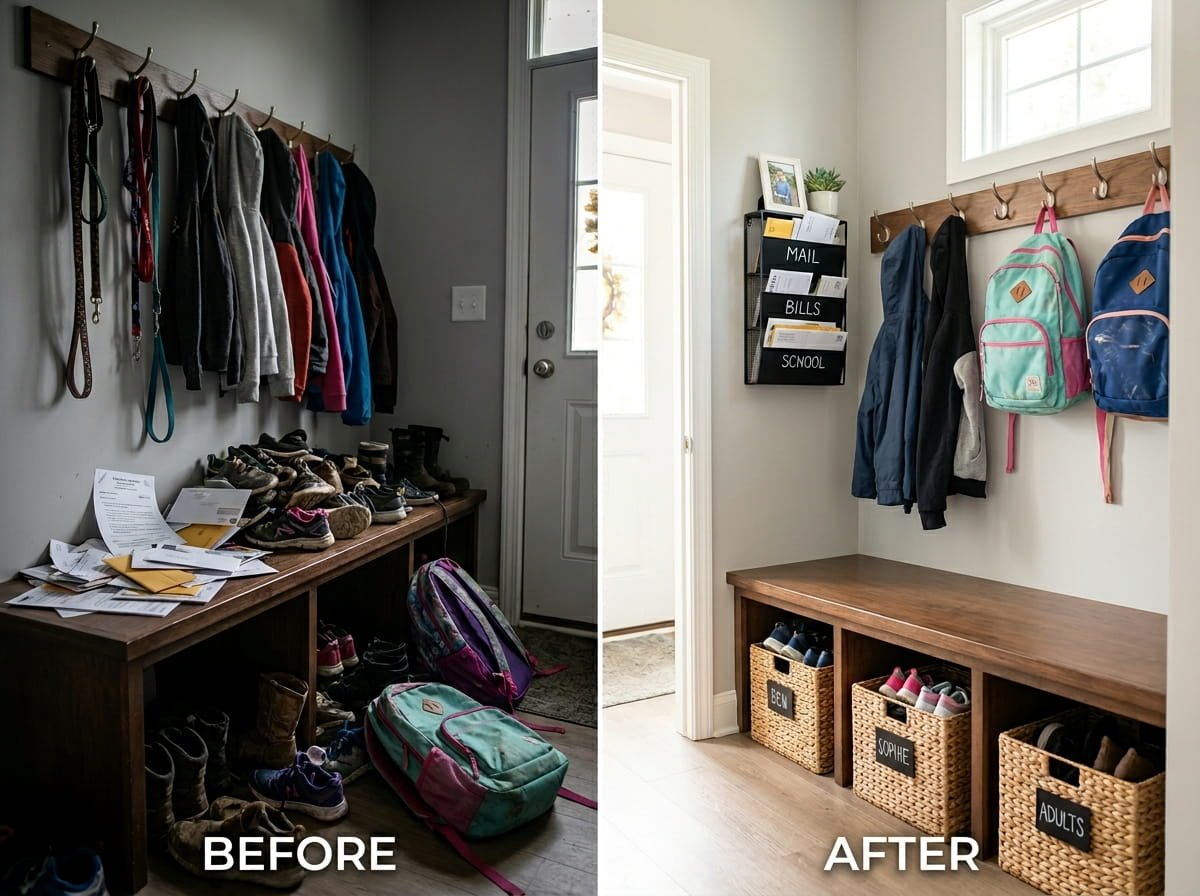
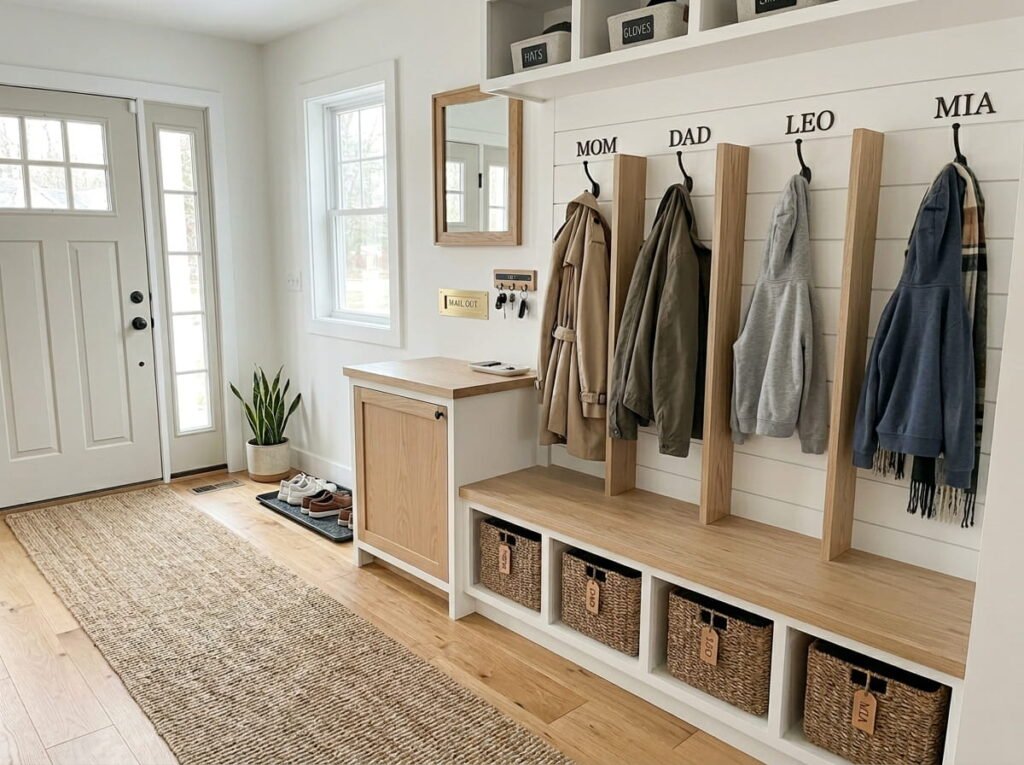
Entry Zone: Keys, bags, shoes, dog leashes, permission slips, outgoing mail. Everything that needs to leave the house lives here.
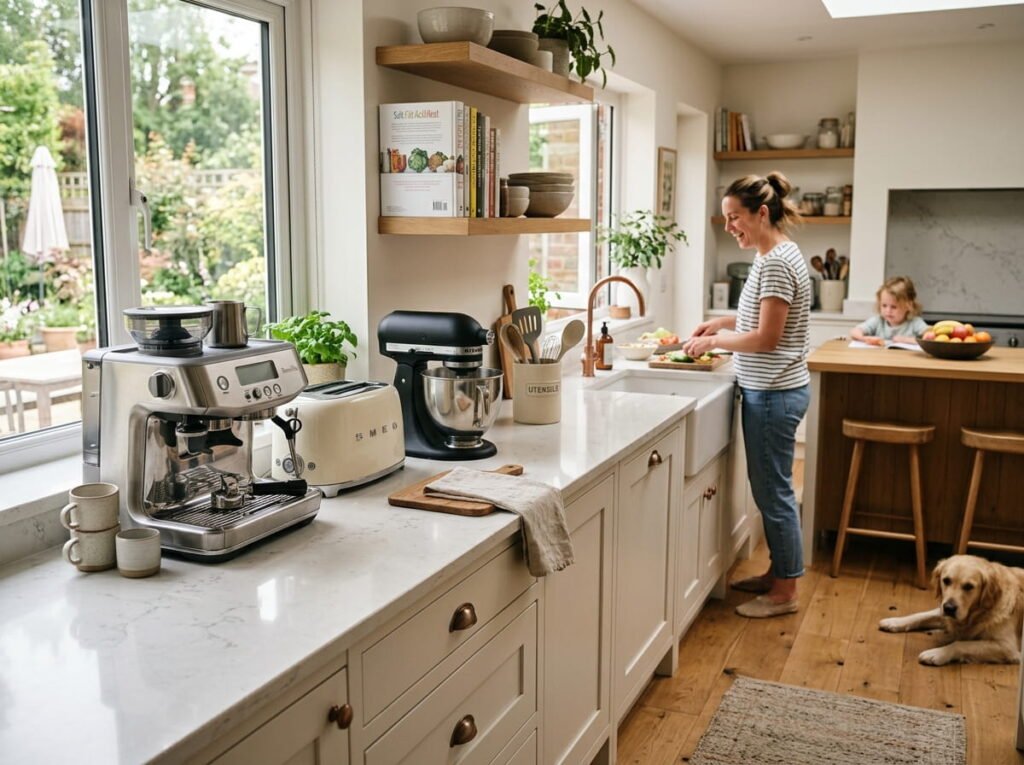
Kitchen Zone: Keep counters clear of anything that doesn’t get used daily. Appliances you use less than once a week belong in a cabinet, not on the counter.
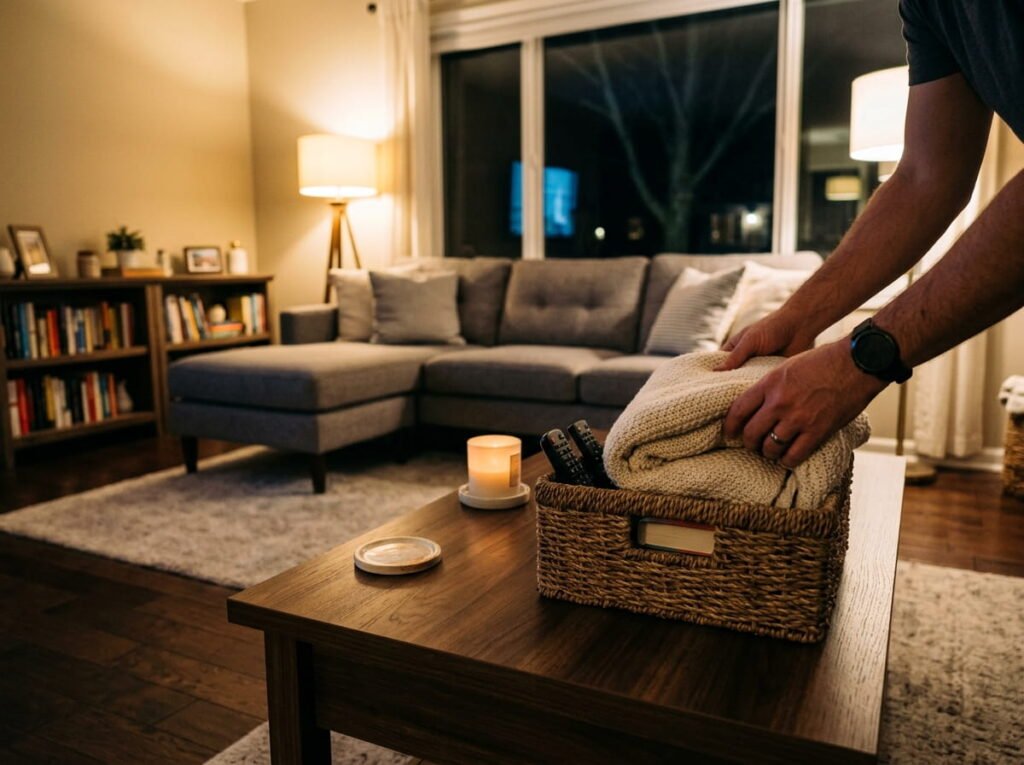
Living Room Zone: Designate one basket per person for frequently used personal items (remote, phone charger, book). One shared basket for throw blankets. That’s it.
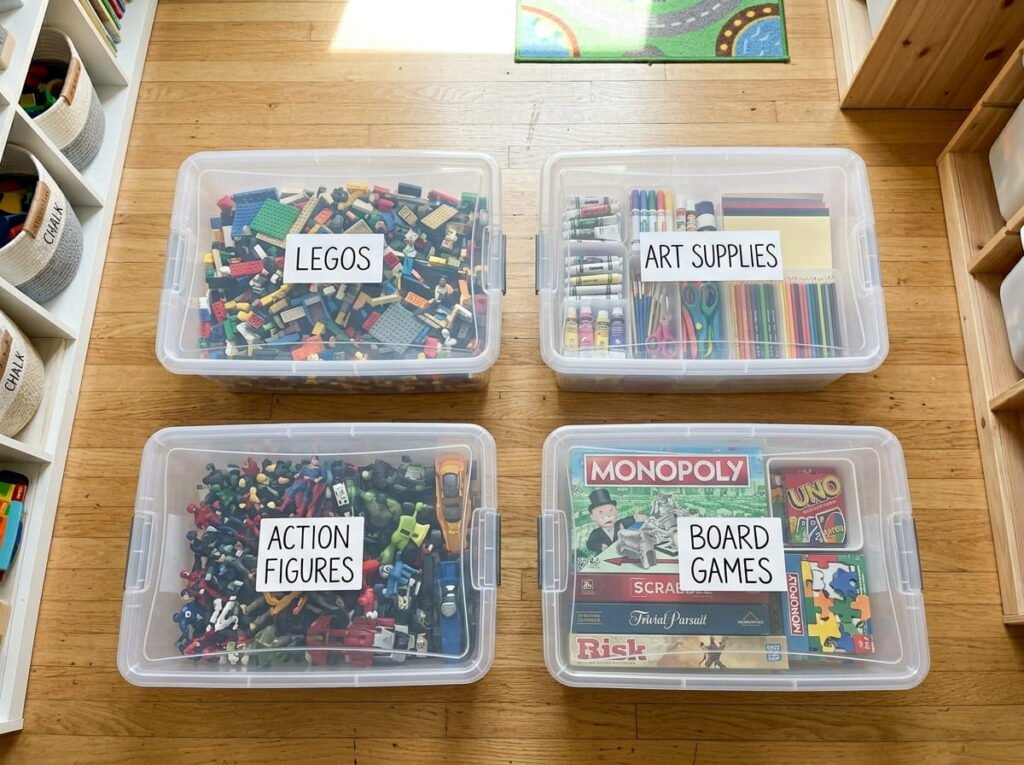
Kids’ Room Zone: Toys in labeled bins by category. Books on shelves. Clothes only in dresser and closet. The floor is not a storage zone.
Laundry Zone: Dirty clothes only go in hampers. Clean clothes get put away same day. The floor and the top of the dryer are not permanent storage locations.
Step 5: Smart Storage Solutions (No-Buy to Budget)
You do not need to spend a lot of money to get organized. Most families already own more than enough containers, baskets, and bins. Here’s how to think about storage in order of cost.
No-Buy Solutions First
Before you buy anything, look at what you already own:
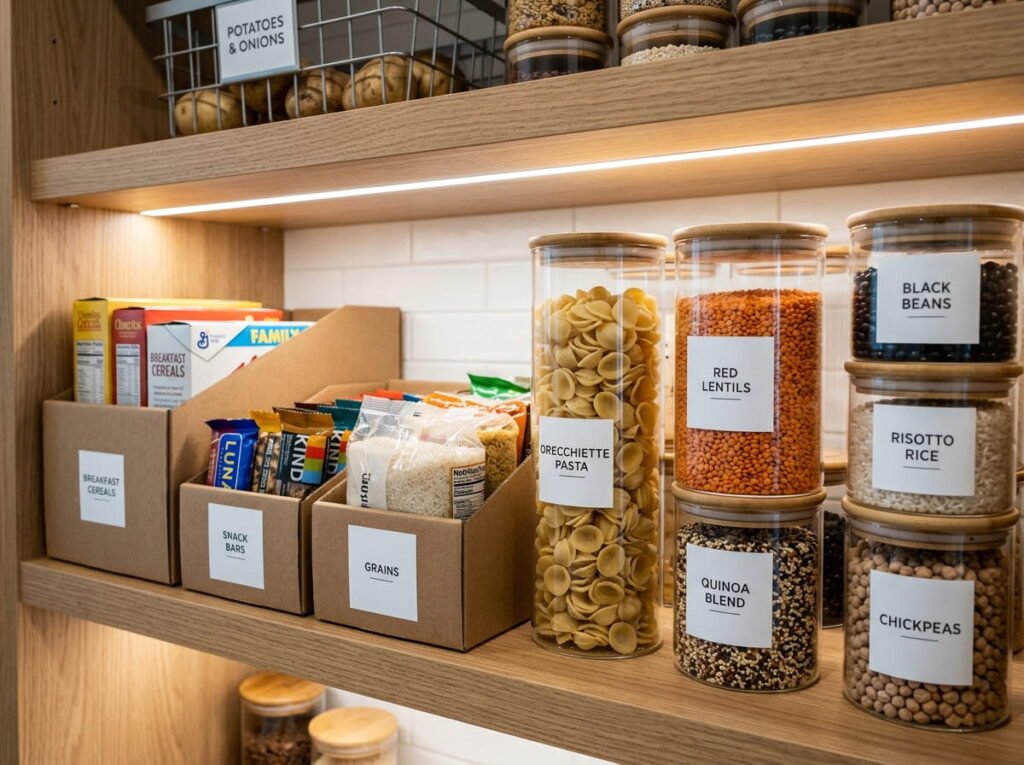
- Repurpose shoeboxes and cardboard boxes as drawer dividers
- Use mason jars for small items in drawers and on shelves
- Fold and stack towels and sheets vertically (the KonMari fold) to double your linen closet space
- Use a tension rod under the sink to hang spray bottles
Budget Solutions (Under $30)
- Over-the-door organizers for bathrooms and kids’ rooms
- Drawer dividers for kitchen utensils and junk drawers
- Clear stackable bins for pantry shelves (labels make a huge difference)
- A simple command hook system in the entryway for bags and backpacks
When to Invest More
Only invest in better storage solutions after you’ve decluttered and know exactly what you’re storing. Buying beautiful matching bins before you know how many you need or what sizes you need is how people end up with a garage full of unused containers.
If you want storage that looks high-end without spending a fortune, check out these IKEA hacks that look like House Beautiful. They turn affordable pieces into custom-looking storage.
Step 6: Room-by-Room Action Plan (Priority Order)
Start small. Win fast. Build momentum. Here’s the order I recommend for most families.
Priority 1: The Entryway (1-2 Hours)
This is the first thing you see when you come home and the last thing you interact with before you leave. A chaotic entryway sets the tone for the whole house.
Quick wins:
- Hooks for every family member’s bag and coat
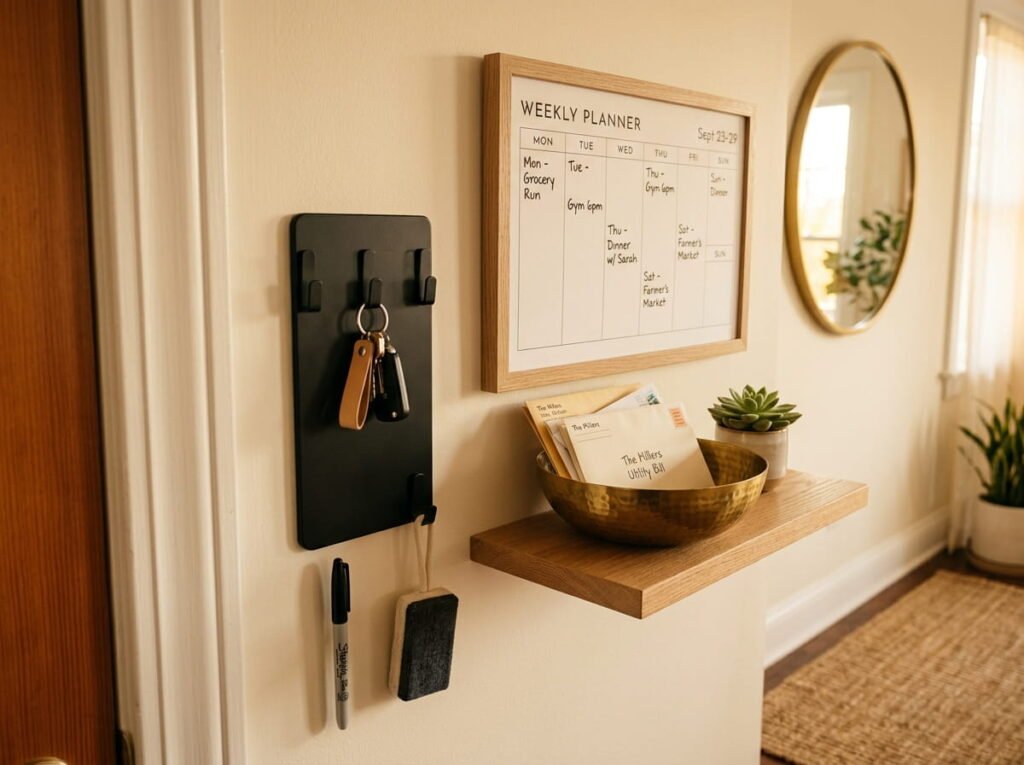
- One designated spot for keys (hooks, a bowl, or a small shelf)
- A bin or basket for shoes with a one-pair-per-person limit outside the bin
- A small organizer or clipboard for permission slips and mail
Priority 2: The Kitchen (Half a Day)
The kitchen is the heart of the home and usually the epicenter of the chaos.
Focus areas:
- Countertops: clear everything that isn’t used daily
- Junk drawer: use the 12-12-12 rule, then add dividers
- Pantry: group by category, label shelves, check expiration dates
- Under the sink: purge, then add a tension rod and small bins
Priority 3: The Main Living Area (2-3 Hours)
Your goal here is visual calm.
Steps:
- Clear all surfaces completely
- Designate homes for frequently used items only
- Add a basket or small bin per person for their personal things
- Remove anything that doesn’t belong in this room
Priority 4: Kids’ Rooms (One Room at a Time)
Do this WITH your kids on a weekend morning. Make it a game, not a chore.
Steps:
- Sort toys by category into labeled bins
- Go through clothes seasonally (donate anything that doesn’t fit)
- Add a simple hook-level system so kids can hang their own things
- Set a “one in, one out” rule for new toys going forward
Priority 5: The Primary Bedroom (2 Hours)
This room is often the last one families get to, but it matters enormously for your mental rest.
Focus:
- Clear nightstands down to only what you use nightly
- Tackle the closet: donate anything not worn in the last 12 months
- Under the bed should be intentional storage (labeled bins) or empty
Priority 6: Garage, Basement, and Attic (Weekend Project)
Save these for last. They’re the hardest and most time-consuming, and you’ll be more confident and decisive after completing the rest of the house first.
Step 7: Daily and Weekly Maintenance System
Getting organized is the hard part. Staying organized just takes a consistent, simple routine. Here’s what works for real families.
The Daily Reset (10-15 Minutes)
Every evening before bed, do a quick 10-15 minute reset as a family.
- All dishes in the dishwasher or washed
- Counters wiped
- Shoes and bags in their designated spots
- Kid toys returned to their rooms (not necessarily organized, just off the main floor)
- Throw blankets folded, remotes in their spot
Make it part of the routine, like brushing teeth. Everyone in the family participates based on age.
The Weekly Reset (30-45 Minutes)
Pick one day a week (many families choose Sunday) for a slightly deeper reset.
- Go through the entry zone and clear any paper clutter
- Wipe down all surfaces
- Do a quick closet and drawer check in high-traffic areas
- Restock any household supplies running low
- Do a 5-minute “relocate” walk through each room, returning items to their permanent homes
The One-In-One-Out Rule (Forever)
This is the single most important maintenance rule. For every new item that enters your home, one item leaves. New shoes? Old shoes go. New toy? Child picks one to donate. New kitchen gadget? One appliance goes to Goodwill.
This rule, practiced consistently, means your home can never go back to where it was.
Step 8: Top Mistakes to Avoid
Even with the best plan, there are a handful of mistakes that derail even the most motivated families. Knowing them in advance is half the battle.
I’ve written a full deep-dive on this topic (10 Home Organization Mistakes), but here’s the quick version:
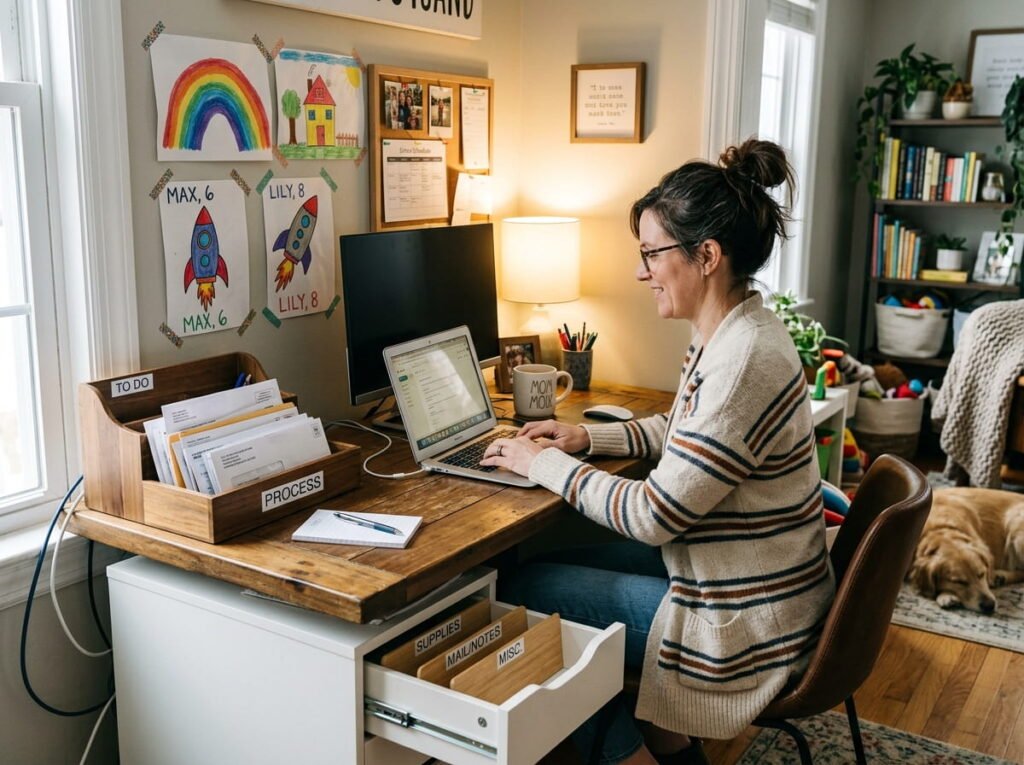
Buying bins before decluttering. You end up with beautiful containers full of things you don’t need.
Trying to do too much at once. You exhaust yourself, leave projects half-finished, and feel worse than when you started.
Setting up systems the rest of the family doesn’t understand. If your kids and partner can’t maintain it, it won’t last.
Ignoring sentimental items. They become the emotional anchor that drags the whole session to a halt. Schedule them separately.
Aiming for Pinterest-perfect. Real family homes need functional systems, not photo shoots. Function always wins.
Real Stories: Families Who Failed, Then Finally Succeeded
The Johnson Family, Raleigh NC: They tried organizing three times in two years. Each time they bought more bins and reorganized the same clutter. The turning point came when they committed to one hour of decluttering every Saturday morning for six weeks before they touched a single storage product. By the time they went shopping, they needed less than half of what they thought they would.
Reddit user shared: “We had tried the whole-house-in-a-weekend approach twice. Both times ended in a fight and a mess we didn’t finish. This time we did just the entryway one Saturday. It took two hours. And we just kept going room by room over two months. Our house actually stays clean now and I don’t think I’ve yelled about the shoes by the door once this month.”
Conclusion: Your 15-Day Challenge Starts Today
You don’t need to do all of this at once. Here’s a simple 15-day challenge to get you started:
Days 1 to 3: Mindset, decluttering rules, gather your supplies (bins, bags, labels)
Days 4 to 6: Tackle the entryway completely
Days 7 to 9: Kitchen counters and junk drawer
Days 10 to 12: Living room surfaces and main areas
Days 13 to 15: Laundry room and one kids’ room
That’s it. Fifteen days, small focused sessions, real visible progress.
Print out a simple checklist, stick it to your fridge, and check things off as you go. The act of physically checking something off is more motivating than most people realize.
You’ve tried before and it didn’t stick. That doesn’t mean you can’t do this. It means the system you were using wasn’t built for your real life. This one is.
Start with the entryway. Just the entryway. And come back to this guide for the next step when you’re ready.
You’ve got this.
Ready to go deeper? Check out our related guides: how to organize a small bedroom| How to declutter your home fast | Small home storage ideas | Weekly home reset routine




Leave a Reply