

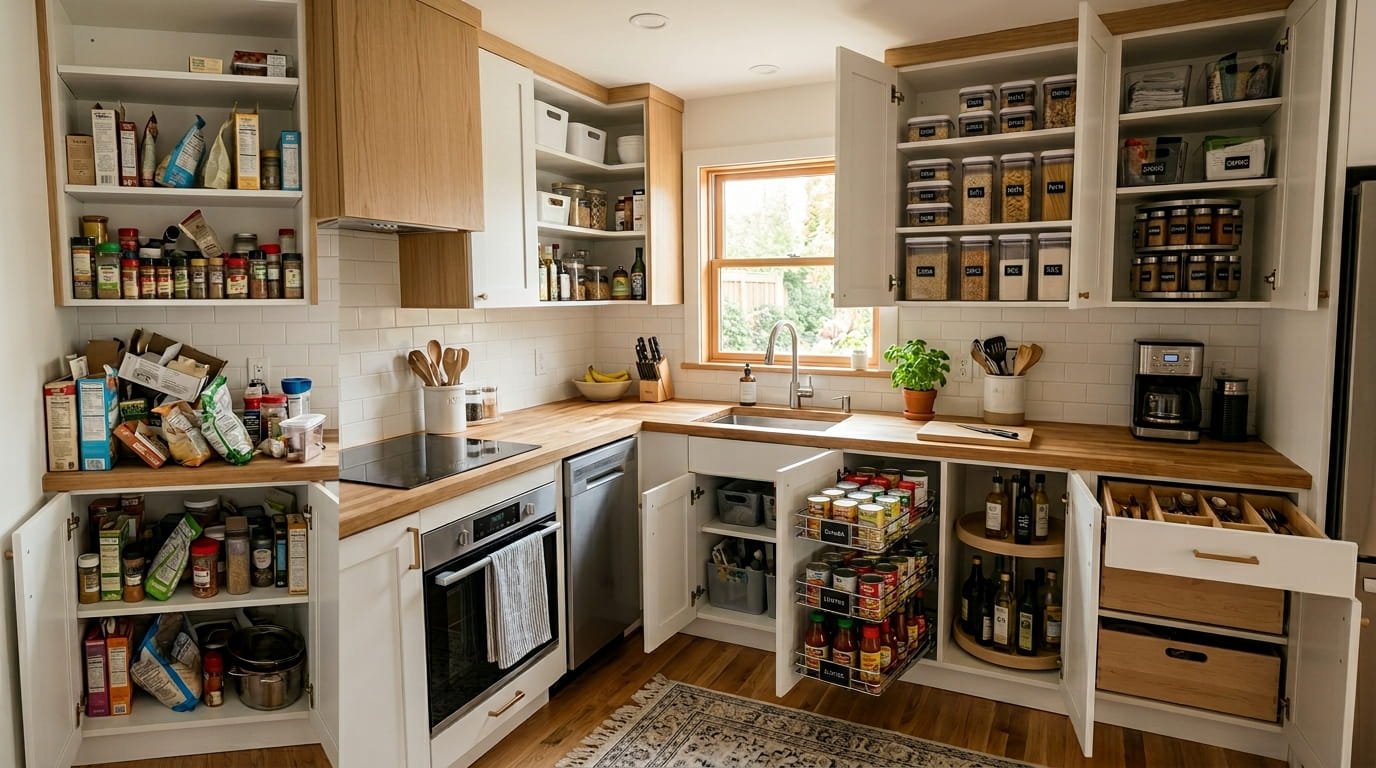
If you have a small kitchen, you already know the frustration. Cabinets that overflow. Drawers that jam. Counters that disappear under daily clutter. You buy an organizer that looks perfect online and it ends up three inches too wide for your cabinet, or the spice rack tips over when you grab the fourth bottle.
The problem is not your kitchen. It is having the wrong tools for the space you actually own. Highlighting the benefits of kitchen organization through academic studies proves that intentional space-saving tools do more than clear clutter, they actively decrease daily stress and eliminate mealtime decision fatigue.
This guide cuts through the noise. Based on product specifications, real customer reviews, and established home organization principles, these are the kitchen organizers that deliver measurable results in small spaces, for families, renters, apartment dwellers, and anyone who needs their kitchen to work harder without spending a fortune.
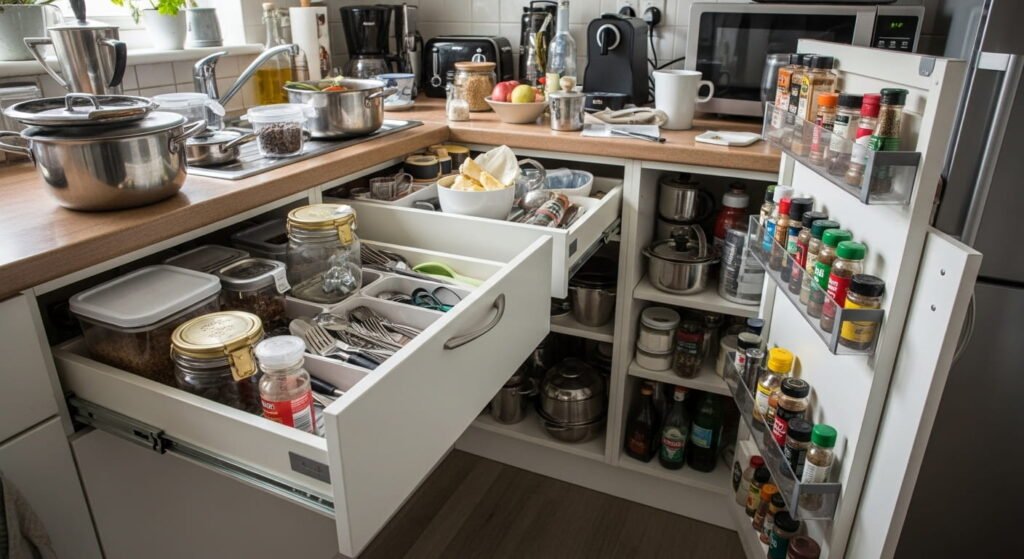
Quick Recommendations at a Glance
| Category | Top Pick | Best Budget | Best Premium |
| Cabinet | Rev-A-Shelf Pull-Out | SimpleHouseware Shelf Riser | Lynk Professional Pull-Out |
| Drawer | OXO Expandable Organizer | Bamboo Drawer Dividers | Joseph Joseph DrawerStore |
| Pantry Bins | mDesign Stackable Bins | iDesign Clear Bins | OXO POP Containers |
| Spice | YouCopia SpiceStack | Copco Tiered Rack | Yamazaki Tower Spice Rack |
| Refrigerator | OXO Lazy Susan | iDesign Fridge Bins | OXO Good Grips Bin Set |
| Under-Sink | SimpleHouseware 2-Tier | mDesign Under-Sink Rack | Rev-A-Shelf Under-Sink Pull-Out |
| Over-Sink | Dish Drying Rack Bridge | Over-Sink Caddy | Polder Over-Sink Rack |
Best Cabinet Organizers for Small Kitchens
Good cabinet organization is the foundation of a functional small kitchen. Organization professionals consistently recommend addressing cabinet storage before any other area, because it frees the most space per dollar spent.
For a complete framework on how to set up your cabinet zones before buying any organizers, the Small Kitchen Organization Ideas guide walks through the full process step by step.
Best Overall Cabinet Organizer
Rev-A-Shelf 2-Tier Pull-Out Cabinet Organizer
Best Overall | Price Range: $45 to $75
The Rev-A-Shelf pull-out is the most consistently recommended cabinet organizer among professional organizers and kitchen remodelers. It mounts to the interior cabinet floor with four screws and slides forward on full-extension ball-bearing slides, bringing the entire depth of the cabinet into view and reach.
Best for: Lower cabinets holding pots, pans, or pantry items where the back section is routinely inaccessible.
| Pros | Cons |
| Full cabinet depth becomes usable | Requires basic screw installation |
| Ball-bearing slides handle heavy loads | Higher upfront cost than static organizers |
| Weight capacity up to 100 lbs | Not ideal for very narrow cabinets under 12 inches |
| Works in cabinets with or without a center stile | Measures carefully needed before purchase |
Who should buy it: Homeowners and renters with landlord permission who cook regularly and want the highest-impact single upgrade to lower cabinet storage.
Who should skip it: Renters who cannot drill, or households with primarily upper cabinet storage challenges.
Best Budget Cabinet Organizer
SimpleHouseware Expandable Shelf Riser
Best Budget | Price Range: $12 to $18
The SimpleHouseware riser creates a second tier inside any standard upper or lower cabinet. The spring-expansion design adjusts from 15 to 26 inches to fit most American cabinet widths without cutting or tools. Many homeowners report doubling their visible cabinet capacity within 15 minutes of installation.
Best for: Upper cabinets with unused vertical space above dishes, glasses, and pantry staples.
| Pros | Cons |
| Zero installation required | Can slide on smooth shelves if overloaded |
| Adjusts to fit most cabinet widths | Not suitable for very heavy cookware |
| Works on any flat shelf surface | Second-tier clearance limited by shelf height |
| Affordable enough to buy multiple units | Wire surface can mark soft items |
Who should buy it: Anyone starting their kitchen organization journey who wants visible results without spending much. An excellent first purchase.
Who should skip it: Anyone needing to store cast iron or heavy appliances on the riser.
Best Premium Cabinet Organizer
Lynk Professional Pull-Out Cabinet Organizer
Best Premium | Price Range: $55 to $90
The Lynk Professional is the premium tier pull-out organizer, built with heavy-gauge chrome wire, side-mount installation for greater stability, and a full-extension slide rated for higher weight loads than most competitors. Organization professionals who outfit kitchen cabinets long-term favor this model for its durability under high daily use.
Who should buy it: Anyone investing in a kitchen they plan to use for five or more years who wants a pull-out that will not bend, warp, or wear out under family-level use.
Best Drawer Organizers
Top Pick: OXO Good Grips Expandable Drawer Organizer
Best Overall Drawer | Price Range: $20 to $35
OXO’s expandable drawer organizer features soft-grip dividers that do not scratch drawer surfaces, adjustable widths that genuinely stay in position under daily use, and compartment sizes designed for actual kitchen tool dimensions. The expandable sides fit drawers from 12 to 23 inches wide.
| Pros | Cons |
| Stays in position without tension-lock issues | Higher cost than basic inserts |
| Soft-grip base prevents sliding | Limited compartment count for very large drawers |
| Dishwasher safe | |
| Works in narrow and wide drawers |
Runner-Up: Joseph Joseph DrawerStore Expandable Organizer
Best for Utensil Drawers | Price Range: $25 to $40
The DrawerStore is specifically designed for cooking utensil storage, with slots sized for spatulas, ladles, whisks, and tongs. Organization professionals frequently recommend it for the drawer directly beside the stove because it keeps every tool independently accessible in under two seconds.
Best for: The primary cooking utensil drawer in active family kitchens.
Best Pantry and Spice Organizers
A well-organized pantry reduces food waste, eliminates duplicate purchases, and makes meal prep faster. For a complete pantry organization system that works within a tight budget, the Pantry Organization Ideas guide covers the full setup process including free alternatives to purchased bins.
Best Pantry Bins
mDesign Stackable Pantry Organizer Bins
Best Pantry Bins | Price Range: $18 to $30 per set of 4
mDesign’s clear stackable bins are among the most purchased pantry organizers in the US for good reason. The open-front design allows contents to be seen and grabbed without fully removing the bin. Clear sides provide instant inventory visibility. Many families report that switching to category-based pantry bins reduces both grocery overspending and food waste within the first month of use.
| Pros | Cons |
| Open front for easy access | Stacking requires shelf clearance measurement |
| Clear sides show inventory at a glance | Not airtight for long-term dry goods |
| Available in multiple sizes | Lightweight construction |
| Affordable set pricing |
Best for: Pantry shelves organized by category: snacks, canned goods, grains, baking supplies.
Best Spice Organizer
YouCopia SpiceStack Drawer Organizer
Best Spice | Price Range: $22 to $35
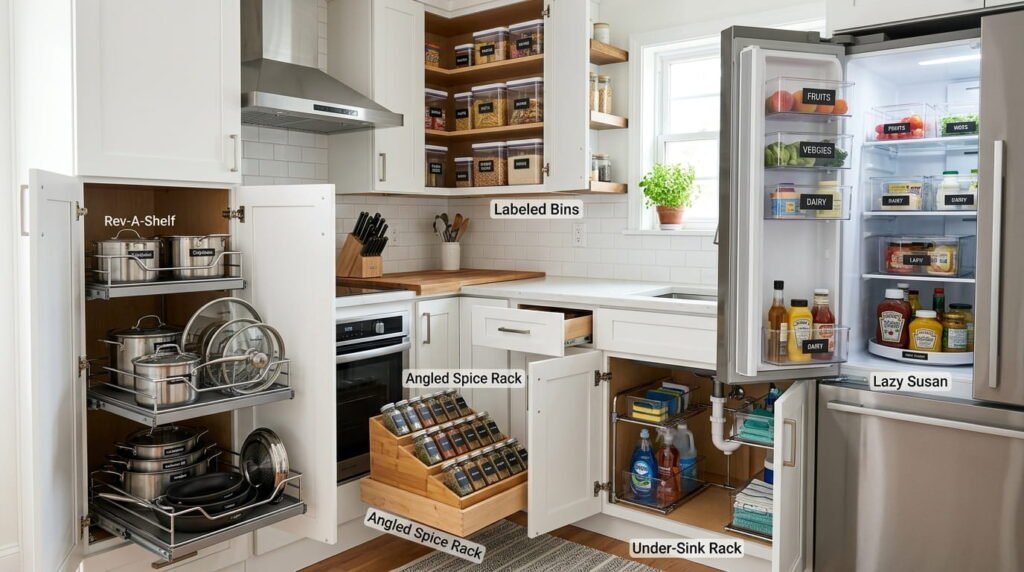
The YouCopia SpiceStack is the most highly rated dedicated spice organizer among families with large spice collections. It sits in a standard kitchen drawer and displays every bottle at a readable angle simultaneously. No pulling bottles out to read labels. No tipping. Organization professionals recommend this over cabinet-mounted spice racks for families who cook varied cuisines and use 15 or more spices regularly.
| Pros | Cons |
| All labels visible simultaneously | Sized for standard spice bottles, taller bottles may not fit |
| Modular, expandable with add-on units | Requires a dedicated drawer |
| Stable under heavy daily use | Higher price point than basic tiered racks |
| Works for most bottle sizes |
Budget Alternative: Copco Non-Skid 3-Tier Cabinet Organizer ($12 to $18) works well in any cabinet or pantry shelf and is a solid entry-level option for families with smaller spice collections.
Best Refrigerator Organizers
Top Pick: OXO Good Grips Lazy Susan Turntable
Best Refrigerator Organizer | Price Range: $18 to $25
The OXO Lazy Susan is the single most frequently recommended refrigerator organizer by home organization experts. It eliminates the hidden condiment problem entirely: every bottle is one rotation from the front. The non-slip base keeps it stable even when the refrigerator door opens and closes. Available in two sizes to fit standard refrigerator shelf depths.
| Pros | Cons |
| 360-degree rotation, smooth under load | Occupies the full shelf width |
| Non-slip base, stable on glass shelves | Not ideal as the only organizer on every shelf |
| Wipes clean easily | Center space slightly underutilized |
| Durable BPA-free construction |
Best Refrigerator Bins
iDesign Linus Stackable Refrigerator Bins
Best Fridge Bins | Price Range: $20 to $32 per set
iDesign’s clear refrigerator bins bring pantry-style categorization into the refrigerator. Assign one bin per food category, label the front, and every family member can navigate the refrigerator independently. Many homeowners report a meaningful reduction in food waste after implementing a bin system because expiring items become visible instead of buried.
Best for: Families who want to create defined refrigerator zones (leftovers, dairy, kids’ snacks, deli items, produce overflow).
Best Under-Sink Organizers
The under-sink cabinet is the most chronically disorganized space in most family kitchens. Pipes create awkward obstacles, and most standard organizers do not account for them.
Top Pick: SimpleHouseware 2-Tier Expandable Under-Sink Organizer
Best Under-Sink | Price Range: $22 to $30
This two-tier expandable rack is specifically designed to work around standard plumbing configurations. The adjustable center section slides open to accommodate the drain pipe, and two side shelves provide level storage on both sides. Organization professionals consider this the default starting recommendation for under-sink cabinet organization because it fits the widest range of cabinet configurations.
| Pros | Cons |
| Adjustable center fits around drain pipes | Top tier has limited height clearance |
| Doubles usable storage without tools | Not load-rated for heavy items |
| Expandable width (17 to 27 inches) | Shelf surface is wire, small items can fall through |
| Affordable price point |
Pro upgrade: Add a $4 tension rod above the adjustable rack to hang spray bottles vertically by their trigger handles. This frees the entire lower shelf for non-spray items and is one of the most cost-effective under-sink storage improvements available.
For more creative ways to maximize under-sink and other overlooked kitchen spaces, Kitchen Storage Without Cabinets covers the full range of non-cabinet storage solutions.
Best Over-Sink Organizer
Top Pick: Polder Over-Sink Adjustable Rack
Best Over-Sink | Price Range: $35 to $55
An over-sink drying rack that extends across the sink basin rather than sitting on the counter beside it is one of the highest-impact counter space reclamation moves available in a small kitchen. The Polder adjusts to fit sink widths from 12 to 22 inches. Dishes dry over the drain and the counter beside the sink stays clear for prep work.
| Pros | Cons |
| Recovers 3 to 4 square feet of counter space | Works only above the sink, not as a general counter organizer |
| Adjustable width fits most standard sinks | Rubber feet can shift on porcelain |
| Doubles as a drying and prep surface | Weight limit applies per section |
| No permanent installation required |
Best for: Any small kitchen where the drying rack currently occupies valuable counter prep space.
How We Evaluated These Organizers
Product selections in this guide are based on the following criteria evaluated consistently across all categories:
Dimensional accuracy and fit: Does the product fit real American kitchen cabinet and drawer dimensions without modification?
Durability under family-use volume: Can the product handle three to five times the daily use of a single-person kitchen and maintain its structural and functional integrity?
Access design for real households: Does the product allow practical one-handed, quick access for adults and accessible independent use for children where relevant?
Value relative to cost: Does the price reflect the actual functional improvement the product delivers, not just its aesthetic quality?
Customer review analysis: What specific failure patterns appear repeatedly across verified purchaser reviews, and do those failures apply to family kitchen conditions specifically?
Buying Guide: How to Choose the Right Organizer
Measure Before Every Purchase
This cannot be overstated. The single most common cause of returned kitchen organizers is dimension mismatch. Measure the interior width, depth, and height of the target space. Account for shelf thickness, any pipe or hinge obstructions, and whether a cabinet door needs to close over the organizer. Measure twice. Buy once.
Match Access Design to Use Frequency
| Use Frequency | Best Access Design |
| Multiple times daily | Open bins, no lid, one-handed grab |
| Several times weekly | Light lid, easy-tab access |
| Monthly or seasonal | Sealed or lidded containers acceptable |
Prioritize by Area of Highest Friction
Not every kitchen area needs an organizer simultaneously. Identify the two or three spaces that create the most daily frustration and start there. Common high-friction areas in family kitchens: the pot and pan lower cabinet, the pantry snack shelf, and the spice storage area.
Start Small Before Committing to a Full System
Buy one or two units before purchasing a matching set of 12. Live with them for two weeks. Confirm the size, the category system, and the family maintenance pattern all work before scaling. This approach prevents the expensive mistake of a complete matching system that turns out to be the wrong size or design for your specific kitchen.
Common Mistakes to Avoid
Buying before decluttering. An organizer placed in a cabinet that still contains items you don’t use does not solve the problem. It repackages it. Declutter the space first, then organize what remains. The How to Organize Kitchen Cabinets Efficiently guide walks through this process completely.
Choosing aesthetics over function for high-frequency items. Beautiful lidded canisters for the pantry look excellent in photos. They also require two hands to open and close. For items accessed multiple times daily by multiple family members, functional access design always outperforms visual elegance.
Ignoring weight ratings. A pull-out organizer rated for 20 pounds will deform under a loaded cast iron skillet. Check weight ratings for every lower cabinet organizer against your realistic loaded conditions, not your lightest possible load.
Over-categorizing. A drawer with eight separate categories requires eight correct decisions every time something is returned. A drawer with three broad categories requires three. For family kitchens, fewer categories maintained consistently outperform numerous categories maintained sporadically.
Buying the wrong size lazy Susan. A lazy Susan too large for the cabinet will prevent the door from closing. A turntable too small will not solve the buried-items problem. Measure the usable shelf diameter before selecting a size.
Installation Tips
For pull-out organizers: Slide the unit in without mounting first and confirm full door clearance at all open positions. Mark screw positions, pre-drill pilot holes to prevent the cabinet floor from splitting, and check that slides are level before final tightening. Test with a representative load before closing the cabinet for the first time.
For tension rod dividers: Install at the height where your tallest flat item (sheet pan, cutting board) clears the shelf above when being removed at an angle. Twist to tension until the rod resists firm lateral pressure. Recheck every few months as seasonal humidity affects tension.
For over-sink racks: Verify the rack is level side-to-side before loading. A slight lean in either direction will cause drainage toward one side and potential tipping under heavier loads.
For lazy Susans: Wipe the shelf surface clean before placing to ensure smooth rotation. On painted or coated shelves, a thin rubber mat underneath prevents drift without permanent mounting.
Maintenance Tips for Longevity
Wipe organizers monthly. Clear bins, turntables, and drawer inserts accumulate food residue that degrades the organizational experience and, over time, the product. A monthly wipe-down during the kitchen reset takes under five minutes.
Reassess placement every six months. Family habits change. A snack bin positioned for a young child needs repositioning as that child grows. A spice organization system built around five years ago’s cooking habits needs adjustment as cuisine preferences evolve. A brief quarterly check prevents gradual drift back toward chaos.
Replace damaged units promptly. A cracked bin or a pull-out that no longer glides smoothly signals system degradation to the whole household. Replace promptly. The cost of one new organizer is always less than the cost of the organizational backslide it prevents.
Frequently Asked Questions
Are pull-out cabinet organizers worth it?
Yes. They maximize cabinet space and make items easier to access, especially in lower cabinets.
What kitchen organizers save the most space?
Vertical storage solutions such as shelf risers, tiered spice racks, and pan dividers provide the biggest space savings.
What organizers work best for renters?
Tension rods, over-door organizers, lazy Susans, and clear bins because they require no permanent installation.
How do I organize a kitchen without a pantry?
Use shelf risers in upper cabinets and add a slim pantry cart or storage unit to create extra food storage space.
What should I avoid buying?
Avoid hard-to-clean organizers, low-quality plastic products, and anything that doesn’t fit your cabinet or drawer measurements.
Final Verdict
The best kitchen organizers for small spaces are not the most expensive ones, and they are not the most visually striking ones. They are the ones that solve your specific highest-friction problem, fit your actual cabinet dimensions, and are simple enough for every household member to use consistently.
If you can only buy one thing: The Rev-A-Shelf pull-out organizer for your most frustrating lower cabinet. It changes how the cabinet functions fundamentally, not cosmetically.
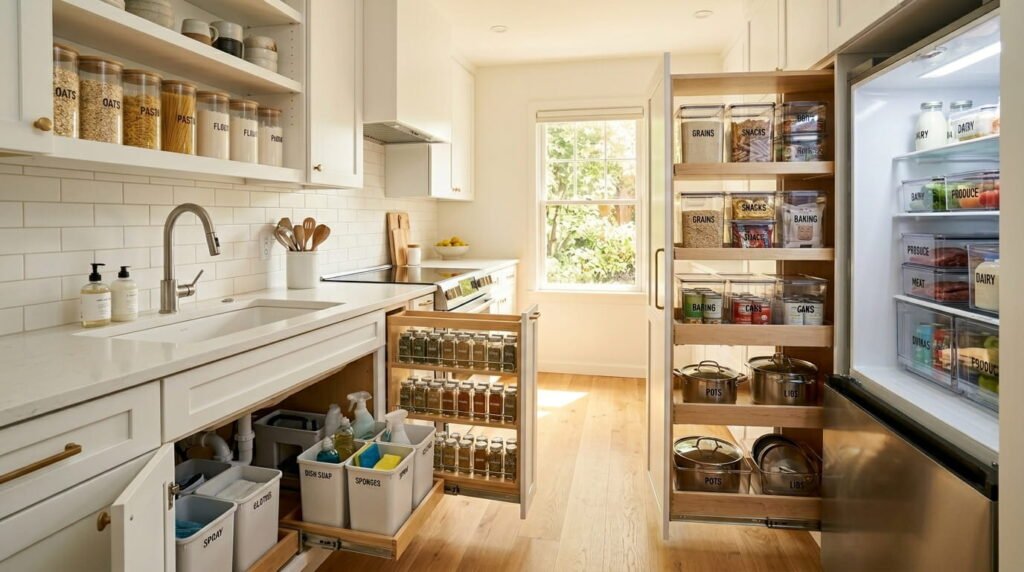
Best combination for under $50: SimpleHouseware shelf riser plus mDesign pantry bins plus a $10 OXO Lazy Susan for the refrigerator. Together these three upgrades address the three most common family kitchen friction points.
For the full transformation: Add the YouCopia SpiceStack, OXO over-sink drying rack, and iDesign under-sink rack and the entire kitchen operates measurably more efficiently within a single weekend of setup.
For the complete kitchen organization system that these products support, the Small Kitchen Organization Ideas guide gives you the full declutter, zone, and setup framework. For maximizing storage beyond cabinets entirely, Kitchen Storage Without Cabinets covers every creative non-cabinet solution available.
Final Recommendation Matrix
| Your Situation | Start Here | Add Next |
| Lower cabinets inaccessible | Rev-A-Shelf Pull-Out | Tension rod dividers |
| Pantry always chaotic | mDesign Stackable Bins | Lazy Susan turntable |
| Can never find spices | YouCopia SpiceStack | Tiered cabinet rack |
| Counter always buried | Over-sink drying rack | Divided utensil crock |
| Refrigerator is a mystery | OXO Lazy Susan | iDesign fridge bins |
| Under-sink is a pile | SimpleHouseware 2-tier | Tension rod for spray bottles |
| Renter, no drilling | mDesign bins + Lazy Susans | Over-door pantry organizer |
Also helpful: Small Kitchen Organization Ideas | How to Organize Kitchen Cabinets Efficiently | Pantry Organization Ideas on a Budget | Kitchen Storage Without Cabinets | Small Home Storage Ideas




Leave a Reply