

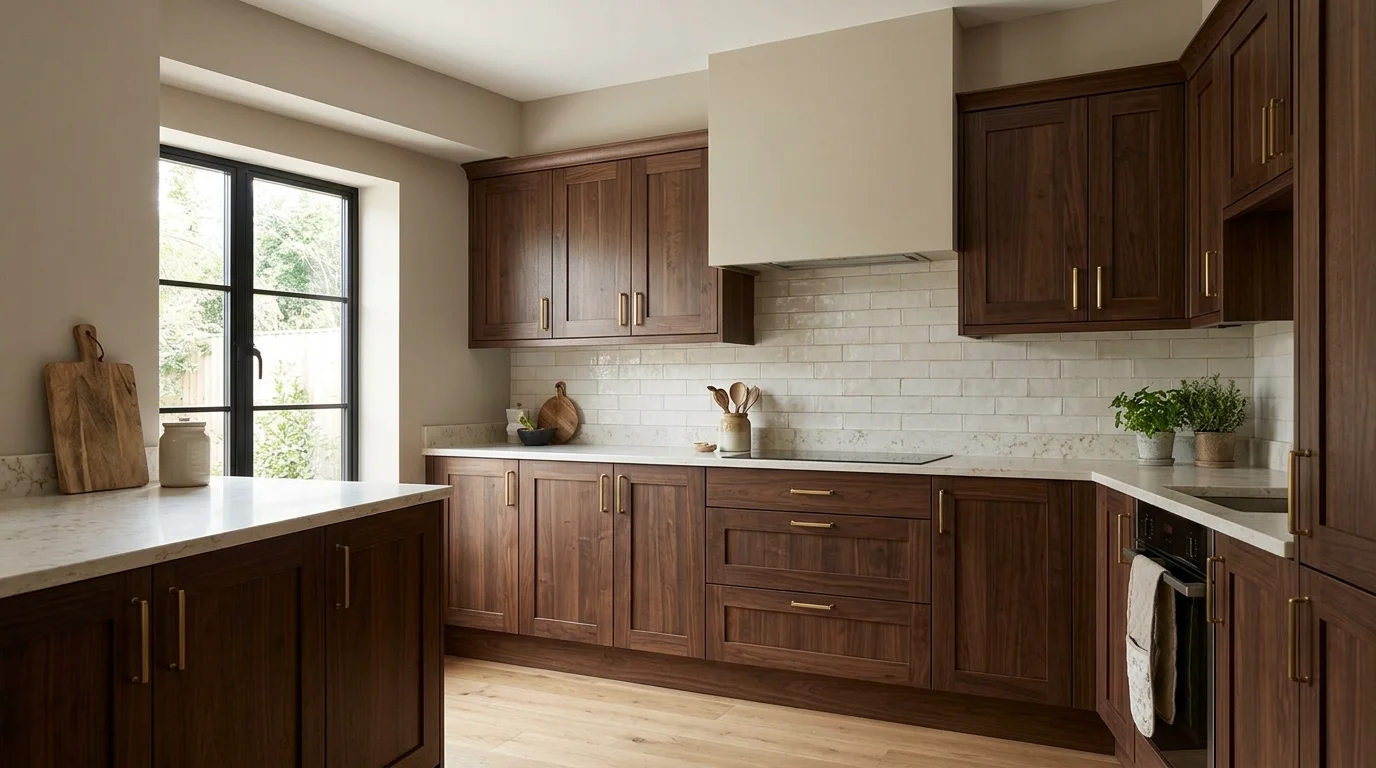
Warm white, soft beige, and greige are the safest wall colors for dark brown kitchen cabinets. Good starting paints are Sherwin-Williams Alabaster (SW 7008), Kilim Beige (SW 6106), and Agreeable Gray (SW 7029). All three are warm neutrals with a light reflectance value (LRV) of 57 or higher, so they send light back into a room where the cabinets absorb most of it.
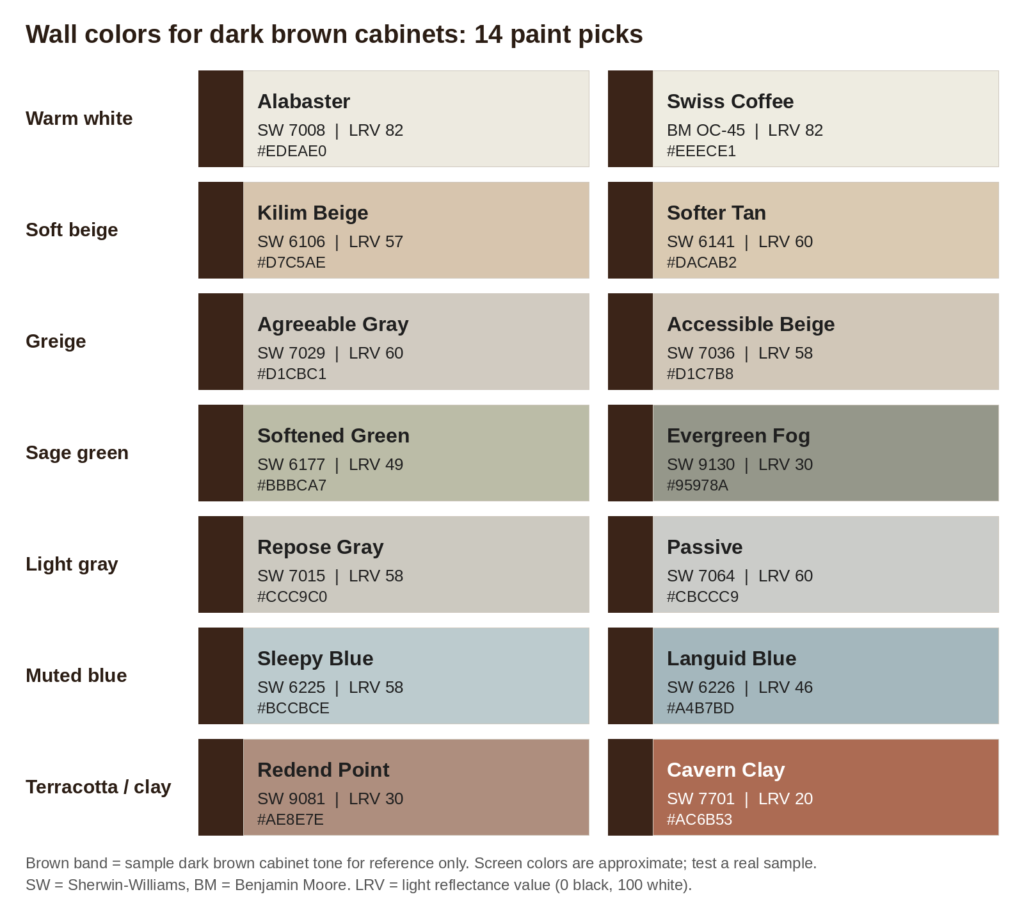
Which one suits your kitchen comes down to three things: the undertone of your cabinets, the direction your windows face, and the color of your light bulbs. The table below lists all seven wall colors in this guide with two real paint examples each. The sections after it show you how to choose between them.
Wall Colors for Dark Brown Cabinets at a Glance
| Wall color | Paint examples (LRV) | Undertone | Works best in |
|---|---|---|---|
| Warm white | Alabaster SW 7008 (82); Swiss Coffee BM OC-45 (82) | Warm, faint yellow | Dim or north-facing kitchens |
| Soft beige | Kilim Beige SW 6106 (57); Softer Tan SW 6141 (60) | Warm yellow | Traditional and farmhouse kitchens with wood |
| Greige | Agreeable Gray SW 7029 (60); Accessible Beige SW 7036 (58) | Warm beige base | Kitchens with mixed finishes |
| Sage green | Softened Green SW 6177 (49); Evergreen Fog SW 9130 (30) | Warm gray-green | Bright kitchens with natural textures |
| Light gray | Repose Gray SW 7015 (58); Passive SW 7064 (60) | Warm-neutral to neutral | Bright, modern kitchens |
| Muted blue | Sleepy Blue SW 6225 (58); Languid Blue SW 6226 (46) | Cool | South-facing kitchens, islands, accent walls |
| Terracotta or clay | Redend Point SW 9081 (30); Cavern Clay SW 7701 (20) | Warm yellow-red | Large kitchens with an earthy style |
SW means Sherwin-Williams and BM means Benjamin Moore. LRV runs from 0 (black) to 100 (white). Screen colors are approximate, so check any pick in person before you buy.
If you are planning color for more than the kitchen, our guide to interior color schemes shows how to carry these tones through the rest of the house.
How to Choose Wall Colors for Dark Brown Cabinets
Dark brown cabinets take in most of the light that reaches them, so the wall color has to do more work than it would beside white cabinets. Four checks narrow the choice quickly.
Read Your Cabinet Undertone
Hold a sheet of plain white paper against a cabinet door in daylight. If you see red, orange, or golden tones, your cabinets lean warm, which is common with cherry, mahogany, and many stained maple finishes. If they look flat gray-brown or close to black, they lean neutral or cool, which is common with espresso finishes. Warm cabinets pair easily with warm walls. Neutral and espresso cabinets give you more freedom to use greige, light gray, or a muted blue.
Use LRV to Judge Brightness
LRV measures how much light a paint color reflects, from 0 for pure black to 100 for pure white. Dark brown cabinets sit near the bottom of that scale, so a wall with a high LRV creates contrast and makes the room feel brighter. The 14 paints in this guide range from LRV 20 to 82. The lowest numbers (Cavern Clay at 20, Evergreen Fog and Redend Point at 30) are best kept for large, well-lit kitchens. Small kitchens gain the most from high-LRV walls.
Check Which Way Your Windows Face
Light direction changes how every color on this page looks. North-facing rooms get cooler, indirect light that makes cool undertones more noticeable, and light shades with blue or gray bases can look cold. Yellow-based colors such as Alabaster or Kilim Beige hold up better there. South-facing rooms get warm light for much of the day, which suits soft pale walls and blues. East- and west-facing rooms change the most between morning and evening, so look at your samples at both ends of the day.
Match Your Bulbs to Your Paint
Artificial light shifts color too. Soft and warm white bulbs (2700K to 3000K) make walls look warmer. Cool white bulbs make them look bluer and cooler. Neutral white bulbs (around 3500K to 4000K) are the closest match to daylight. Pick one bulb color for the whole kitchen and install it before you judge any sample, so the under-cabinet lights and overhead fixtures do not pull the color in different directions.
7 Wall Colors That Go With Dark Brown Cabinets
1. Warm White for a Bright, Classic Kitchen
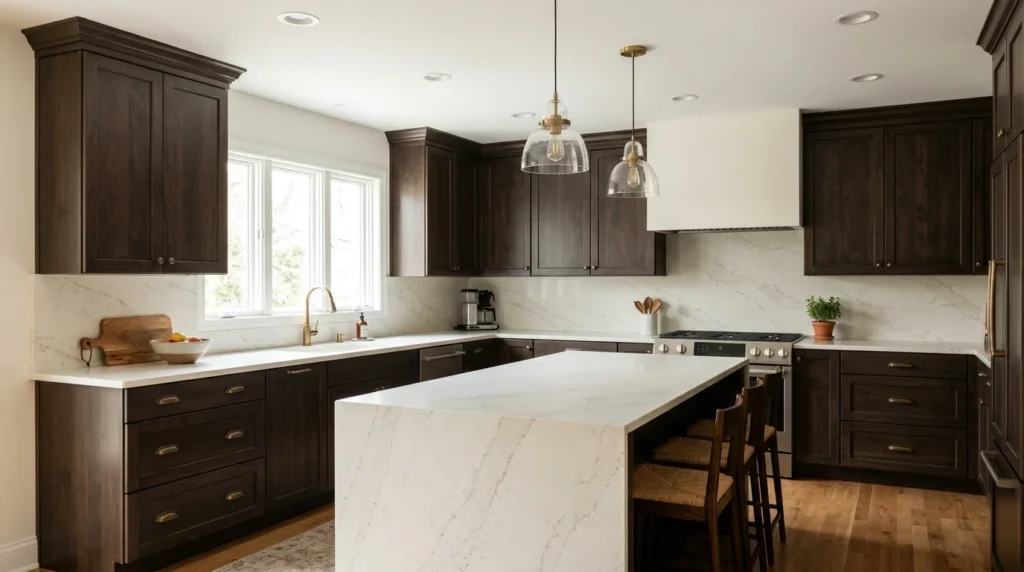
Alabaster (SW 7008, LRV 82) and Benjamin Moore Swiss Coffee (OC-45, LRV 82) are warm whites with a faint beige-yellow warmth. Their high LRV gives the strongest contrast against dark brown cabinets, and the yellow base keeps them from looking clinical. This is the best choice for a kitchen with little daylight or a north-facing window, where a stark white can turn flat and gray. It works with warm cherry and mahogany cabinets and with espresso finishes, which makes it the lowest-risk option on this list. Pair it with white or light quartz countertops and light to mid-tone wood floors. If your countertop is a bright, cool white, hold a sample against it first, because a warm white wall can look yellow beside it.
2. Soft Beige for a Warm, Settled Look
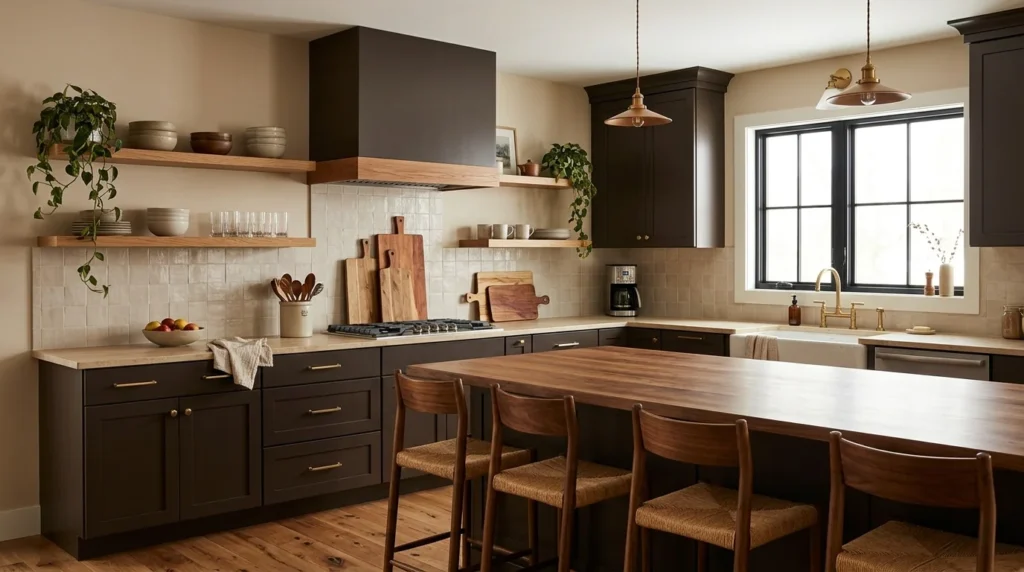
Kilim Beige (SW 6106, LRV 57) and Softer Tan (SW 6141, LRV 60) both have a warm yellow undertone and sit in the same color family as most brown cabinets. Instead of contrasting with the cabinets, they blend with them, which gives a calm, low-contrast room. They suit traditional and farmhouse kitchens, especially those with a wood island or open shelving like the setups in our guide to kitchen storage without cabinets. Pair them with cream or beige stone countertops and warm wood floors. Low contrast also means the cabinets stand out less, so in a dim kitchen a warm white is the better choice.
3. Greige for a Balanced, Modern Kitchen
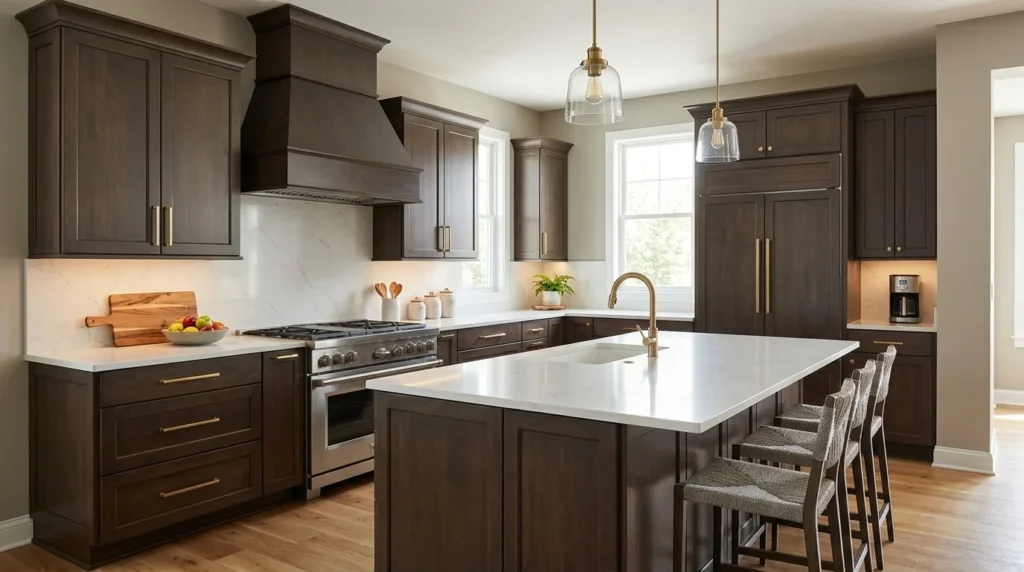
Agreeable Gray (SW 7029, LRV 60) has a warm beige base, and Accessible Beige (SW 7036, LRV 58) is a warm greige with a beige-yellow tint. Because greige carries both gray and beige, it sits comfortably between warm cabinets and cooler finishes such as gray quartz or stone tile. That makes it the best fit when your kitchen mixes undertones, for example red-brown cabinets, a gray countertop, and a warm floor. Accessible Beige leans more toward beige, while Agreeable Gray leans more toward gray, so choose the one closer to your countertop. Greige suits modern and transitional kitchens that want more depth than white without the commitment of a full gray. Pair it with white or gray quartz and gray-toned stone or tile floors.
4. Sage Green for a Natural, Earthy Feel
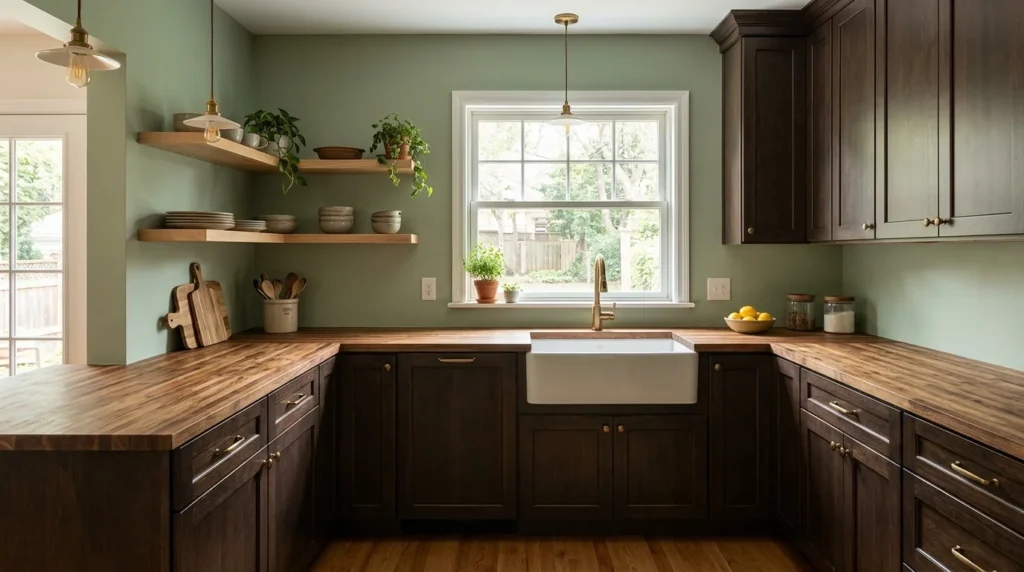
Softened Green (SW 6177, LRV 49) is a warm gray-green with a yellow cast, and Evergreen Fog (SW 9130, LRV 30) is a deeper gray-green with neutral undertones. Both look muted rather than bright, so they sit beside dark wood without competing with it. Green is a natural partner for brown, and the pairing looks best with textures such as rattan, woven baskets, and wood shelves. Softened Green suits a kitchen with steady daylight. Evergreen Fog has a much lower LRV, so use it in a larger, brighter room or on an island or lower wall instead of every wall. Pair either one with butcher block or cream stone countertops and light wood or natural stone floors. Sage fits farmhouse, cottage, and nature-inspired kitchens more easily than sleek modern ones.
5. Light Gray for a Clean, Contemporary Kitchen
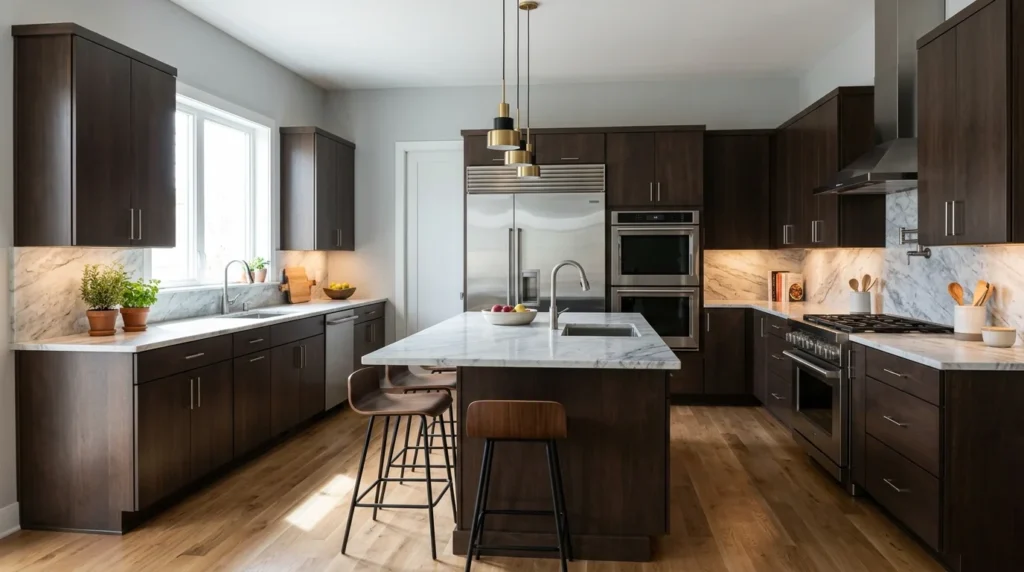
Repose Gray (SW 7015, LRV 58) has a trace of warm beige under a gray base, and Passive (SW 7064, LRV 60) is neutral with no warm or cool cast. Undertone matters more with gray than with any other color here. A gray with a blue base can look stark and mismatched beside red-brown cabinets, so stay with warm-neutral or neutral grays like these two. Repose Gray can read slightly lavender in cool north light, so sample it before you commit. Both work best in bright, modern kitchens where daylight keeps gray from looking dull. Pair them with white or gray marble or quartz countertops.
6. Muted Blue for Subtle Contrast
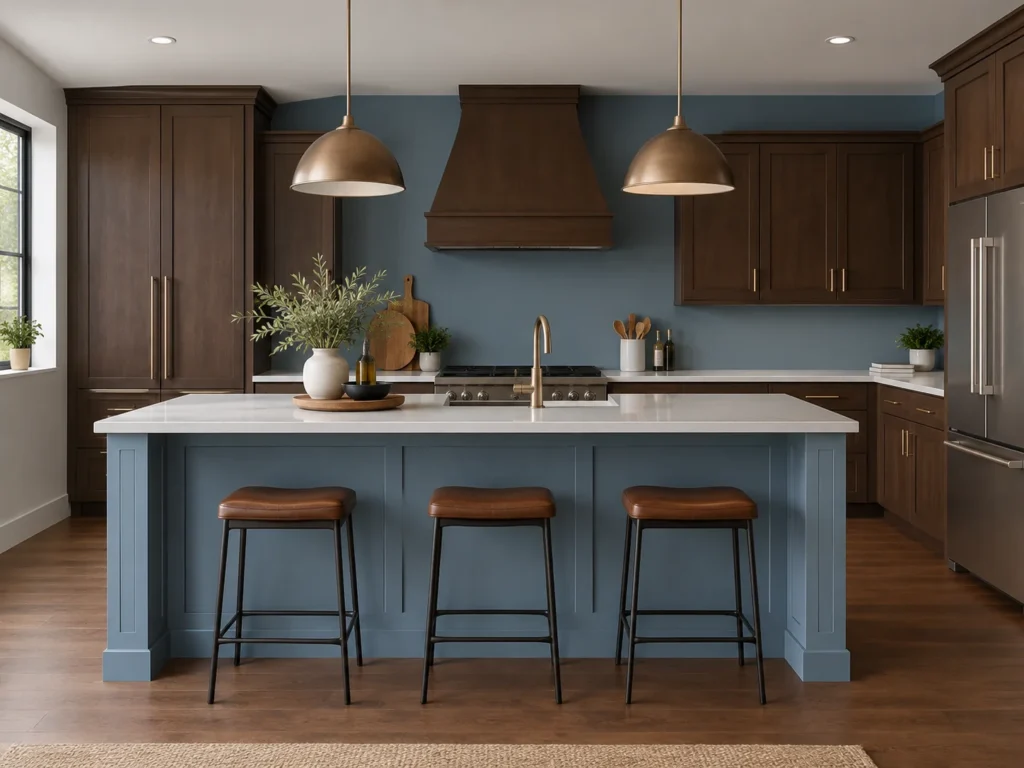
Sleepy Blue (SW 6225, LRV 58) and Languid Blue (SW 6226, LRV 46) are soft, gray-leaning blues with cool undertones. Brown is a dark shade of orange, and blue sits opposite orange on the color wheel, so a muted blue gives dark brown cabinets a gentle contrast without the weight of navy or cobalt. The cool undertone looks best in south-facing or well-lit kitchens, where warm daylight balances it. In a north-facing room the same blue can turn cold. Both colors also work on an island, a pantry wall, or a single accent wall instead of every wall. Pair them with white, cream, or light gray countertops.
7. Terracotta or Muted Clay for an Earthy Kitchen
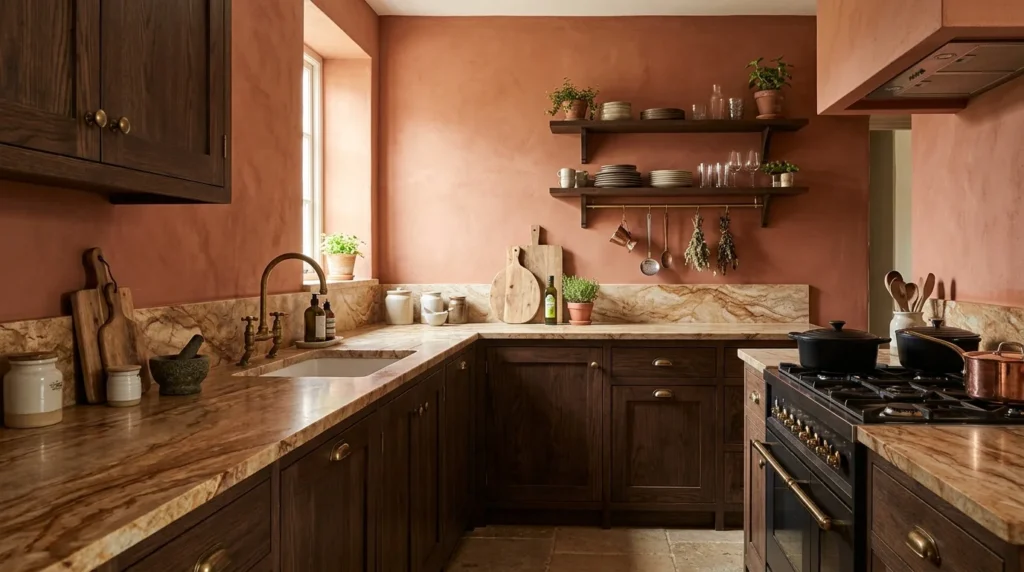
Redend Point (SW 9081, LRV 30) is a soft, dusty clay-beige, and Cavern Clay (SW 7701, LRV 20) is a deeper terracotta tone. Both have a warm yellow-red undertone, which puts them in the same family as brown cabinets and gives a closely coordinated, earthy look. The low LRV is the main risk. In a compact or dim kitchen these colors absorb light and make the room feel heavier, so use them on one wall only or choose a different color from this list. Cavern Clay is best saved for large, bright kitchens with an earthy or Mediterranean style. Pair either one with warm stone or butcher block countertops.
Trim, Backsplash, and Hardware
Trim: A warm white such as Alabaster or Swiss Coffee works as trim with most of the seven wall colors, since it adds a clean edge without changing the wall color’s undertone. Semi-gloss is the usual trim finish because it wipes clean easily.
Backsplash: A white or cream tile backsplash reflects light toward the walls and breaks up the long run of dark cabinets. If your wall is sage, blue, or clay, keep the backsplash a plain light neutral so the wall stays the one color statement in the room.
Hardware: Brass and bronze pulls blend warmly with dark brown cabinets and tend to suit warm white, beige, sage, and clay walls. Black pulls give a sharper, more modern edge that suits greige and light gray. Brushed nickel tends to suit muted blue and gray walls.
Wall finish: Eggshell is a good all-around choice for kitchen walls because it wipes clean and hides surface flaws. Satin is slightly shinier and holds up better near the stove and food prep area, but it shows flaws more.
How to Match Wall Colors With Countertops and Flooring
Aim for surfaces that share an undertone family rather than an exact match. A kitchen where the walls, counters, floors, and cabinets are all the same tone can look flat. The table shows which wall colors tend to work with common finishes.
| Surface | Wall colors that work | What to check |
|---|---|---|
| White or cream quartz | Warm white, soft beige, greige | Bright white and warm ivory pull toward different walls. Hold a sample against the counter. |
| Gray quartz or marble | Greige, light gray, muted blue | Look at the veining. Warm veining suits greige, cool veining suits light gray or blue. |
| Stone with gold or brown veining | Warm white, soft beige, sage green | Pull the wall color from the veining, not from the base color of the stone. |
| Butcher block or warm wood (oak, pine) | Warm white, soft beige, sage green, clay | Warm wood looks best against warm walls. |
| Gray-toned wood, tile, or stone floors | Greige, light gray, muted blue | Cool floors can make a warm beige wall look yellow. |
What Wall Colors Should You Avoid With Dark Brown Cabinets?
No color is off limits, but three situations cause most of the problems.
A bright, cool white can look harsh against very warm brown cabinets, where a softer, warmer white reads as crisp instead. Deep, saturated walls such as navy, charcoal, or dark forest green are risky in a kitchen with limited daylight, because they leave almost no contrast against the cabinets and make the room feel smaller. Mid-tone brown or tan walls that sit close to the cabinet color can make the cabinets disappear into the wall and leave the room looking heavy and flat.
How to Test Paint Colors Before You Buy
A small paint chip is not enough for a kitchen with dark cabinets. Use these steps instead.
- Paint two coats of each sample on a piece of poster board or primed board about 2 feet square, so you can move it around the room.
- Hold each board directly against a cabinet door and a cut piece of your countertop instead of judging it from across the room.
- Look at it in the morning, at midday, in the evening, and at night with your final bulbs on.
- Move the board to the darkest wall and the brightest wall, since the same color can look different in each spot.
- Wait until the paint is fully dry before you decide, because wet paint looks darker than the finished color.
Frequently Asked Questions
What is the best wall color for dark brown kitchen cabinets?
Warm white is the safest choice, with Alabaster (SW 7008) and Swiss Coffee (OC-45) as strong starting points. Soft beige and greige come next. Your final pick depends on your cabinet undertone and the direction your windows face.
Should kitchen walls be lighter or darker than dark brown cabinets?
Lighter in nearly every case. A wall with a higher LRV than the cabinets creates contrast and reflects light back into the room. Deeper wall colors only work in large, bright kitchens, and usually on an island or a single wall.
What paint finish is best for kitchen walls?
Eggshell is the best all-around choice because it wipes clean and hides wall flaws. Use satin on the walls near the stove and food prep area, where you will clean more often.
What trim color goes with dark brown cabinets?
Alabaster or Swiss Coffee in semi-gloss is a dependable default. It frames the wall color cleanly and keeps the room from looking busy.
How can you brighten a kitchen with dark cabinets?
Start with a high-LRV wall color such as a warm white or light beige. Then add layered lighting with under-cabinet lights, overhead fixtures, and a few warm-toned lamps or pendants, and choose a light backsplash and light countertops if you have the choice.
Final Thoughts
Start with the two facts you can check today: your cabinet undertone and the direction your kitchen faces. A dim kitchen usually does best with Alabaster or Kilim Beige, a bright modern kitchen with Passive or Agreeable Gray, and a farmhouse kitchen with natural wood with Softened Green. Buy sample pints for your top two picks and test them with the steps above before you paint the whole room.




Leave a Reply