

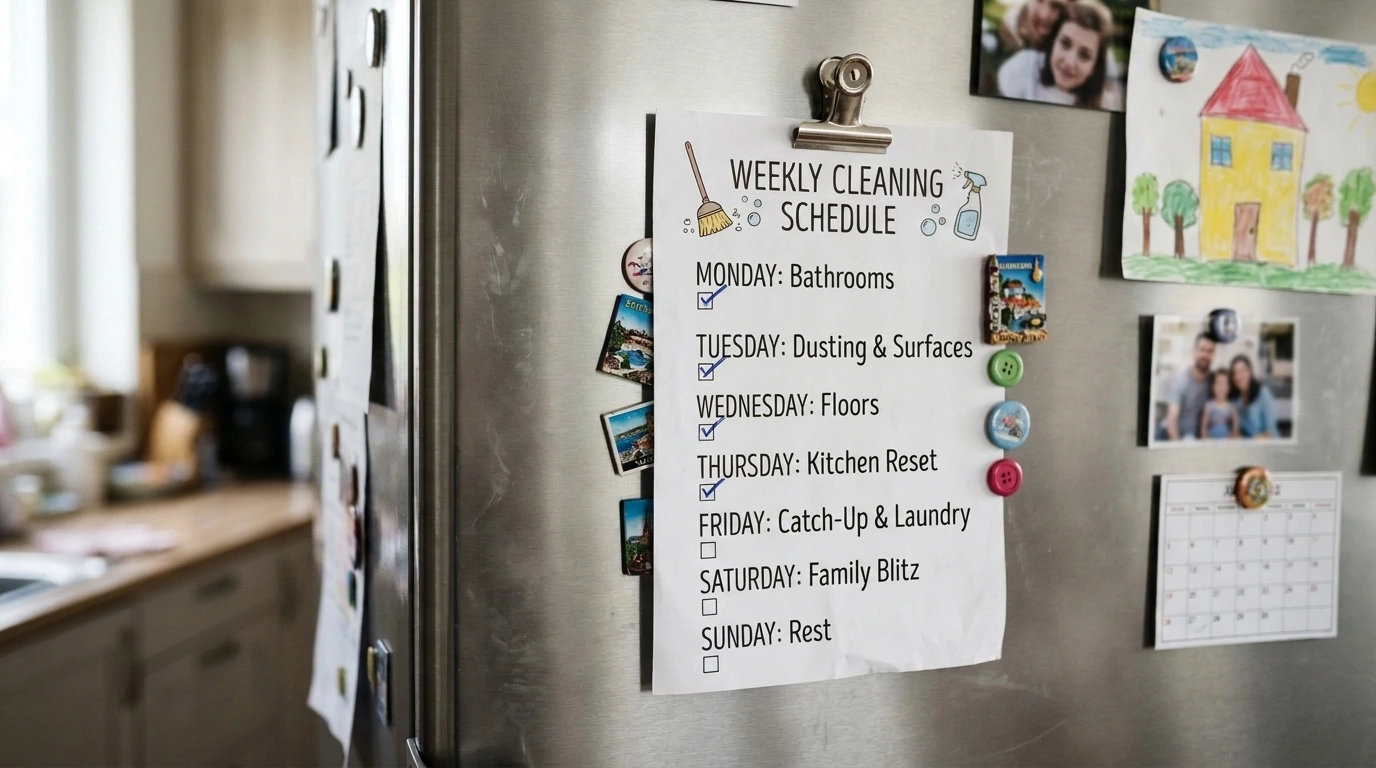
Most weekly cleaning schedules quietly assume something you do not have: a free Saturday morning. They hand you a tidy grid, then expect two uninterrupted hours to execute it. Real weeks do not work that way. Between work, school runs, pets, and the general entropy of family life, the only time that reliably exists is the twenty or thirty minutes between dinner and bedtime.
So this plan is built around that constraint instead of ignoring it. Every weekday has one focus area that fits inside a single short session, the tasks are grouped so you are not dragging the vacuum out five days a week, and the weekend is protected rather than booked. You can print the schedule below, stick it on the fridge, and stop holding the whole mental checklist in your head.
This is the weekly layer of a larger system. If you want the full picture, the daily reset and the once-a-month deep clean, see the full daily, weekly and monthly cleaning routine. This page does one job well: the week.
The Weekly Cleaning Schedule at a Glance
Here is the full week. Copy it, print it, or laminate a single sheet and check tasks off with a dry-erase marker. Each weekday is capped at roughly 20 to 30 minutes and assumes you do a short nightly reset (dishes in, counters wiped, main room picked up). That nightly habit is what keeps these weekly tasks fast, because you are never cleaning around clutter.
| Day | Focus | Key Tasks | Time |
| Monday | Bathrooms | Scrub toilets, wipe counters and mirrors, rinse shower walls, swap hand towels, empty bins. | 25 min |
| Tuesday | Dusting and surfaces | Dust high to low across living areas and bedrooms: furniture, shelves, electronics, frames, sills. | 15 min |
| Wednesday | Floors | Vacuum all carpets and rugs including furniture edges, then sweep and mop hard floors. | 25-30 min |
| Thursday | Kitchen reset | Wipe appliance fronts and cabinet doors by the stove, clean the microwave, sanitize the sink, cull the fridge. | 20 min |
| Friday | Catch-up and laundry | Clear the week’s laundry backlog, spot-clean handprints, tackle one hot spot (mail pile, mudroom). | 20 min |
| Saturday | Family blitz | A 30-minute timed, whole-family sprint: pet areas, bedroom tidy, main-floor vacuum if needed. | 30 min |
| Sunday | Rest | A one-minute counter wipe after meals. Otherwise, off. Recovery is part of the system. | 5-10 min |
Download it free: Get the printable Weekly Cleaning Schedule (PDF) with a check-off column, a who-does-what list, and a notes box. Print a fresh copy each week, or laminate one and use a dry-erase marker.
Why the Days Are Ordered This Way
The sequence is not arbitrary, and the logic is what makes it stick:
· Monday takes bathrooms because starting the week with a clean bathroom resets the tone, and bathrooms are the task most people dread putting off.
· Wednesday consolidates every floor into one session, so the rest of the week needs only a light sweep instead of a daily drag-out of the vacuum.
· Friday is deliberately a catch-up day, because energy dips by week’s end and a flexible slot absorbs whatever slipped earlier.
· Saturday turns the heaviest moment into a shared 30-minute sprint rather than one person’s solo marathon.
· Sunday is scheduled rest. Building recovery into the plan is what stops it from collapsing by week three.
Day-Based or Zone-Based: A Quick Chooser
There are two ways to run the week. Pick based on your home, not your mood:
· Choose day-based (the table above) if you live in a smaller or single-level home and prefer the same kind of task each day. It spreads one chore type across the whole house.
· Choose zone-based if you have a larger or multi-level home and would rather finish one room completely before moving on. In that version, Monday is the kitchen and dining zone, Tuesday the living room, Wednesday the bedrooms, Thursday the bathrooms, Friday the entryway and laundry, with the weekend flexible.
The printable works for either layout. The only rule is to commit to one for a full month before judging it, because the first two weeks always feel clunky while the rhythm forms.
How to Actually Do Each Day (With the Non-Obvious Part)
The table tells you what. This section adds the part most schedules leave out: the sequence that makes each session faster, and the one detail per day that saves the most time.
Monday: Bathrooms (25 min)
Squirt toilet-bowl cleaner first and let it sit while you do everything else, so the chemistry works instead of your arm. Then wipe counters, mirrors, and faucets, scrub and flush the toilet, and rinse the shower walls with a daily spray or a vinegar-water mix. Empty the bin and swap the hand towels last.
Time-saver: if you rinse the shower weekly, you never need heavy scrubbing. The buildup that forces a 45-minute deep scrub only happens when you skip the quick weekly pass.
Tuesday: Dusting (15 min)
Work strictly top to bottom so the dust you knock loose lands on surfaces you have not cleaned yet, not ones you just did. Hit furniture tops, shelves, electronics, frames, and sills with a microfiber cloth or an extendable duster. Finish with doorknobs and light switches in the main rooms.
Time-saver: move a few items to dust under them, but do not clear entire surfaces. Full surface-clearing is a monthly task, and mixing it into the weekly pass is what blows the 15-minute budget.
Wednesday: Floors (25-30 min)
Clear toys and small items off the floor first, in every room you plan to reach. Vacuum carpets and rugs, including the furniture edges where pet hair gathers, then sweep and mop the hard floors. A spray mop with a washable pad is far faster than a bucket.
Time-saver: the five minutes spent clearing the floor first saves ten minutes of vacuuming around obstacles. Pre-clearing is the whole game on floor day.
Thursday: Kitchen Reset (20 min)
Wipe the appliance fronts and the cabinet doors beside the stove, where grease migrates. Steam the microwave clean with a bowl of water heated for two minutes, then wipe. Sanitize the sink and do a 60-second fridge cull of anything expired or wilting.
Time-saver: the fridge cull on Thursday prevents the quarterly horror-show clean-out. Small and weekly beats large and dreaded.
Friday: Catch-Up and Laundry (20 min)
Clear whatever laundry has piled up and have the kids sort their own. Spot-clean walls, switches, and the dining table for sticky prints, then spend the last five minutes on one persistent hot spot: the mail pile, the mudroom bench, or the homework stash.
Time-saver: rotate which hot spot you attack. One cleared clutter magnet per week keeps all of them from rebuilding at once.
Saturday: Family Blitz (30 min)
Set a timer, assign everyone one quick job, and put music on. Vacuum the main floor, tidy the garage entry, wipe the pet area, straighten the living room. The goal is speed and shared effort, not perfection. A visible timer turns it into a game instead of a lecture.
Sunday: Rest (5-10 min)
A one-minute counter wipe after meals, stray items into a basket, and that is the day. Treat the off day as load-bearing, not optional.
Adjusting the Plan to Your Home
No single template fits every household. Three common adjustments:
· Small home: combine Monday and Tuesday (bathrooms and dusting) into one 30-minute block, since the surface area is lower.
· Large or multi-level home: split floors across two days, upstairs Wednesday and main floor Thursday, or hand one level to a partner or teen.
· Shift work: anchor tasks to your awake hours, not to clock days. If Tuesday is your day off, make it your heavy day. Keep the sequence, drop the calendar.
Seasonally, add a mudroom and entry-rug task in winter for salt and slush, a quick patio wipe in summer, and a vacuum behind radiators in fall before you switch the heat on. If a listed task does not apply to your home, delete it. The schedule should mirror your actual life.
Sharing the Load
A weekly plan only lightens the week if more than one person runs it. Assign age-appropriate jobs: a seven-year-old can empty bathroom bins and dust low surfaces, a ten-year-old can vacuum stairs with supervision, and a teen can fully own one bathroom once you have taught them the sequence. Rotate assignments monthly so no one gets stuck with the task they hate.
With a partner, skip the parental task-assigning and ask instead which weekly jobs they mind the least. People follow a plan they helped build far more reliably than one handed to them. Pair the Saturday blitz with something good afterward, a movie night or a later bedtime, so the week ends on a reward rather than a nag.
When Life Gets in the Way
The schedule is a rhythm, not a contract. For the weeks that fall apart:
· Sick week: drop to essentials only. Run the dishwasher, wipe the table, keep bathroom surfaces swabbed with a disinfecting wipe. Let the rest wait.
· Guests coming: triage with a 45-minute timed blitz on the guest bathroom, living room, and kitchen. Skip the bedrooms nobody will see.
· Low-motivation week: do one missed task on Friday and call the week done. A quick toilet scrub beats a perfect plan you abandon.
· Partner not keeping up: revisit the conversation, not the chore chart. Ask what is making it hard, offer to swap or lighten tasks, and aim for partnership rather than an audit.
Where the Weekly Plan Fits
Think in three layers. The daily reset handles the surface mess from meals and play so you never start a weekly task from chaos (see the 30-minute daily cleaning routine). This weekly schedule handles the buildup that daily cleaning cannot reach: grime, dust, floors, and bathroom sanitizing. Once a month, you rotate in the deep tasks, windows, fridge coils, a cupboard. When the three layers run together, no single day ever feels like a crisis. And if clutter itself is slowing you down, clearing it first (see how to organize your home step by step) makes every weekly session shorter.
Frequently Asked Questions
How do I print and use the schedule?
Print a fresh copy weekly, or laminate one and use a dry-erase marker. Download the printable PDF, place it on the fridge or a family command center, check off tasks as you go, and wipe it clean to start the next week.
What if my work schedule is irregular?
Anchor the tasks to your available windows rather than to specific days. Relabel them Day 1, Day 2, and so on, and move through the sequence whenever a half-hour opens up. The order matters more than the date.
How long should each day take?
Twenty to thirty minutes. If you are consistently running longer, you are almost certainly cleaning around clutter, so declutter the space first and the time drops sharply.
Should we clean every single day?
No. Sunday is a rest day and Friday is flexible. The daily reset is a separate, lighter layer, a quick evening tidy rather than a full task. If you prefer, combine the week into four focused days instead of seven light ones.
How is this different from a daily routine?
The daily routine clears the mess that accumulates from meals and daily life. The weekly schedule tackles the deeper buildup over several days: toilet scrubbing, full vacuuming, dusting. Run together, they remove the need for a weekend marathon entirely. See the 30-minute daily cleaning routine for the lighter everyday layer.
Start This Week
A calm home is not the result of one heroic Saturday. It is small, predictable sessions spread across the week and shared among the people who live there. Print the schedule, spend five minutes assigning or choosing tasks with your family, and run it for two weeks before you judge it. Most households find the payoff is not just a cleaner house but reclaimed time and a quieter Saturday. When you are ready to connect the week to the full system, the complete home cleaning routine guide is the next step.





Leave a Reply