

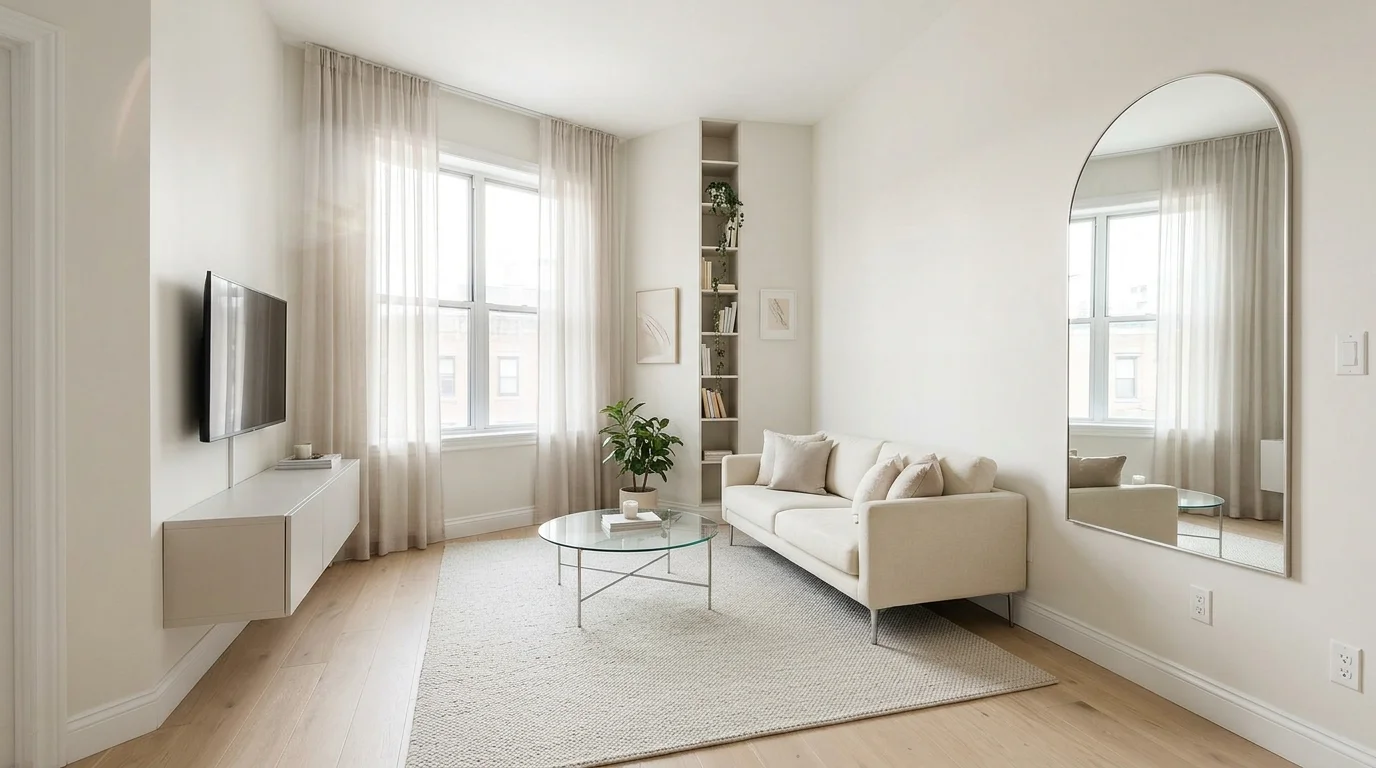
Small rooms have a way of feeling cozy right up until they start feeling cramped. A single window that never lets in quite enough light, furniture that seems to fill every inch of floor, a corner that collects clutter no matter how often you clear it out: these are the small, everyday signs of a room working against you instead of for you.
The good news is that you don’t need to knock down a wall or add a single square foot to fix it. Strategic use of color, light, and furniture placement can trick the eye into reading a room as larger, brighter, and more open than it actually is. These are the same visual illusions professional stagers and interior designers rely on to make compact spaces feel spacious, and most of them can be done in a weekend.
Below are 12 proven techniques for how to make a small room look bigger, grouped into four areas: paint and color, light and reflection, furniture choice and layout, and verticality and decluttering. Start with one or two, or work through the full list for a room that finally feels like it has room to breathe.
Paint & Color Techniques to Make a Room Look Bigger
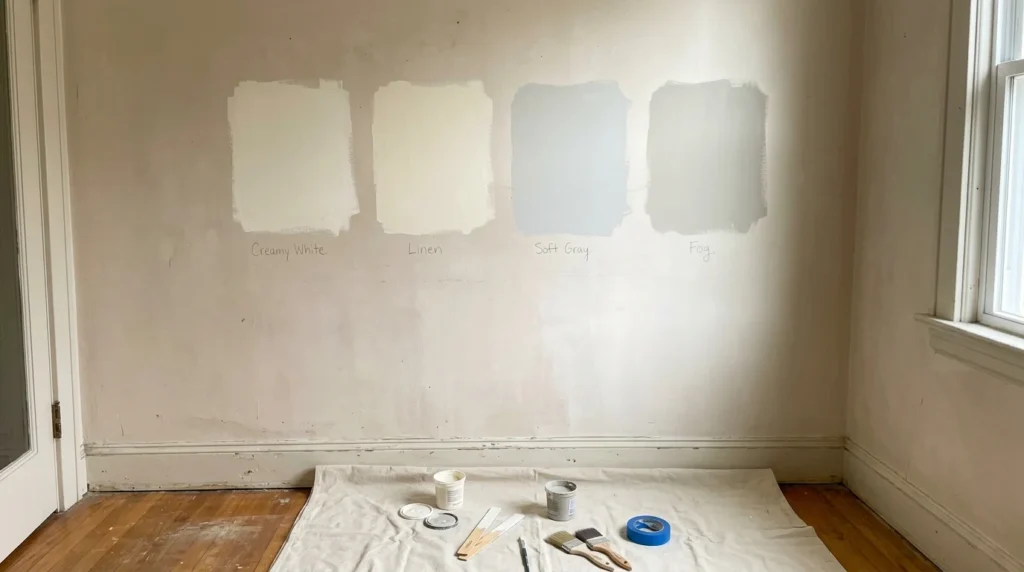
Paint is the fastest, cheapest way to change how large a room reads, and it’s usually the best place to start.
Trick 1: Stick to Light Tones and Soft Monochromatics
Off-whites, soft grays, warm beige, and light pastels bounce natural light around a room instead of absorbing it, keeping walls from visually closing in. Dark tones do the opposite: they absorb light and make a wall feel closer than it is. Popular choices include warm off-whites like Benjamin Moore’s Simply White or Sherwin-Williams’ Alabaster, both of which read as bright without feeling cold. For the biggest effect, paint the walls and trim the exact same color. Without a contrasting trim line, your eye has nothing to stop on, so the walls read as one continuous surface instead of a boxed-in shape.
Trick 2: Paint the Ceiling Light, or Match It to the Walls
A ceiling in a slightly lighter shade than the walls, or in bright white, draws the eye upward and adds a sense of height a small room often lacks. For maximum depth, go a step further and paint the ceiling, walls, and baseboards the exact same light color. The seamless color flow removes the visual breaks, where one surface ends and another begins, that make a small room feel chopped into pieces rather than open. Stick to a flat or matte finish on the ceiling itself to avoid glare from overhead lighting, even as the walls below go glossier.
Trick 3: Use High-Gloss or Semi-Gloss Finishes
Finish matters as much as color. High-gloss and semi-gloss paints reflect noticeably more light than flat or matte finishes, adding a subtle sense of depth and polish to any surface they cover. They work especially well on trim, doors, built-ins, and ceilings, where a touch of sheen catches ambient light without the shine overwhelming an entire wall. Avoid high-gloss on walls with visible imperfections, since sheen highlights every dent and patch job rather than hiding it.
Trick 4: Don’t Rule Out a Dark Accent Wall
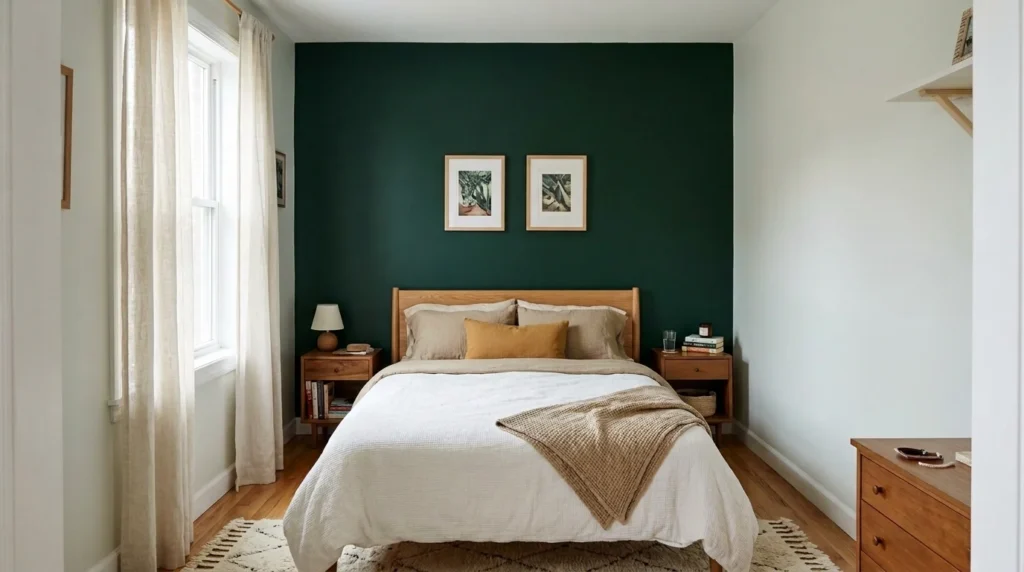
It’s a common myth that dark colors always shrink a room. Used strategically, a deep-hued accent wall on the far wall, the one farthest from the entryway, can create a sense of added depth by drawing the eye toward the back of the room, as long as every surrounding wall stays light. Think of a navy or deep forest green behind a bed or sofa, paired with crisp white trim and bedding. This is one of the more popular tricks for how to make a room look bigger with paint precisely because it looks counterintuitive on paper, yet reads as intentional depth in person.
Light & Reflection Strategies
Once your color palette is set, light becomes the next lever to pull. A dim room will always read as smaller than it is, no matter what color is on the walls.
Trick 5: Harness Strategic Mirror Placement
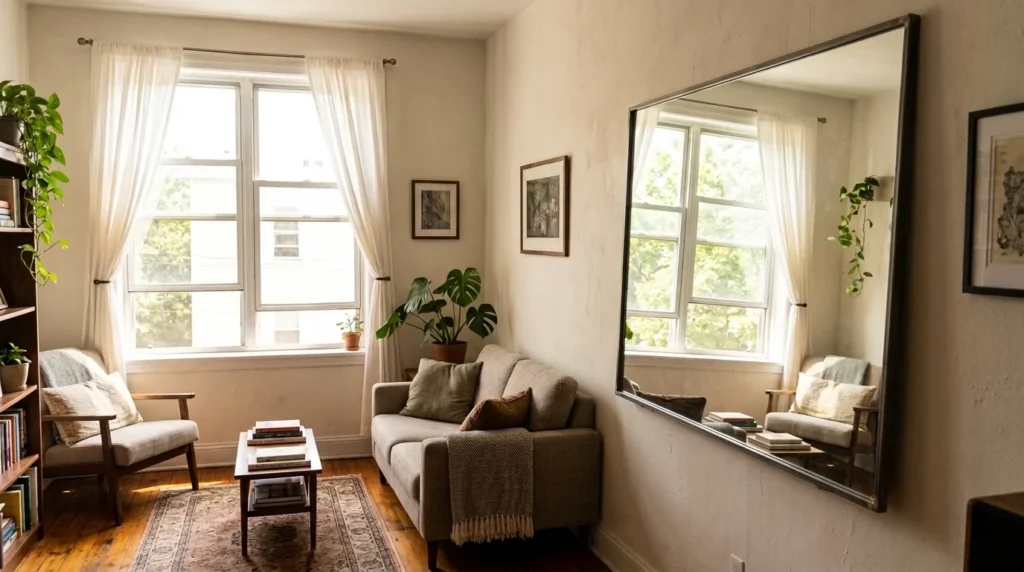
Place a large floor or wall mirror directly opposite a window so it bounces daylight back into the room. Mirrors positioned across from a natural light source can cut dark corners dramatically and visually double a room’s apparent depth, acting almost like a second window on an otherwise solid wall. A mirror roughly two-thirds the width of the wall it hangs on tends to strike the right balance between impact and proportion. Oversized mirrors in a simple frame work best; an ornate or heavily segmented frame can create visual clutter of its own and undercut the effect.
Trick 6: Layer Lighting at Different Heights
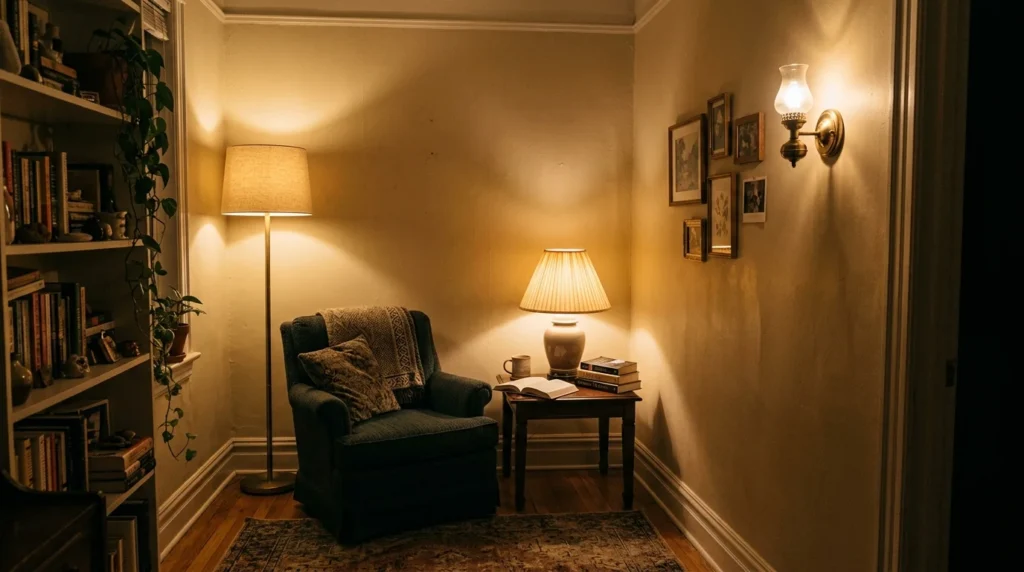
A single overhead fixture creates harsh, centralized light and leaves the corners of a room in shadow, which makes the perimeter feel smaller and less inviting than the center. Instead, combine a floor lamp, a table lamp, and a wall sconce or two so light reaches every edge of the room, not just the middle. Aim for three light sources per room as a baseline: one ambient, one task, one accent. Layered lighting at different heights also softens shadows, keeping the whole space feeling evenly lit rather than spotlighted.
Trick 7: Maximize Natural Light With Sheer Window Treatments
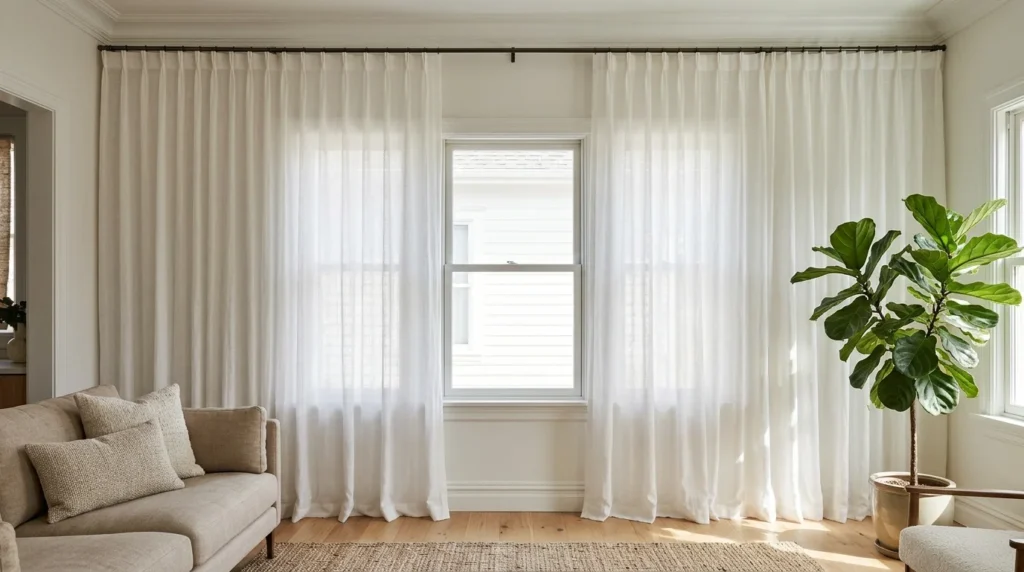
Swap heavy, dark drapes for sheer curtains or light-filtering blinds that let daylight pass through even when closed. Linen-look polyester sheers in white or a soft neutral let in the most light while still offering privacy after dark. For an extra boost, mount the curtain rod close to the ceiling, well above the window frame itself, and extend it a few inches wider than the window on each side. This makes the window appear larger and the ceiling read as higher, even though the glass behind the curtains hasn’t changed size at all.
Smart Furniture Choice & Layout
Paint and lighting affect how a room reads. Furniture affects how it actually functions, and the wrong pieces in the wrong spots can undo everything the first two sections accomplish.
Trick 8: Choose Elevated, Legged Furniture
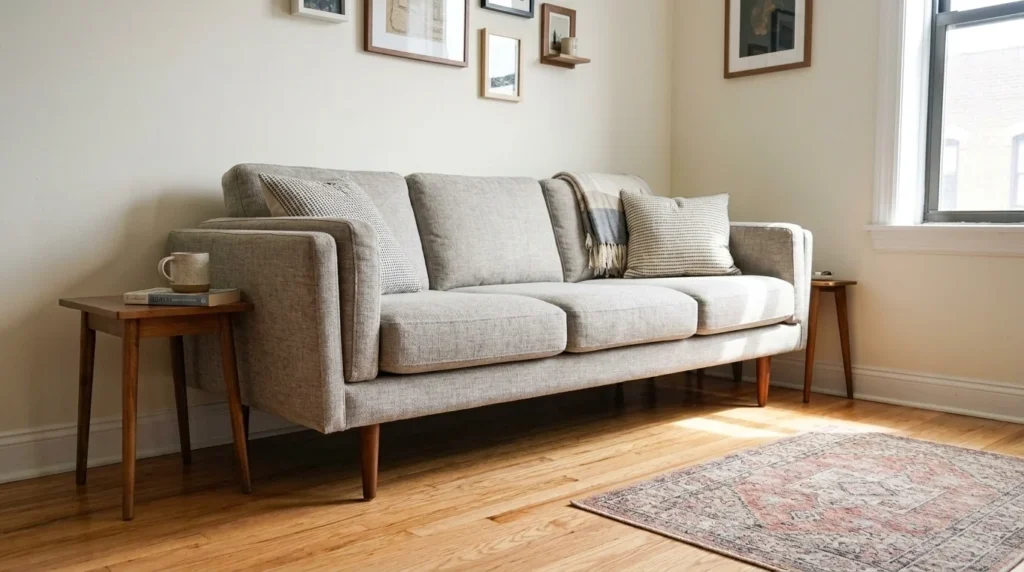
Sofas, chairs, and beds raised on slim, visible legs let light and air travel underneath them instead of stopping at a solid, boxy base. That unbroken sightline across the floor is one of the simplest ways to make a room read as more open, since the eye naturally interprets visible floor space as room to move through, even when the furniture itself takes up the same footprint. Look for sofa and bed frames with exposed tapered or hairpin legs rather than upholstered skirts that touch the floor.
Trick 9: Pull Furniture Away From the Walls
It’s tempting to push every piece flat against the walls to save space, but this actually does the opposite: it outlines the room’s full perimeter and makes its limits obvious at a glance. Leaving even a few inches of breathing room around furniture creates a buffer that reads as airiness rather than empty, wasted space. Even 3 to 6 inches of clearance between a sofa back and the wall is often enough to read as intentional rather than cramped.
Trick 10: Use Transparent and Reflective Materials
Glass coffee tables, acrylic or lucite accent chairs, and polished metal frames all do one thing well: they take up physical space without taking up visual space. A solid wood console and a glass one might occupy the exact same square footage, but the glass one visually disappears into the room instead of anchoring and weighing it down. A nesting side table set in clear acrylic is an easy swap for a solid wood end table without losing storage or surface space.
Verticality & Decluttering
The final pillar has nothing to do with paint or furniture. It’s about where you let the eye travel, and how much it has to process once it gets there.
Trick 11: Draw the Eye Upward With Vertical Elements
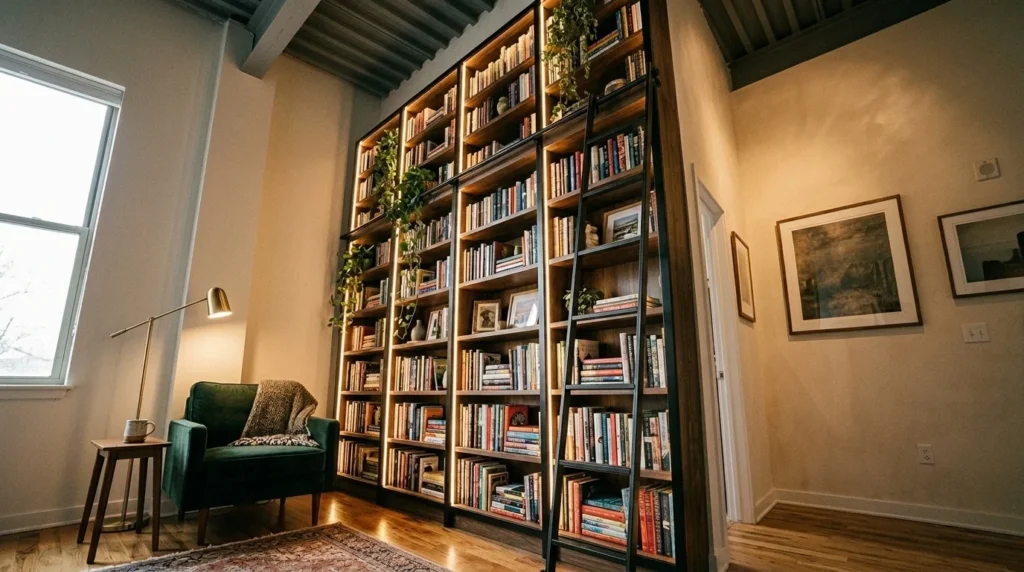
Floor-to-ceiling shelving, vertical stripes, or a tall, narrow arrangement of framed art all pull the eye up rather than out across the floor. A single tall bookcase that reaches the ceiling will almost always make a room feel bigger than two short, squat ones, even if they hold the same number of books. Emphasizing a room’s height over its floor width is one of the most effective ways to make a small room feel taller and, by extension, bigger overall, since most small rooms have more unused vertical space than they do unused floor space.
Trick 12: Adopt a “Scale and Declutter” Discipline
A handful of larger, well-chosen decor pieces almost always reads better than a shelf crowded with dozens of small trinkets. Clutter forces the eye to stop and process many small objects one at a time instead of moving freely across the room, which makes the space feel busier and smaller than it is. A simple rule: if a shelf has more than five or six objects on it, it’s probably time to edit. Clear the surfaces you can, and when you do decorate, favor a few statement pieces over many small ones.
Quick Reference: Summary Comparison Table
The 12 tricks above break down into four repeatable moves. Use this table as a quick reference once you’re ready to start.
| Focus Area | Design Technique | Expected Visual Effect |
| Paint & Finish | Monochromatic light walls, trim, and ceiling | Eliminates visual breaks, expanding the room’s apparent borders |
| Mirrors | Placed opposite natural light sources | Bounces daylight into dark corners and creates a sense of depth |
| Window Drapes | Ceiling-mounted, sheer curtains | Extends the visual height from floor to ceiling |
| Furniture | Legged, glass, or acrylic pieces | Keeps floor sightlines open and air moving through the room |
Frequently Asked Questions
What’s the single best trick for making a small room look bigger?
If you only do one thing, declutter your surfaces and reposition a large mirror opposite your main light source. Both changes cost nothing but time, and together they deliver one of the most noticeable transformations on this list within a single afternoon.
Does paint color actually make a measurable difference?
Yes. Light, reflective paint bounces more ambient light around a room, which measurably increases how bright and open the space reads, even though its actual square footage hasn’t changed. The effect is subtle on its own, but it compounds well when paired with the lighting and furniture changes above.
Can I use a dark accent wall and still make the room feel bigger?
Yes, as long as it’s limited to one wall, ideally the one farthest from the entryway, and every surrounding wall stays light. In that position, a dark wall creates a sense of depth rather than closing the room in. Dark color on multiple walls has the opposite effect and will shrink the space.
What’s the best lighting setup for a small room with little natural light?
Skip the single overhead fixture. Combine a floor lamp, a table lamp, and one or two wall sconces so light reaches the corners instead of pooling in the center, and choose warm white bulbs in the 2700K to 3000K range to avoid a harsh, clinical feel.
What’s the cheapest trick to start with?
Decluttering and pulling furniture a few inches away from the walls. Both are free, take an afternoon, and noticeably open up a room before you spend a single dollar on paint or new decor.
Conclusion & Next Steps
Making a small room look bigger comes down to three repeatable pillars: maximizing light, keeping sightlines open, and choosing colors that reflect rather than absorb. None of the 12 tricks above require construction, and most can be done over a single weekend.
Start with the lowest-cost, highest-impact changes first: declutter your surfaces and reposition a mirror opposite your main light source. Once those are done, move on to furniture placement, then tackle paint last, since it’s the most time-intensive step on this list.
Looking for more room-by-room ideas? Check out our guides on how to organize a small bedroom and bedroom furnishings that make the most of a small space, or share your own small-space makeover tips in the comments below.




Leave a Reply