

Introduction
Look at your kitchen right now. Really look at it.
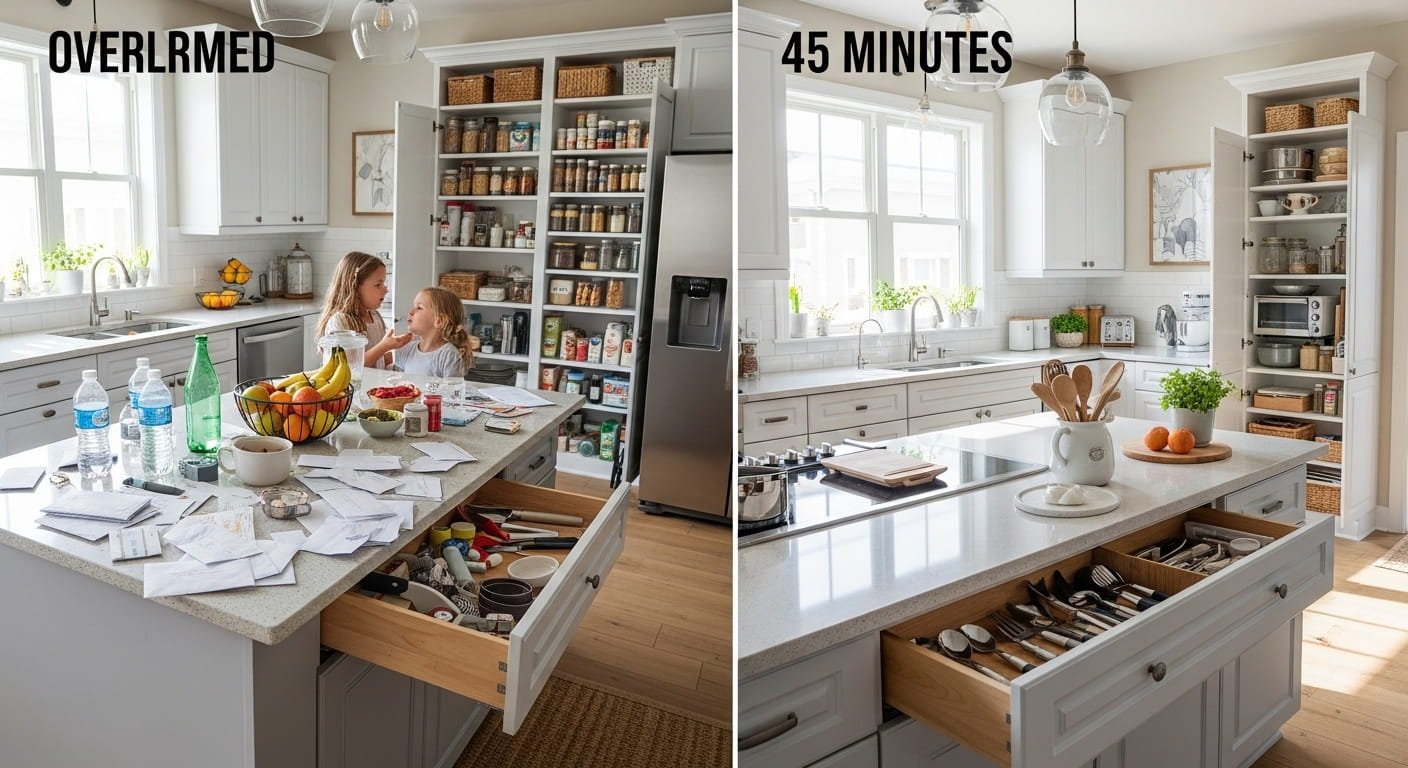
The counter with three days of mail, a rogue banana, someone’s water bottle, and a butter dish that somehow migrated from the table. The drawer that takes two hands to close. The pantry shelf where the snacks have completely taken over the shelf that used to hold, you think, the pasta. The fruit bowl that is now just a bowl of decisions nobody wants to make.
You’ve been meaning to deal with it. For weeks, probably. Maybe longer. Every morning you tell yourself you’ll tackle it this weekend, and every weekend something more urgent takes over. The kids. Work. The fact that you just genuinely need one day where you don’t deal with anything difficult.
Here is what I want you to hear: the kitchen is not as far gone as it feels. And fixing it does not require an entire Saturday, a professional organizer, or a complete system overhaul. It requires 45 focused minutes, a decision-making framework that cuts through the overthinking, and the willingness to start before you feel ready.
That’s it. Forty-five minutes.
Not a marathon. Not a lifestyle change. A focused sprint with specific rules and a visible finish line. By the time that timer goes off, your kitchen will feel different. And different enough to breathe is all you need to keep going.
Let’s move.
The Mindset Shift That Actually Unlocks Speed
Most people approach kitchen decluttering like a puzzle they need to solve perfectly. Every item gets picked up, considered, debated, set down, picked up again. Forty minutes in, the kitchen looks worse than when they started, and the motivation is gone.
Fast decluttering requires one fundamental shift: speed is the point, not the enemy.
Your first instinct about whether to keep something is almost always right. Research on decision-making consistently shows that extended deliberation on low-stakes objects does not improve the decision. It just exhausts you. The banana holder you haven’t used in two years is not a complex ethical question. Your gut knows. Trust it and move.
The other shift: done is better than perfect. A kitchen that is 80% decluttered in 45 minutes is infinitely more livable than one that is 100% decluttered in theory but untouched in reality. Progress over perfection. Every single time.
The 45-Minute Kitchen Declutter Method
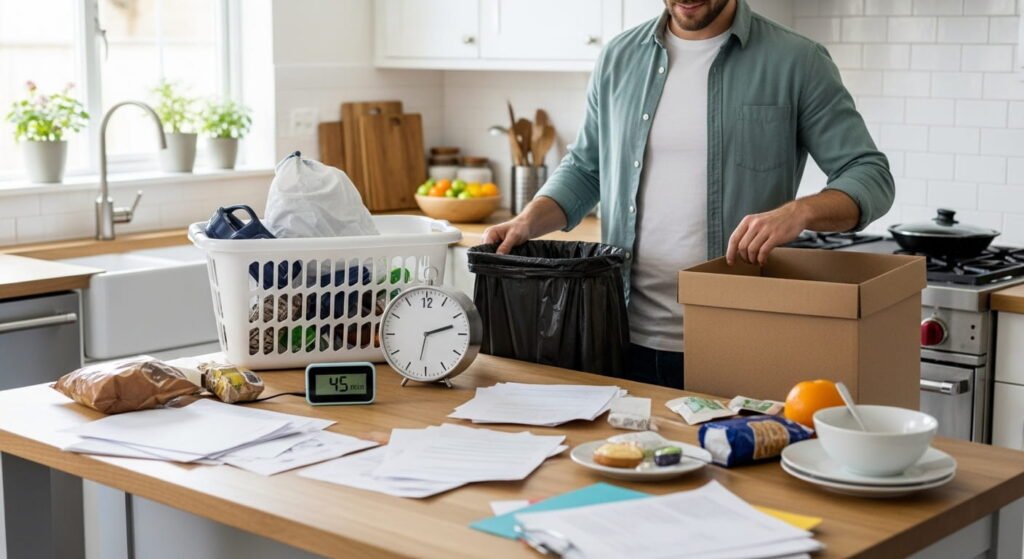
Set a timer. This is not optional. A timer converts an open-ended task into a sprint with a finish line, and it changes how fast and decisively you work. No timer means no urgency. No urgency means three hours of wandering and one reorganized junk drawer.
Before you start the timer, gather four things: a trash bag, a donation box or bag, a laundry basket or bin for relocating items to other rooms, and a marker with masking tape if you want quick labels. Everything you need, ready before you touch a single item.
Then set the timer for 45 minutes and begin.
Here is the breakdown:
Minutes 1 to 10: The Counter Sprint Clear every item off every counter surface. All of it. Trash in the bag, items that belong elsewhere in the basket, and only genuine daily-use items get to stay. This is the highest-visibility action in the whole kitchen. Ten minutes here changes how the entire room looks and feels.
Minutes 11 to 20: The Drawer Pass Open every drawer quickly. No reorganizing. Just removal. Pull out anything obviously broken, obviously expired, obviously a mystery object no one can name, and anything that doesn’t belong in the kitchen at all. The goal is to remove, not to perfect.
Minutes 21 to 30: The Pantry Sweep Scan every pantry shelf for expired items, items that belong in a different room, and items you recognize as things you haven’t touched in months. This is not a full pantry organization session. It is a removal pass. Anything clearly leaving the house goes in the donation box or the trash. Anything that belongs in the kitchen but needs a better home gets noted, not fixed yet.
Minutes 31 to 40: The Fridge and Freezer Check Pull out anything expired, anything unidentifiable, and any open containers that are genuinely not going to be used. Wipe one shelf if there’s time. This is the least visible part of the kitchen but one of the most impactful for daily cooking friction.
Minutes 41 to 45: The Floor and Final Pass Pick up everything from the floor. Return the relocation basket’s contents to their correct rooms. Wipe the counter surfaces you cleared. Stand back and look.
There it is. Forty-five minutes. Different kitchen.
The Best Order for Maximum Visible Impact
The sequence above is deliberate. Counters first because that is where most people’s eyes go. Clean counters signal order even when drawers are still imperfect. The visual win from cleared counters carries the motivation forward.
Drawers second because they take less emotional energy than the pantry. They’re manageable bites of progress that build momentum.
Pantry third because it carries more decisions and slightly more complexity. You’re warmer by this point, faster in your decisions, and less likely to stall.
Fridge last because it’s contained, finite, and ends the session with something clean and satisfying. The closed door makes the win feel complete.
If 45 minutes runs out before you reach the fridge, that is fine. Come back for a second 45-minute session. The counter win alone is worth the time.
The Four-Category Decision Rule (That Actually Holds Up Under Time Pressure)
For every item you pick up during the declutter, there are only four possible outcomes. Not ten. Not twenty. Four.
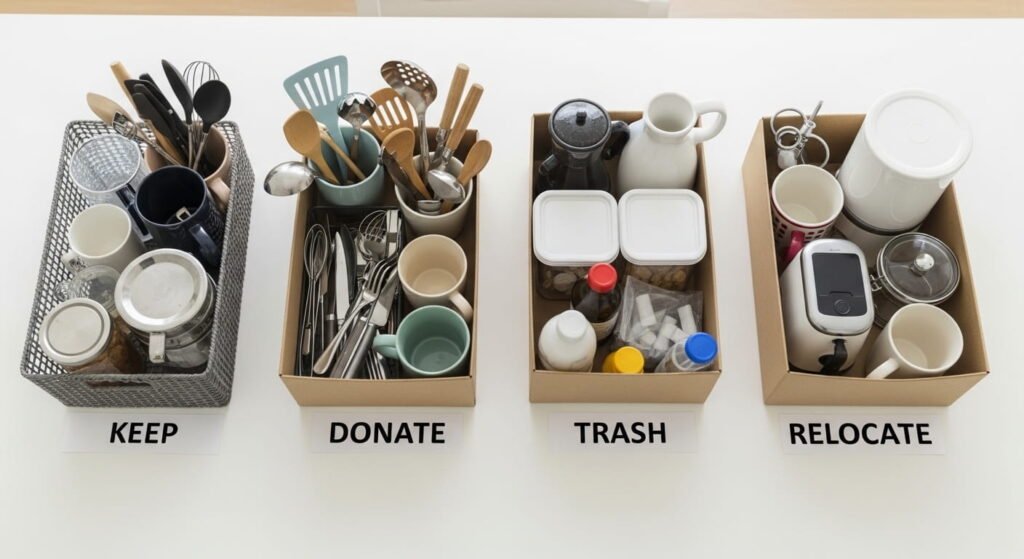
Keep: It is used regularly and belongs in this kitchen. Back it goes.
Trash: It is broken, expired, unidentifiable, or so worn out that donating it would be unkind. Straight to the bag without a second thought.
Donate: It is in good condition and someone else would genuinely use it. In the donation box.
Relocate: It belongs in your home, just not in the kitchen. In the basket.
The rule that makes this framework fast: if you pick something up and cannot place it in one of these four categories within five seconds, it goes in the donate box. Uncertainty is a signal that the item does not have a clear enough role in your kitchen to earn the space it takes up.
What to Do With the Items Immediately
This step is the one most people skip and the reason decluttered spaces revert quickly.
The trash bag goes out to the bin before the session is over. Not later. Now.
The donation box goes directly into the back seat of your car before the end of the day. Not the garage. Not by the front door for “when you get around to it.” The car. Because the car means it leaves during the next errand, and things that stay in the house have a tendency to come back into the kitchen.
The relocation basket gets walked through the house before you sit down. Two minutes. Each item returned to its actual home.
Do not leave any of these three for tomorrow. The psychological relief of a cleared kitchen evaporates when the donation box is still sitting in the corner a week later, and the second-guessing starts to creep back in.
Speed and Motivation Hacks for Busy Parents
The playlist rule: Create one specific playlist that only plays during decluttering sessions. High-energy, upbeat, around 45 minutes long. Over time, hearing it triggers an automatic “let’s move fast” mode. Your brain starts associating the playlist with productive momentum rather than tedious work.
Bring in a partner: Having another adult in the room, even just chatting, makes the session feel less isolating and significantly faster. One person holds the items, the other makes the call. Or simply having someone present while you work raises the accountability enough to prevent the slow drift into nostalgic contemplation of every item.
Make it a competition for kids: For children 8 and older, set a parallel challenge. While you tackle the kitchen, they tackle one drawer or one shelf in their room. Set the same timer. The shared start creates family energy and produces progress on two fronts simultaneously.
The before photo: Take one photo of the kitchen before you start. When you hit minute 25 and wonder if any of this is making a difference, look at the photo. The contrast between the before image and what you’re looking at in real time is almost always more dramatic than it feels from inside the process.
Common Fast Declutter Mistakes to Avoid
Trying to organize during the declutter. These are two separate actions. During a declutter sprint, your only job is to remove things. Reorganizing what remains is a different session. Mixing the two is how 45-minute sessions become 3-hour sessions with nothing finished.
Making a “maybe” pile. Maybe piles become permanent residents. If you cannot decide in five seconds, the item donates. No exceptions during a fast session.
Getting pulled into sentimental items. The kitchen is generally low in sentimental content, but a gift mug here or a hand-me-down dish set there can stall momentum completely. Put sentimental items in the relocation basket and deal with them on a different day when you have emotional bandwidth. This session is about speed.
Stopping to clean mid-session. The urge to wipe down the shelf you just cleared or scrub the drawer you just emptied is real and productive-feeling. Resist it. Clean after the removal pass is complete, not during. Cleaning during a declutter sprint is how timers expire with three areas still untouched.
After the Declutter: Quick Setup Tips to Lock In the Win
The 45-minute session creates a clean surface. A few quick follow-up actions in the next 30 minutes lock in that clean surface before life fills it back up.
Put a small tray on the cleared counter. A tray creates a visual boundary that signals “this is a contained zone, not a landing strip.” Items on a tray look deliberate. Items outside the tray look out of place. One tray on the counter shifts behavior without any other change.
Add labels to any shelves or drawers where categories shifted during the removal pass. Even a piece of masking tape with a marker label is enough to communicate “this shelf is for X” to every family member.
Return the donation box location to a designated spot near the door until it leaves the house. Visibility keeps it from being ignored.
And set a date for the next step. The declutter creates the clean slate. The organization work, such as setting up proper categories, adding bins where needed, and establishing zones, is what turns the clean slate into a lasting system. The Pantry Organization Ideas on a Budget guide gives you the full low-cost setup process to take the pantry from decluttered to genuinely organized. The Small Kitchen Organization Ideas guide gives you the complete kitchen framework if you’re ready to build the whole system.
Conclusion
A 45-minute kitchen declutter is not a small thing. It is the act that proves to yourself that your home is not out of your control.
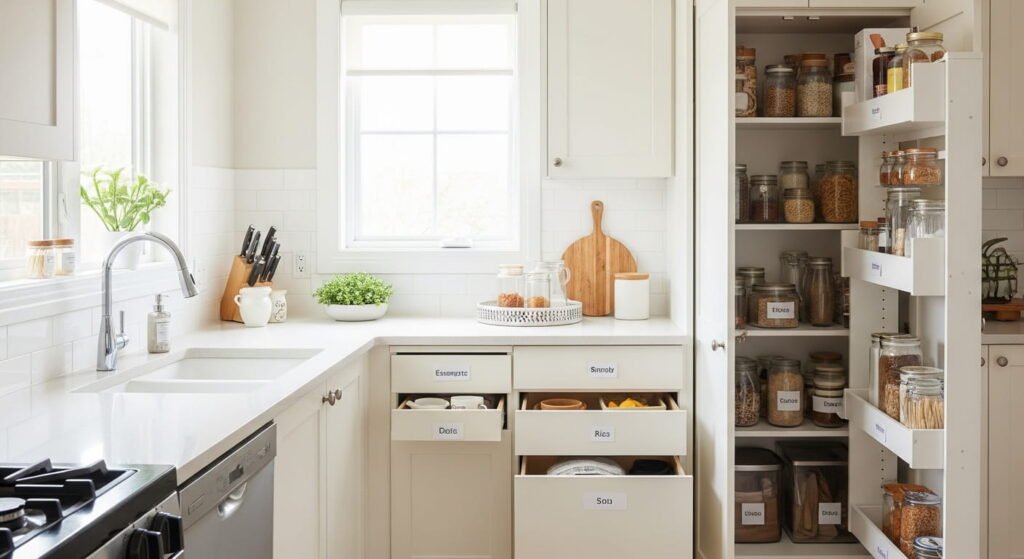
One session. Cleared counters. Lighter drawers. A pantry you can actually see into. Those visible results shift something. They replace the low-grade “I should deal with this” stress that has been running in the background for weeks with actual relief. And that relief has momentum.
The families who successfully transform their kitchens do not do it in one massive perfect session. They do it in 45-minute sprints, one area at a time, until the whole space reflects how they actually want to live.
Yours starts right now.
Set the timer.
Also helpful: Pantry Organization Ideas on a Budget | Small Kitchen Organization Ideas | Best Kitchen Organizers for Small Spaces | How to Declutter Your Home Fast





Leave a Reply